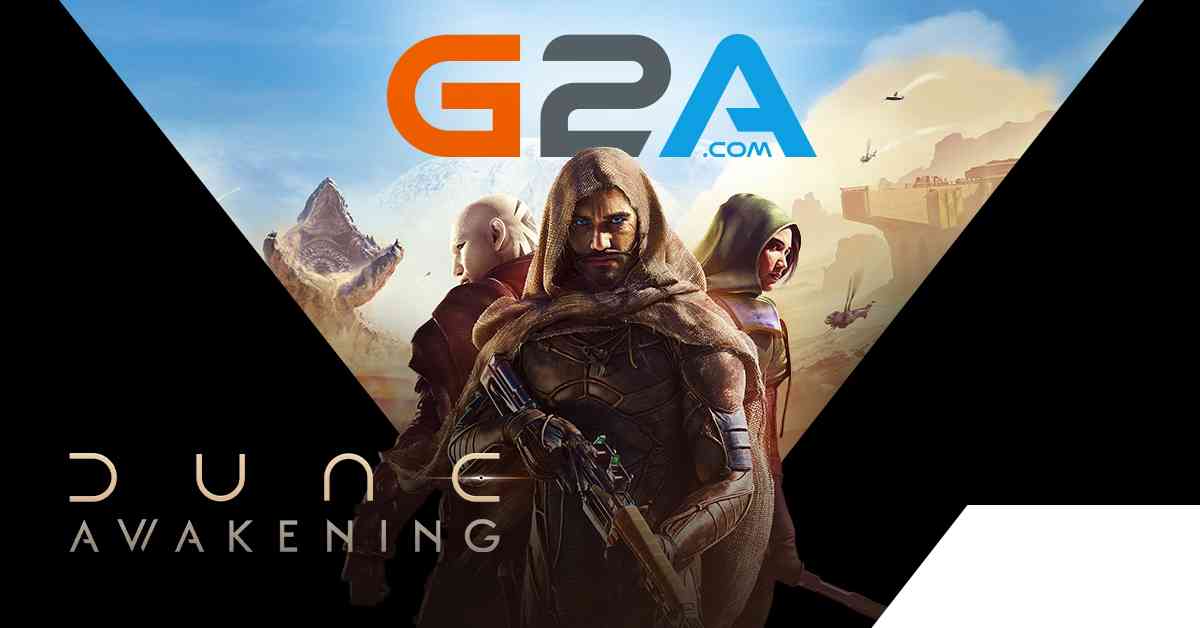
The gate to Arrakis has just opened and Funcom’s latest opus is on a roll. But there’s a whole host of Dune games that came before, several of them changing the face of gaming forever. Today, we’ll take a look at the history of the franchise boasting some of the most important video games ever made.
In case you’re unfamiliar with Frank Herbert’s iconic science fiction saga, here’s the scoop. Imagine a distant future and a space empire relying on mélange, a potent psychic drug which extends human life, boosts mental capacity (including psychic powers), and basically enables interstellar travel due to the latter. The fate of the entire empire depends on this drug, also known as spice, which can only be harvested on the desert planet of Arrakis. And desert’s a desert: hot, inhospitable, and crawling with giant and incredibly deadly sandworms. Various Houses vie for control over Arrakis, as ruling over this planet means ruling over the galaxy. And so, you have House Atreides coming to blows with the evil House Harkonnen. Paul Atreides, the heir to the family throne, soon learns that not only will he have to man up, but also play the key role in a prophecy concerning Arrakis…
1992: the year when gamers set their foot on Dune
And so Cryo Interactive gave us the first-ever video game set in the Dune universe over 30 years ago. This one owes as much to David Lynch’s movie from 1984 – and the 1991 Gulf War – as the original novel from 1965. After all, just look at the visuals. Doesn’t in-game Paul Atreides look like Kyle MacLachlan? Doesn’t Feyd-Rautha look like Sting?
Anyway, Dune loosely follows the plot of the novel. You play as Paul, and you are tasked with driving the Harkonnens out of Arrakis. By any means possible. You can, of course, establish military dominance over the desert world, but there’s also a way to terraform it into a lush paradise (destroying spice in the process, by the way).
Gameplay-wise, it’s a strategy game where you have to manage your army, unlock new technologies and weapons, conquer territories, mine spice – of course! – and kick Harkonnen butts whenever you get a chance. But there are also point-and-click adventure elements in this one, too: you get to explore various structures, talk to characters, complete some mini-quests, all as if it was, say, another Broken Sword game or something. It isn’t really a major part of the game, but it does make it stand out among its peers.
Cryo Interactive’s Dune is of course considered iconic and a legendary addition to the franchise. But there’s one game that followed soon after and made a much, much greater impact on the industry as a whole.
Arrakis gave us RTS games
There were some proto-RTS games before 1992. War of Nerves. Utopia. Cytron Masters. Stonkers. Bokosuka Wars. The Ancient Art of War. Gain Ground. Herzog Zwei. Still, none of these single-handedly defined what is pretty much the genre’s ultimate form, like 1992’s Dune II did.
Released by Westwood shortly after Cryo Interactive’s Dune, Dune II once again puts you in charge of a House of your choice. Your goal is simple: destroy your rivals and conquer Arrakis. However, in addition to Atreides and Harkonnen, there’s a new faction: House Ordos. So, you build up your base (on concrete slabs, as buildings deteriorate much faster without them), harvest spice using – you guessed it – harvesters, create and army, and then move out to trash the enemy base, rinse and repeat nine times before you get to the final battle.
Gameplay-wise, there’s so much to talk about here. Dune II is pretty much the template for virtually every RTS that came after it, be it mechanics, the interface, and so on. And you could finally issue commands to each unit or building individually. Many more advanced real-time strategies came afterwards: Warcraft: Orcs & Humans, Command & Conquer, Warcraft II: Tides of Darkness, Age of Empires, StarCraft… Naturally, they all expanded upon the foundations laid by Dune II, but they still owe a great deal to Westwood Studios’ legendary opus.
Dune II spawned two further sequels: a partial remake called Dune 2000 (but released in 1998) and Emperor: Battle for Dune (2001). The former is an audiovisual overhaul of the original, with gameplay more like Command & Conquer: Red Alert, but also a fresh storyline and live-action cinematics featuring none other than the legendary actor, John Rhys-Davies. The latter, on the other hand, shifted to 3D and while gameplay-wise it followed suit, it still introduced plenty of fresh ideas, including decision making that has a larger impact on the story and campaign.
Emperor: Battle for Dune was the last RTS set in the world of Dune until 2022’s Dune: Spice Wars, a real-time 4X strategy. Cryo Interactive was working on Dune Generations, an online RTS to be released sometime in the early 2000s, but the project was scrapped, and the company ultimately filed for bankruptcy.
Things are starting to look grim for Dune
But not before they released Frank Herbert’s Dune, an action-adventure game closely following the plot of the novel and inspired by the 2000 Dune miniseries on SyFy Channel. You play as Paul Atreides, and your task is to gain the trust of the Fremen and learn their ways to lead the final charge against the evil Harkonnen. Sounds good on paper, but the game ultimately didn’t live up to expectations, becoming one of the reasons for Cryo Interactive’s closure in 2002.
There was also one more game in the works, called Dune: Ornithopter Assault. Planned for the Game Boy Advance, this one was conceived as an aerial shooter where you piloted the titular ornithopter, soaring over Arrakis, destroying all sorts of targets, and completing various missions. Though it was cancelled in 2002, it was eventually released on PC, but without license, as Elland: The Crystal Wars. Steam reviews say it’s good, so if you’re in for nostalgic gaming, this one might be a good pick.
The resurgence
This story you probably know: Dennis Villeneuve dropped his magnum opus, the 2021 Dune, to rave reviews and commercial success. The 2024 sequel was even better. This has certainly reinvigorated interest in the franchise, including video games set in this universe.
And so, we got the aforementioned Dune: Spice Wars in Early Access in 2022. This 4X RTS lets you fight for control over the planet of Arrakis, and you can either handle things diplomatically or by military might. With seven factions, each with a different leader and perks, there’s plenty to do here, though reviewers noted that the game somewhat failed to capture the essence of Dune.
There’s also Dune: Imperium (2024), a video game adaptation of a popular deckbuilding/worker placement game in the Dune universe, originally released in 2020.
And the latest release is Dune: Awakening, a survival MMO set in an alternate timeline where the Fremen have mysteriously disappeared, and Paul Atreides was never born. You get to create your own character and then engage in all sorts of shenanigans on Arrakis, including trying to stay alive despite the harsh conditions, building bases, playing a diplomat, or just fighting, either PvE or PvP. Dune: Awakening has been a major success so far, with more than 140,000 concurrent players on Steam on launch day. User reviews seem to be very positive, too.
Does this mean that this is possibly the best Dune game lately? It’s quite possible. What does the future hold for the franchise, though? It’s hard to say. With the success of Awakening, we can expect more updates and content. Who knows, maybe we’ll get some new games along the way? Only time will tell, but if the Dune Messiah movie turns out to be successful like its predecessors, then we can totally expect more fresh gaming stuff to drop.
Before you go, be sure to take a look at G2A.COM and grab some hot deals on Dune: Awakening and more!