The cash-out number on a betting slip is an offer, not a valuation. A sportsbook works out what it will pay to buy a live position back. That figure carries a fresh margin of its own, and usually a further cut on top.
The button matters most in long formats. A series that runs to five games reprices four times before a result exists. Every pause turns a bet on the teams into a question about price.
What the cash-out figure is quoting
Cashing out settles a bet before the event ends. The operator reprices the position at the current live odds, subtracts its own cut, and offers what remains.
Accepting closes the bet early; declining leaves it running to the finish. Many books also offer a partial exit, which banks part of the position and leaves the rest live, priced on the same basis.
The feature is in mainstream use. Among in-play bettors surveyed in Ontario, just over half had cashed out a bet. The three reasons given most often were wanting the money immediately, limiting a loss, and a sense that leaving early was safer.
Not one of those reasons is about the price on the button. That gap, between why an exit gets taken and what the exit actually quotes, is where the money goes.
Paying the spread twice
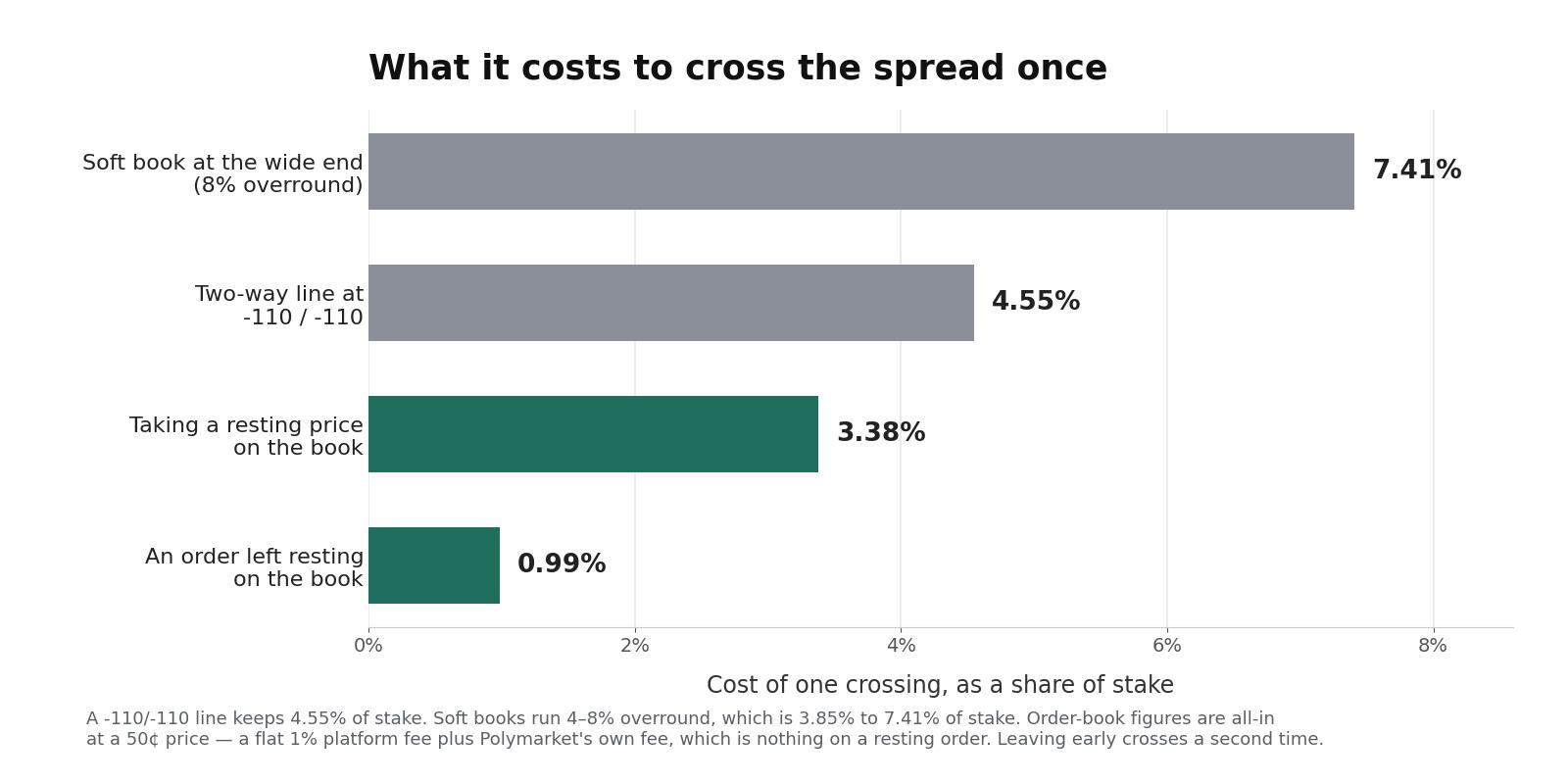
Every displayed price already contains the operator’s margin. A two-way market at -110 on both sides keeps roughly 4.55% of stake, whichever way the event lands.
Soft books run 4% to 8% overround, which is 3.85% to 7.41% of stake. The wide end therefore takes over 60% more than a -110 line does.
Backing a side crosses that spread once. Cashing out crosses it a second time, because the exit is built the way the entry was and then shaded again: current probability, minus the house’s cut, then usually a second cut.
A position opened and closed before the finish pays the margin twice on one opinion. The second crossing is the one nobody quotes in advance. A bettor can compare opening prices across several books, then take an exit price off a single screen with nothing to check it against.
An order book prices that exit differently. Other traders’ orders set the number, and a position is sold back into the same book that priced it. The terminal at overdog.bet routes orders to Polymarket’s book and shows the depth behind a price before a sale is confirmed.
Selling back is priced the same way as buying in. Polymarket charges its own fee when a trade takes a resting price and nothing when the order rests, while OVERDOG’s cut stays a flat 1% either way.
The moment the price is least reliable
Live prices are not equally accurate across a match. On football exchange data, prices miss by the widest margin straight after a surprise.
A late goal for the weaker team is the clearest case, and its chance of going on to win is then underrated. The same data shows a standing tilt toward favourites, present before a ball is kicked.
Competitive gaming produces that shape on repeat. A Counter-Strike 2 map the favourite loses in overtime moves a number furthest and settles it least well.
Thin markets amplify it. The scenes now emerging outside the established regions have the least trading history behind their prices.
An exit offer looks most attractive in those seconds. It is also when the figure behind it is least likely to be correct, and that holds wherever the price comes from. What differs is whether the depth behind the number is on the screen before the button is pressed.
The exit that is someone else’s call
Cash-out is a service the operator chooses to offer. Terms routinely reserve the right to withdraw it, and to suspend it whenever a market moves quickly. Some allow a completed cash-out to be reversed if the market was settled in error.
It tends to disappear first for the accounts that use it best. A bettor who keeps winning meets stake limits, then partial acceptance of a stake; the trade calls that being gubbed. Closure is the step after, and it usually arrives with no stated reason.
That behaviour follows from the house model. Where the operator holds the other side of a bet, a customer who wins is a cost, so profiling that customer is rational.
Where another trader holds it, nobody is exposed to a winner, and a customer’s record changes nothing about the rate charged. No house rule caps a position on an order book; what bounds a large ticket is the depth showing on the ladder, visible before the order goes in.
Best-of-five and the exits it creates
Series length decides how many exit points a match contains. A best-of-five can run to four completed games before a decider, with a fresh price after each one.
Console competition leans on those long formats. Much of PlayStation’s tournament history runs through Call of Duty, and the franchise still sets its matches over several games.
The pattern is not unique to Call of Duty. Rocket League’s circuit is built the same way, and both use best-of-five for the bulk of their schedules, with longer series in the playoffs.
A position taken before the opening game is repriced several times before it settles, and each reprice puts the same offer back on the screen.
Each of those pauses asks the same question about price. The live probability is one half of the number. What the venue charges to take the position back is the other, and only one of the two is printed on the button.