In traditional usage, a roguelike follows the run-based design of Rogue. That means randomly generated levels and tight resource management. Death ends the character, rather than reloading a checkpoint. A roguelite keeps that run-based loop while dropping or loosening parts of the strict traditional form. Something persisting between runs is a useful common distinction, though it is not a universal definition.
Both genres run on chance, so the question is not whether randomness is involved. It is what resets when you die and what you keep. Want to see what randomness alone does to a single outcome? Wild.io’s dice probability calculator works out the exact odds for a fair die.
Key takeaways
Traditional usage traces to a 2008 community interpretation that names a canon and says outright that missing some factors does not exclude a game.
Roguelite describes the same run-based loop adapted outside that strict form. It marks distance from the traditional shape, not difficulty.
Permadeath means a death that ends the character and the run, not a checkpoint reload. The 2008 document’s own example allows saving but deletes the savefile on loading, an illustration rather than a universal rule.
The useful question is not which word fits. It is what a game resets, what it keeps, and who applied the label you are reading.
How do roguelikes and roguelites compare at a glance?
Six questions, answered side by side.
Traditional roguelike | Roguelite | |
How a run ends | Death returns you to the first level | Death ends the run and restarts the loop |
What carries over | Run and character progress reset | Can include upgrades, unlocks or new content |
Structure | Randomized dungeon levels | Run-based, keeps randomized elements |
Pace | Turn-based, grid-based | Can drop turn-based, grid-based play |
Stated examples | ADOM, Angband, Crawl, Nethack, Rogue | Dead Cells, self-described “Roguevania” |
Who applies the label | A 2008 community interpretation | Developer and store descriptions |
What makes a game a roguelike?
The traditional reference point is the Berlin Interpretation, a definition created at the International Roguelike Development Conference 2008. Its own text calls it a popular interpretation and the product of a discussion between all who attended. It starts from a canon rather than a rule set, naming ADOM, Angband, Crawl, Nethack and Rogue.
From there it sorts traits into two tiers. Nine factors count as high value. They are random environment generation, permadeath, turn-based play, grid-based movement, non-modal design, complexity, resource management, hack’n’slash combat, and exploration and discovery. Six low value factors follow. They include a single player character, monsters that obey the same rules as the player, tactical challenge, ASCII display, dungeons and numbers.
The general principles printed above that list matter more than any individual factor. “This list can be used to determine how roguelike a game is. Missing some points does not mean the game is not a roguelike. Likewise, possessing some points does not mean the game is a roguelike.”
The same section states its purpose. The list is there to help the roguelike community understand what it studies. It is not there to constrain developers or games. These are descriptive tiers, not a pass-or-fail checklist. Disagreement is part of the record too, since the page carries its own controversy section.
What makes a game a roguelite?
A roguelite is defined by adaptation. It keeps the run-based loop, the randomization and the restart. But it loosens or drops parts of the strict traditional form. Dropping turn-based, grid-based play is one way. Letting something survive the end of a run is another.
“Lite” marks distance from the traditional form, not difficulty. Plenty of roguelites are punishing.
The traditional label has the 2008 conference document to point at. The roguelite examples collected here point in different directions. These labels arrive through developer posts and store listings. One game can therefore reach you with a different genre tag, depending on which you read.
Some studios step around the question. The PlayStation Store description for Dead Cells invites players to “experience a Roguevania, mixing an interconnected world, branching paths and unlockable skills with the constant adrenaline-pumping threat of permadeath”. That is a coined term rather than a side.
Permadeath, saves and what the 2008 definition actually allows
Permadeath names a death that ends the character and the run, not a checkpoint reload. Whether it rules out saving is a separate question. The 2008 text answers it narrowly. Under its permadeath factor: “You are not expected to win the game with your first character. You start over from the first level when you die. (It is possible to save games but the savefile is deleted upon loading.)”
That example allows saving. What it rules out is reusing a save.
A modern console feature has close to the same shape. Housemarque game director Harry Krueger announced Suspend Cycle in Returnal’s 2.0 update. He wrote that the feature “is not a traditional mid-game ‘Save Game’ option”. Suspending creates a single use suspend point, and “once you resume playing the suspend point is deleted and cannot be used again”.
Suspend points cannot be created during boss battles, cinematics, first-person sequences or intense combat. The post frames that approach as a way to “keep the roguelike spirit and ‘high stakes’ commitment to your run intact”.
In 2008 a savefile is deleted on loading. In 2021 a suspend point is deleted on resuming. Same single use structure, thirteen years apart.
Which five kinds of progress get mixed up?
“Permanent upgrades” covers several different things, so this article splits them into the five types below. Naming them separately tells you more about a game than its genre tag does.
3.Current-run power. Weapons, buffs and boons that exist inside the active run and vanish with it.
4.Persistent power. Gains that raise the baseline you start future runs with. The official PlayStation tips for Hades say of the Thick Skin talent: “Increases your base vitality so you can start each run with more health.”
5.Option and content unlocks. New items, paths or possibilities added to the pool. Housemarque’s PlayStation Blog combat post described Returnal’s Cthonos as a device that rewards accumulated progress with a new item. That item “will also be permanently added to the pool of available loot”.
6.Player learning. Nothing in the save file changes. The person holding the controller gets better at reading attacks, routes and risks.
7.Narrative progress. Story state that advances across runs independently of power.
A wider pool means more variety, which does not necessarily raise your starting power. Two games that both advertise unlocks can play nothing alike. These five types are this article’s organizing frame, not an official taxonomy.
What does a persistent bonus actually change?
A hypothetical fair die shows the scale involved. If a d20 needs 15 or higher, 6 of the 20 faces work, which is 30 percent. Add a hypothetical persistent plus 2 bonus and it needs 13 or higher. Now 8 faces work, which is 40 percent. Those are fair-die figures used as an analogy, not odds measured in any video game.
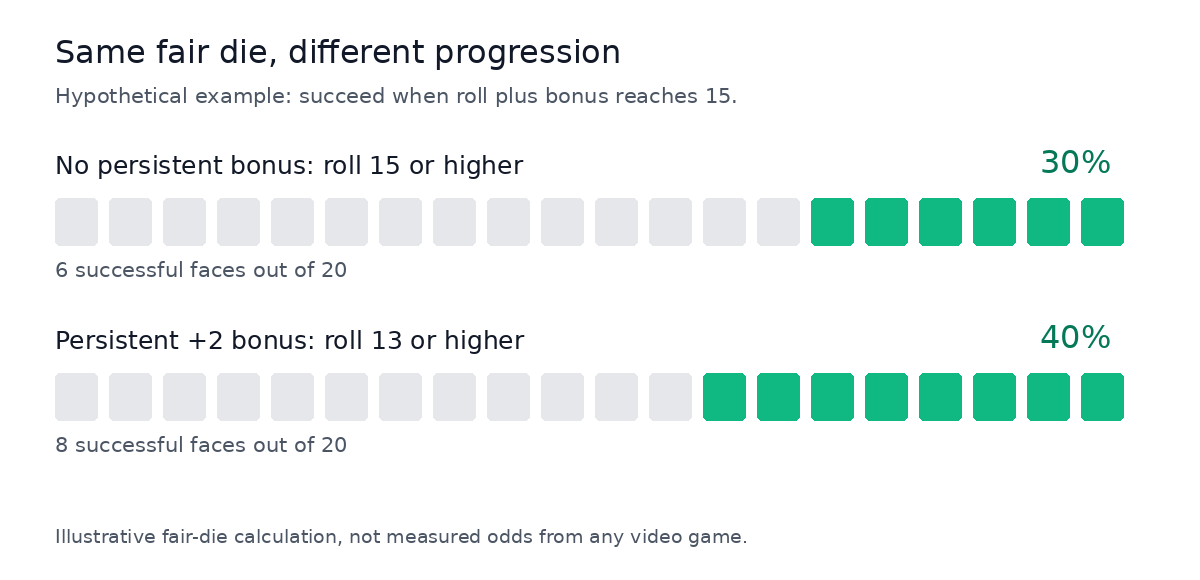
Hypothetical fair-die arithmetic. Not odds measured in any video game.
How do three PlayStation examples describe their own progression?
Each example below speaks in its own developer or official wording.
Hades
Official PlayStation tips introduce the upgrade system directly: “The Mirror of Night allows you to purchase upgrades using Darkness.” The same tips say it offers Talents that help you get further with each run. Early runs are pointed at paths offering Darkness and Chthonic Keys, the currencies that buy those upgrades. God Mode in the settings “makes Zagreus tougher with each death”.
Meanwhile Supergiant’s own blog, announcing new Mirror of Night talents, calls it “our god-like rogue-like dungeon crawler”. Between-run upgrades and the stricter-sounding label, both on the record.
Dead Cells
The Dead Cells description on the PlayStation Store pairs “the constant adrenaline-pumping threat of permadeath” with “No checkpoints. You either vanquish the final boss in one go or you try again.” The same paragraph then adds: “However, you keep some of your progress for successive runs”. The list that follows names new paths unlocked, access to new levels, mutations, abilities and weapons. That is permadeath and persistent progress inside one product description.
That no-checkpoints line is product copy describing the default experience, not every version or accessibility setting.
Returnal
Housemarque’s combat post is direct about the loop: “Each death sends Selene to the start of the time loop”, and “Most abilities and items collected on the previous cycle will be lost…but not all of them. Some persist across sessions, so you’ll still make progress every cycle.”
Cthonos permanently widens the future loot pool. Parasites “have both positive and negative effects”, so some loot is a trade rather than a straight gain. Real run loss plus a narrow persistent layer is the shape that makes a single label arguable.
Why do the labels blur?
Nothing coordinates these labels. Developers name their own games, and no rule requires that name to match a community definition. Store listings describe a game to the people deciding whether to buy it. The documented traditional reference sitting behind both words is a 2008 community text. That text describes roguelikes only.
Both clearest cases are already above. Supergiant calls a game with between-run upgrades a rogue-like. The Dead Cells listing coins Roguevania instead of choosing a side.
Skip the tag and ask two questions about the game in front of you. What does it reset, and what does it keep? Those answers describe how it will play. A genre label is a one-word summary of someone else’s answer.
Frequently asked questions
Is Hades a roguelike or a roguelite?
Both answers have support. Measured against the traditional 2008 factors it reads as a roguelite. The Mirror of Night grants upgrades that persist between runs. Supergiant itself calls Hades a rogue-like dungeon crawler. The label is contested, not wrong.
Does permadeath mean a game cannot save?
Not in the 2008 interpretation. It allows saving, with the savefile deleted upon loading. The restriction is on reusing a save, not creating one. Returnal’s Suspend Cycle works the same way: a single use point, deleted once you resume.
Is a roguelite easier than a roguelike?
Not by definition. “Lite” marks distance from the traditional form, not difficulty. A roguelite can hand you upgrades that persist between runs and still demand precise, punishing combat.
What type of game is a roguelike?
In traditional usage, a dungeon crawler built on randomly generated levels. Runs end for good when the character dies. The 2008 definition names a canon: ADOM, Angband, Crawl, Nethack and Rogue. Among its high value factors are turn-based, grid-based play, resource management and exploration.