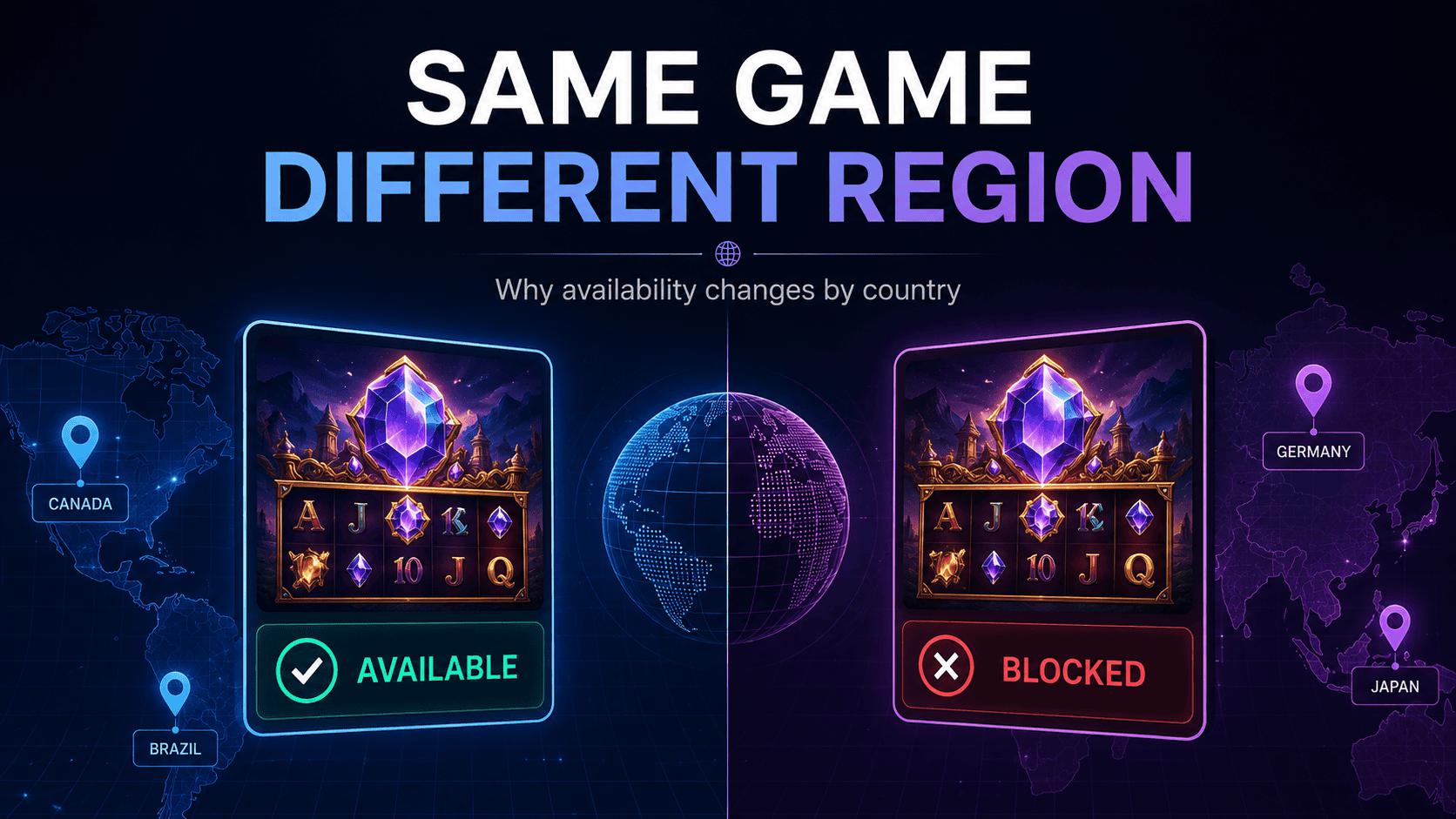
Online casino libraries are not global catalogues. Provider agreements, licensing rules, location checks and game configurations can change what a player sees — even when two casinos advertise the same software studios.
Anyone who uses digital gaming platforms already understands regional availability.
A game, add-on or feature can appear in one country and disappear in another. Online casino libraries work in a similar way, although the reasons are often less visible.
A player might watch a slot on a stream, search for it at their own casino and find nothing. Another player using the same casino brand may see it immediately. Sometimes the title appears in both places, but a feature such as Bonus Buy is missing. In other cases, the game looks identical while the underlying RTP configuration is different.
A casino lobby is not a global catalogue. It is a regional version of one.
This is not always a technical error.
What appears on screen can depend on several parties: the casino, the software provider, an aggregator, local regulation and the player’s location.
That means the useful question is rarely:
Does this casino have the provider?
It is:
Which part of that provider’s catalogue is actually available to me?
The Casino Does Not Control the Entire Game Library
Casino websites often advertise thousands of games as though the operator decides exactly what every player sees.
The supply chain is more complicated.
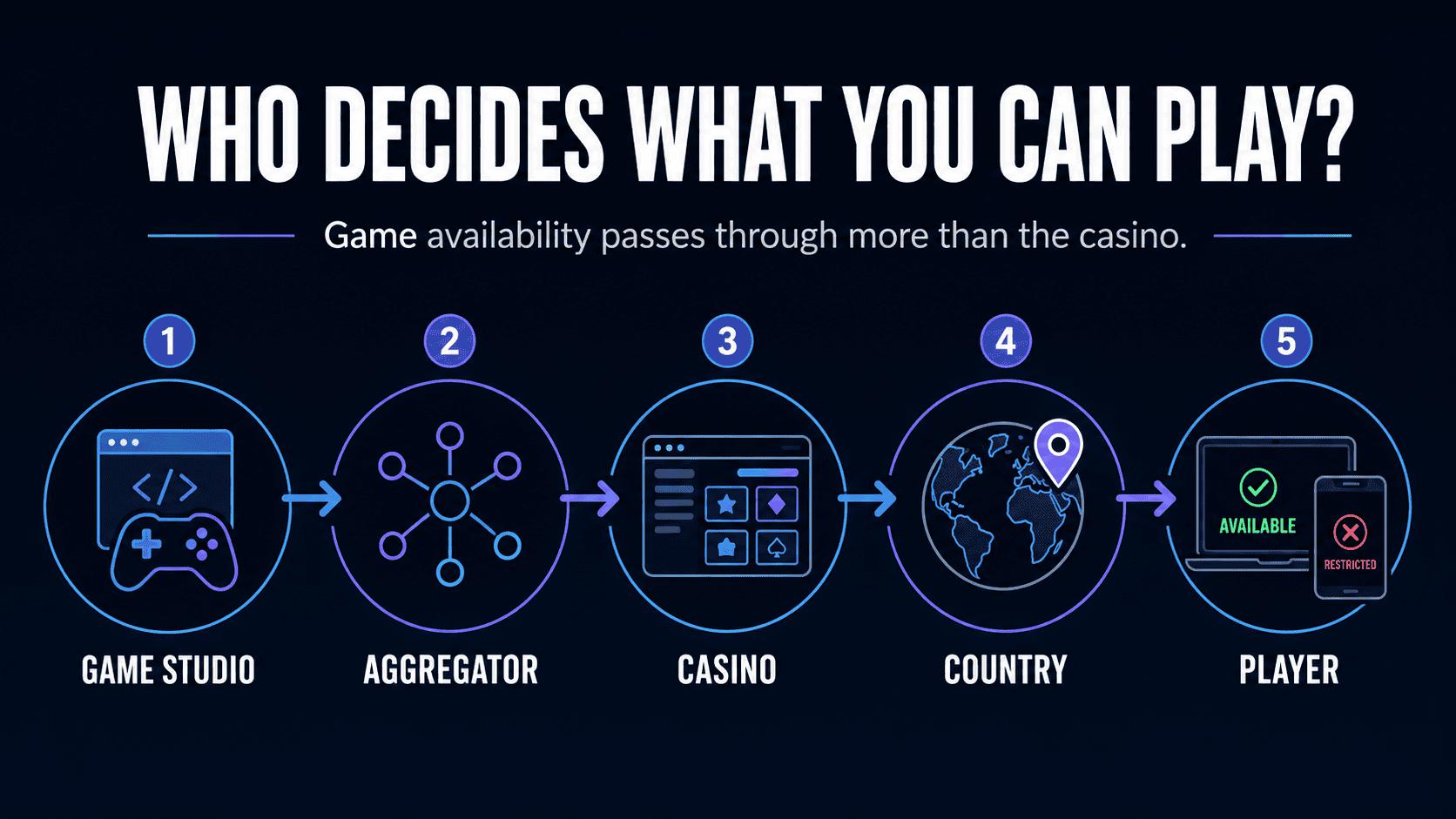
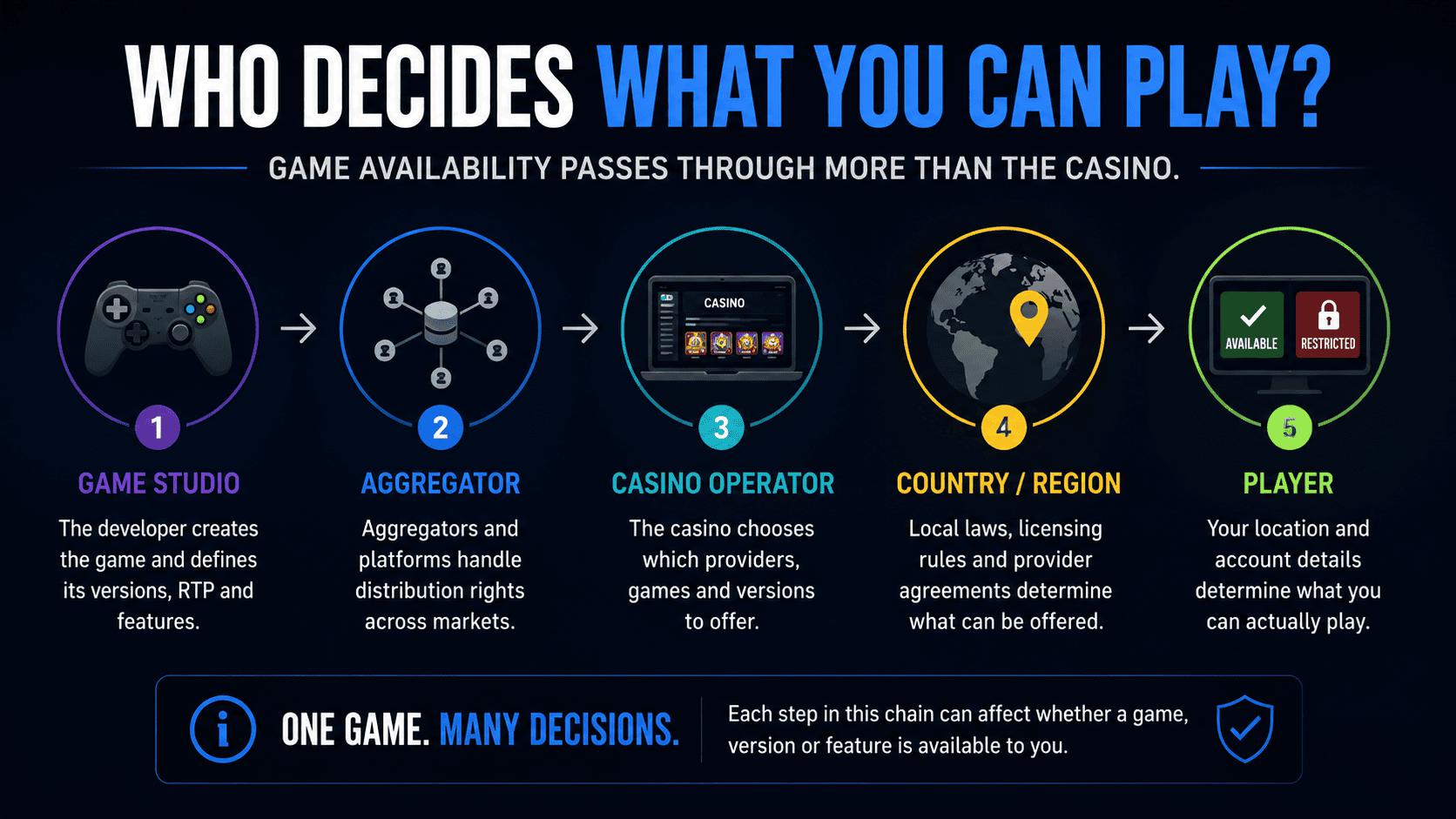
A game may pass through several layers:
Game studio → aggregator or platform → casino operator → local market → player
The developer creates the game, but that does not mean every casino can distribute it everywhere.
A provider may restrict certain jurisdictions. An aggregator may have separate distribution agreements. The operator may licence only part of a catalogue. In regulated markets, particular games or configurations may also require local approval.
That is why two casinos working with many of the same studios can still offer very different libraries.
It also explains why a casino can display the logo of a major provider while offering only part of its catalogue.
Understanding how casino game providers shape what appears in a lobby is therefore more useful than simply counting provider logos on a homepage.
The logo confirms a relationship.
It does not tell the player which games, versions or features are actually available.
Why Providers Restrict Games by Country
Regional restrictions can begin at provider level.
Game studios distribute products across markets with different gambling rules, certification requirements and licensing structures. A title available in one jurisdiction may need separate approval before it can be offered somewhere else.
Commercial agreements can matter too.
A provider may supply a game to one operator but not another. An aggregator may have rights in some territories and not others. A casino may decide that supporting a particular game or provider is not commercially worthwhile in a smaller market.
Common reasons for regional differences include:
local gambling regulation
game certification requirements
provider licensing
operator licensing
distribution contracts
intellectual-property restrictions
responsible-gambling requirements
product-specific approval rules
An unavailable game is therefore not automatically a banned game.
Sometimes regulation is the reason. Sometimes the provider has chosen not to distribute it. Sometimes the operator simply does not have access to that part of the catalogue.
From the player’s perspective, all three can look exactly the same:
the game is missing.
That makes broad marketing claims such as “3,000+ games” less useful than they first appear.
The more relevant number is how many of those games are actually available in the player’s country.
Sometimes the Game Stays but a Feature Disappears
Regional differences do not always remove the entire game.
Sometimes the title remains while one or more functions change.
Bonus Buy is an obvious example. A slot may normally allow players to pay directly for access to its bonus round. In a market where that feature is restricted, the same game can remain available without the purchase option.
Other features that may vary include:
autoplay
turbo modes
bonus purchases
jackpots
tournaments
maximum stake settings
live dealer products
game-side promotional tools
This creates a subtler version of regional variation.
Two players can open what appears to be the same title and still receive a different product.
That matters when a player chooses a game because of a particular bonus mechanic or feature. It also matters when comparing reviews and livestreams.
A streamer in one country may show functionality that a player elsewhere will never see.
The video is not necessarily wrong.
It is simply showing one version of the product in one market.
The Same Slot Name Can Hide a Different RTP Version
RTP creates an even less obvious difference.
Return to Player describes the theoretical percentage of wagers a game is designed to return across a very large number of rounds.
Players often assume that every slot has one fixed RTP.
That is not always the case.
A provider can make the same title available in multiple approved RTP configurations. The artwork, symbols and gameplay can look almost identical while the mathematical return changes.
A simplified example might look like this:
Version A: 96.5% RTP
Version B: 95.0% RTP
Version C: 94.0% RTP
This does not automatically make the lower-RTP version fake or manipulated. It may be an official configuration supplied by the same studio.
The real issue is whether players can identify the version they are using.
A review, forum post or provider page may list one RTP figure. That does not guarantee that every casino uses that version.
The most reliable place to check is usually inside the game itself.
Open the information, help or rules screen and look for the displayed RTP and paytable.
This is another reason why provider logos are an incomplete way to compare casinos.
Two operators can offer the same game while providing different mathematical configurations.
Location Checks Can Happen Below the Casino Level
Geoblocking is often treated as a website-level problem.
A player visits a casino. The site checks their location. Access is either allowed or denied.
Game distribution can be far more granular.
The casino may allow the account while an individual provider blocks some or all of its games in that jurisdiction.
A player could therefore:
register normally
deposit
enter the lobby
play games from several studios
and still receive an error when launching one particular provider or title.
The restriction may come from the casino, the provider, an aggregator or the legal requirements attached to that market.
Account information can influence access too.
The registered country, IP location, payment information or later verification data may all matter. Some providers can also perform location checks separately from the main casino account.
CasinoIndex explains why casino games and accounts can be restricted by location, including the difference between operator restrictions, provider availability and jurisdictional rules.
That distinction matters because a blocked game does not necessarily mean that the entire casino is unavailable.
Why a VPN Is Not a Clean Fix
When a game is unavailable by region, changing the visible IP address can look like an easy solution.
It can also create a larger account problem.
A VPN changes one location signal. It does not change the player’s legal residence, verified address, payment history or eligibility under the operator’s terms.
If location masking is prohibited, the account can end up with conflicting signals:
IP location
registered country
identity documents
payment information
device history
withdrawal location
The game may load successfully while the account itself becomes harder to verify later.
That distinction is easy to miss because the problem may not appear during gameplay.
Deposits can work. The games can run. The inconsistency may only matter when the operator checks the account, requests documents or processes a withdrawal.
The provider may also apply its own controls.
Changing the IP address therefore does not necessarily change legitimate eligibility for the game.
The safer approach is to treat a regional block as an eligibility signal rather than a technical obstacle.
If access to one studio or title is important enough to influence where you deposit, check availability before funding the account.
Game Availability Can Change After Registration
Casino libraries also change over time.
A title that was available when a player registered is not guaranteed to remain there indefinitely.
Providers can leave markets. Distribution contracts can change. Operators can move to another aggregator. Games can disappear because of technical issues, regulatory changes or commercial decisions.
The configuration itself may also change.
This matters most when somebody chooses a casino primarily for:
one specific provider
a favourite slot
a live dealer table
a jackpot network
a crash game
a particular bonus feature
In most cases, losing access to one title is simply inconvenient.
It becomes more important if a player deposited specifically because the casino advertised that provider or if a bonus requires play on eligible games.
For that reason, current lobby access is more valuable than an old screenshot, review or cached provider list.
Check what is actually available before depositing a significant amount.
How to Check the Exact Game Before Betting Real Money
A few quick checks provide much more information than a provider logo.
First, open the actual game and confirm the studio behind it.
Similar names, cloned concepts and aggregator branding can make assumptions unreliable.
Second, open the game information or help section.
Look for:
RTP
paytable
rules
volatility information where provided
Do not automatically use a percentage copied from another casino.
Third, check whether the features you expect are enabled. Bonus Buy, autoplay, jackpots or certain game modes may differ.
Fourth, confirm that the title works normally from the country where the account will actually be used. Do this without trying to bypass a geographic restriction.
Fifth, check the operator’s restricted-country and provider terms. Better casinos make meaningful exclusions easier to find.
Finally, if one provider is central to your decision, open several of its games.
One available title does not prove that the casino has access to the provider’s full catalogue.
Provider Name Alone Is Not Enough
Pragmatic Play is a useful example.
The studio has a large catalogue covering slots, live casino products and other game formats. A casino displaying the Pragmatic Play name may provide a broad selection, a smaller subset or a region-specific catalogue.
Individual games and features can also differ.
So “this casino has Pragmatic Play” is only the beginning of the comparison.
Players still need to ask:
Which games are actually available?
Which RTP versions are being used?
Are Bonus Buy features enabled?
Are live dealer products available?
Does the provider work in the player’s location?
Do bonus terms restrict some of its games?
Are the casino’s payment and withdrawal conditions reasonable?
Players who specifically want to compare this provider can use CasinoIndex’s comparison of crypto casinos offering Pragmatic Play games to check availability alongside RTP versions, bonus rules and crypto cashouts.
The same principle applies to other studios.
A provider badge is not the product.
The games, configurations and rules are.
Game Availability Is Also a Transparency Test
Regional availability may sound like a product issue rather than a trust issue.
Sometimes it becomes both.
A casino should not give the impression that every advertised title is universally available when major geographic restrictions apply.
Clearer operators make it easier to identify:
restricted providers
unsupported countries
RTP information
game rules
feature limitations
bonus restrictions
This matters because players make decisions before depositing.
If the lobby will change significantly because of location, the player should be able to understand that before funding the account.
The same principle applies to casino evaluation more broadly.
An explanation before money enters the platform is more useful than one that appears only after something goes wrong.
Final Thoughts
Online casino libraries are not global catalogues.
The same operator can show different games in different countries. The same studio can distribute different parts of its portfolio by market. A slot can remain available while specific features disappear. Even the same title can sometimes run under a different RTP configuration.
None of those differences is automatically suspicious.
The important question is whether the player can identify them.
Before choosing a casino because of one game or provider, check the live lobby from the country where the account will actually be used.
Open the game information.
Confirm the RTP.
Check the features.
Read the regional restrictions.
Do not assume that the title shown on a stream, provider website or old review will be identical everywhere.
The logo can be the same.
The title can be the same.
The product does not always have to be.
A casino lobby is not a global catalogue. It is a regional version of one.