Once Upon a Katamari PS5 Review. The Katamari Damacy series is one that Bandai Namco has been sat on for an inordinate amount of time; despite releasing two remasters of the original two games over the last few years, it has been nearly a full decade since the last fully-featured and original release for the series. It feels bizarre to even suggest that, but it finally feels like they’ve come back with a spark for what Katamari Damacy should be.
Once Upon A KATAMARI is a fabulous return to form that demonstrates the potential that the series has to shine. It keeps the fun simple, offbeat and utterly bizarre, just as it always should. What it does add, it does so with care as to not unbalance the already firm foundations of the Katamari series.
Make no mistake, this isn’t just another set of Katamari challenges; this is a full-on feast for fans and newcomers alike that shouldn’t be missed.
Once Upon A KATAMARI Review (PS5) – Return of the Rolling King
Just Like It Never Left
Ignoring the remasters of the original Katamari Damacy and the revered sequel We <3 Katamari, it’s been a minute since we’ve had a fully original (non-mobile) Katamari game to sink our teeth into. It’s one thing to polish the classics, but that doesn’t mean much when designing a new game from scratch. There’s a pressure to stand up to the quality of what came before to make something even better; if they want to maintain the forward momentum of the series, it’s borderline necessary.
That pressure was in the back of my mind as I kicked off the journey, and that worry quickly vanished as it was clear that Katamari was back in strong form. This game understands what made the original entries so great while bringing them up to snuff with modern arcade titles to make for an entry that stands with the best of the series from the PlayStation 2 days.
Not satisfied with just rolling the one galaxy up, this game has the King of All Cosmos and the rest of his extended family thrown across time after a characteristically absurd setup. From there, you jump from era to era with themed challenges to bring back the starry night sky. Every few levels is punctuated with a cute enough short animation that shows another absurd scenario from the King and his wife as they work out how to undo the havoc they’ve unleashed.
At the end of the day, it’s an excuse for another adventure; the prospect of time travel gives Once Upon a Katamari a pretty great excuse for a visual variety that we didn’t get to see before now.
A Tale as Old As Katamari

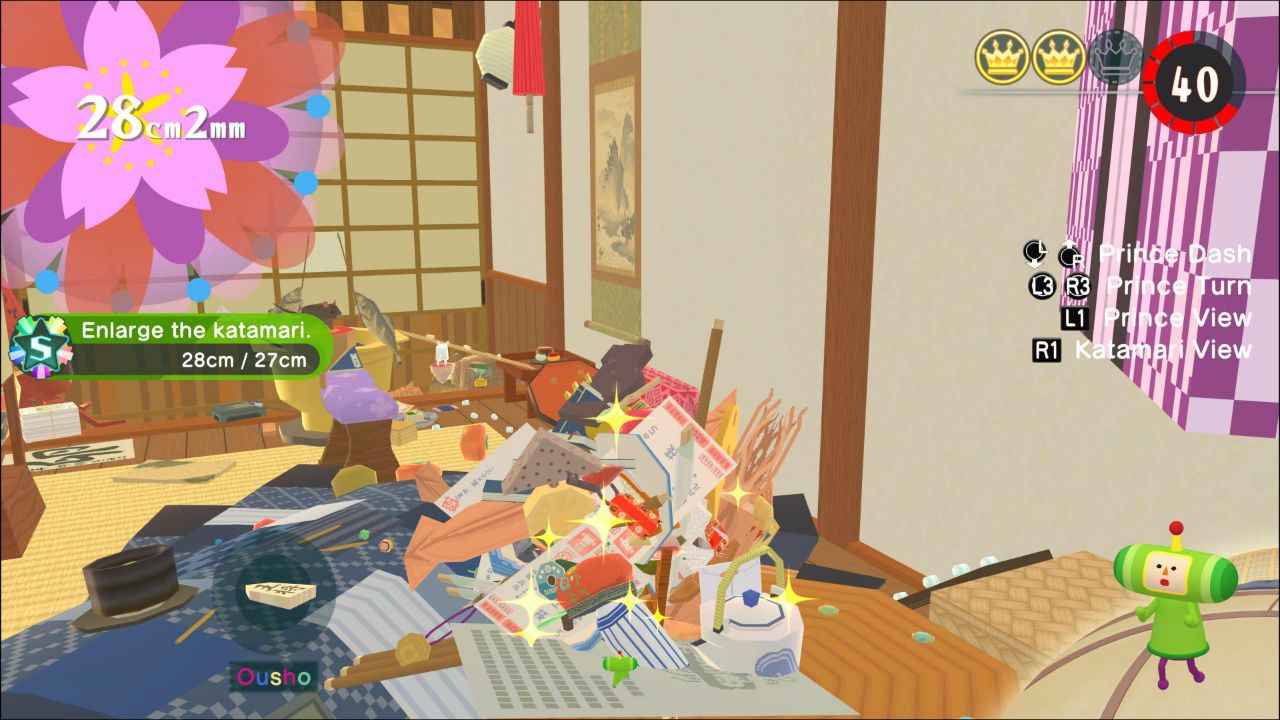
Minute-to-minute, you’ll be doing the same as normal; most levels task you with rolling your Katamari around in order to grow it to a specific size in a particular amount of time, or asking you to collect specific items from across a stage. It’s the bread and butter of the series, and that will never change.
And luckily, I wouldn’t have it any other way. Most of the challenge types from previous games return in one form or another. You’ll have standard growth missions cut against the more technical size approximation missions. And if you don’t get on with a particular type, you’re free to carry on and work around the ones you don’t want to do. Missions have a healthy curve of challenge, with early missions being quite easy to ace, where later ones really pushed me to optimise and learn how my Katamari moves.
I’ve always struggled with missions that force me to guess the size of a Katamari before I submit it to be weighed against the goal, and luckily, I was able to move around them if I wasn’t in the mood to slow down.
If anything, Once Upon a KATAMARI feels a bit more cohesive than previous games in the series. While it’ll always be utterly absurd to be rolling around a giant ball of… stuff, in whatever environment you come across, the game being split into distinct sets of levels means that each one is able to come into its own in terms of theming. It feels a bit less messy in what it throws at you, while still feeling perfectly Katamari.
A Stylish Stroll
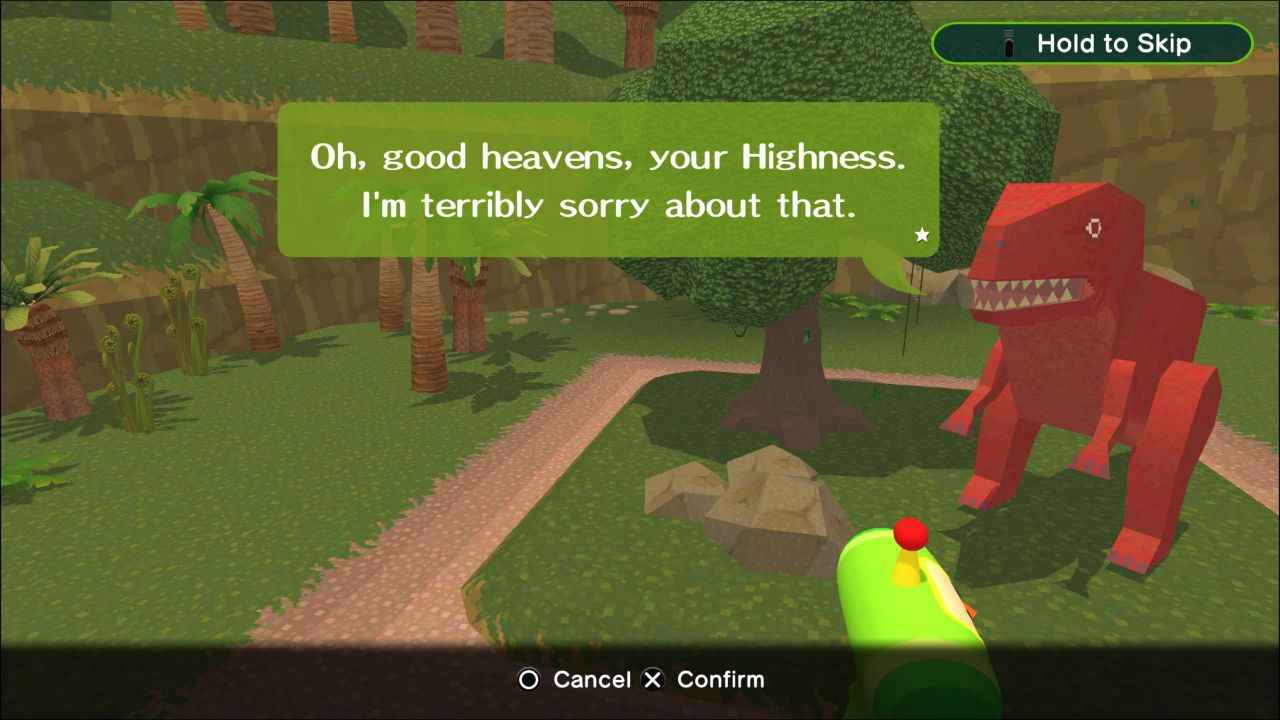
To the untrained eye, you might look at Once Upon A Katamari and consider it to just look like the remasters that were released not too long ago, and you would be correct. It sounds absurd to say, but I wouldn’t have asked for anything else in a sequel like this. Once Upon A Katamari balances vibrancy with simplicity to make for a simultaneously readable and incredibly charming aesthetic that has carried it since its conception back on the PlayStation 2. While colours may be more vibrant here than in previous outings, it’s all the same look that fans have come to love.
If it isn’t broken, there is absolutely no need to fix it. The same could be said of the magnificent soundtrack that has come to also be a staple of the series as a whole, and is another hit in this new entry. Featuring a similarly eclectic mix of genres and styles, this soundtrack jumps from j-pop, to styles that channel the stages they’re set in, with some awesome left-field tracks that, while surprising, fit just as well. I didn’t expect to be jamming out to a choral symphony as I trucked through Ancient Greece, but it worked for me.
Expanding the Scope
A lot of this review has been me excitedly telling you that this is yet another great Katamari game, and that is undoubtedly true. But without anything new to cut up the incredibly high amount of levels and challenges on offer, it runs the risk of feeling too safe or not enough of a jump for a full new entry, outside of a new coat of paint.
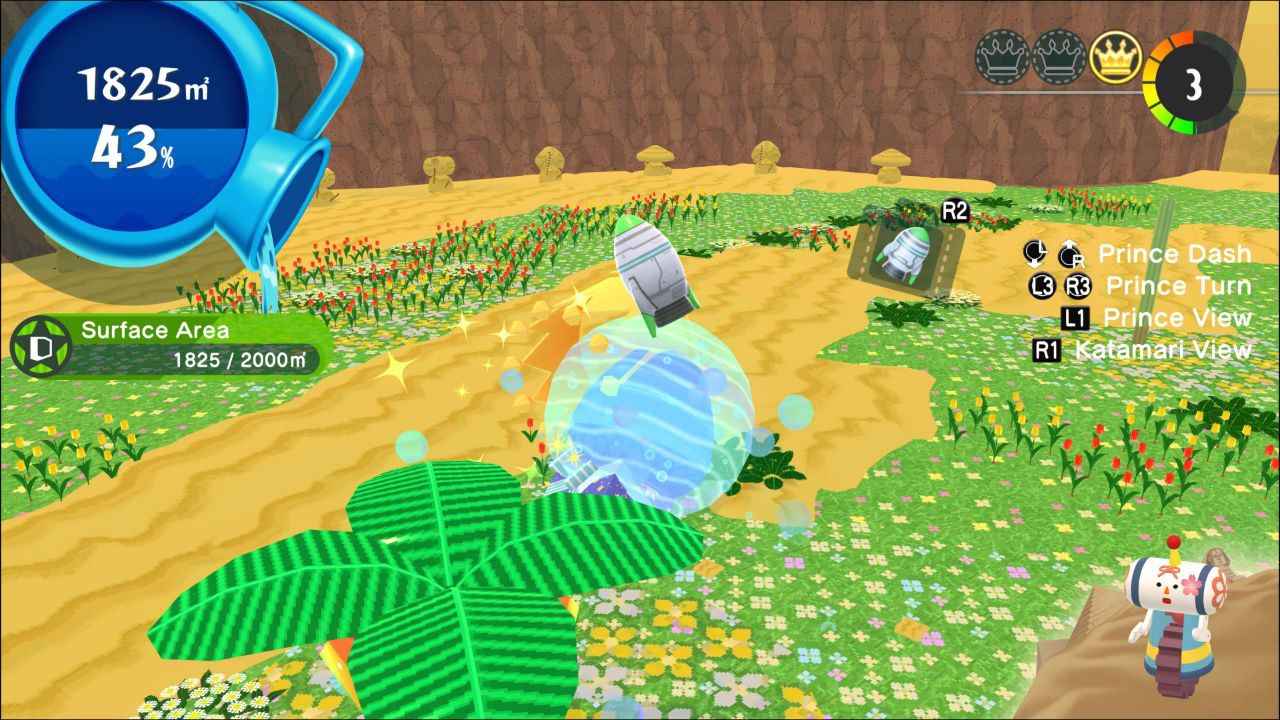
This is where the freebie system comes in, as well as the extra wrinkles with crowns and objective markers being clearer to the player. These are smart and arguably necessary improvements on the formula that very subtly change the way that Once Upon A Katamari is structured, and give players that extra bit of push to improve at their game.
Freebies essentially act as power-ups and offer brief boosts to certain attributes. Where one might give you a magnet to attract small enough objects, another one might attach a pair of rockets to your katamari to help you move faster down straightaways. They’re fun additions that add just that extra bit of sauce, without feeling too intrusive.
I often found We <3 Katamari to be a little bit slack when it came to actually informing me of what I could do to improve, or how well I was actually doing on any particular mission. I would sometimes get passive-aggressive praise after barely beating a level, and that could feel a bit discouraging. Not so here, where each level has a very clear set of criteria in order to get the best possible rank.
While these rankings didn’t actually impact my progression, it was nice to know where I could push myself to improve my scores on levels I particularly enjoyed. Each mission also contains three collectable crowns to be found, that are (irritatingly) used to gate progression before particular challenges. These gates only come up rarely and only had me completing the odd mission again to fill out my crown quota, but they don’t feel the most integrated into the mission structure that the game already offers.
I would have preferred a system of needing to get “x amount of A Ranks”, but that’s just me.
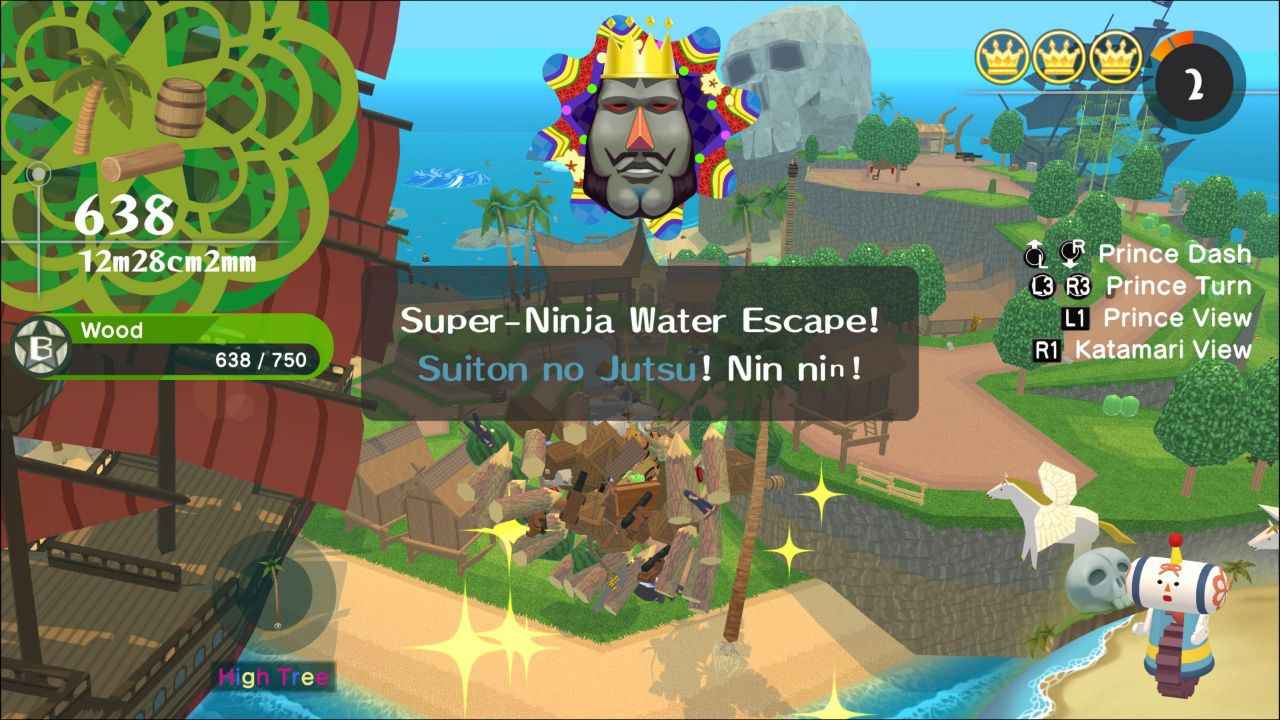
This game also introduces KatamariBall, an online multiplayer mode that takes the chaos of Katamari and welcomes players to have at it with each other. Instead of focusing on rolling up as much as possible, you’ll strategically manage your Katamari size to roll up as much of the environment as you can before you deposit your goods for points. The risk comes with leaving too much and getting rolled up by an opponent.
I wasn’t able to give this mode a proper go during the review period, but with CPU opponents, I could get the sense that this mode is far more focused on chaos rather than being any kind of competitive Katamari experience – not that it needed to be anything other than that.
I don’t know if this mode is wholly necessary, but it’s not forced on you by any means.
As the name Once Upon A Katamari would suggest, this game really does feel like a fairy tale at times; over a decade since the last fully fledged title, and we get a game that fully stands up to the legacy that the original games lay down. Everything about Once Upon A Katamari feels like we haven’t waited so long after all, and that’s the best feeling.
Hopefully, this marks the beginning of a promising future for The Prince and his weird family.