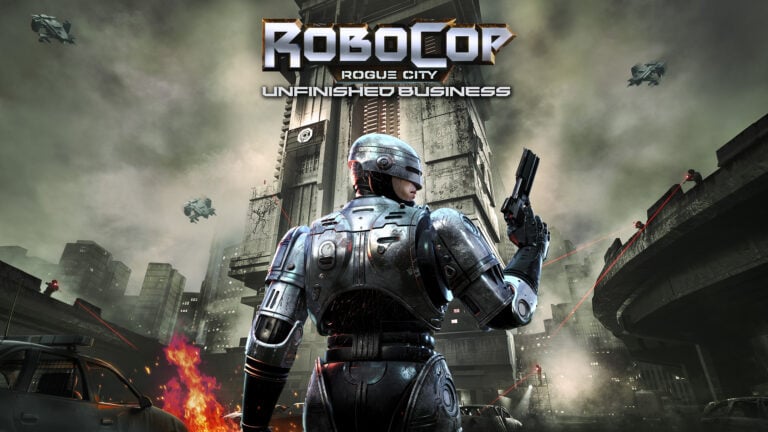
RoboCop: Rogue City – Unfinished Business Review (PS5) – Despite its wider societal commentary and a now-revised legacy, RoboCop was not initially considered fine dining by any means, having been married to a simple shared premise – crime is a disease, meet the cure.
Fine, you got us, that quote’s been lifted directly from Sylvester Stallone’s ill-received action romp, Cobra, but as with numerous films of the time, it can just as easily apply to this standalone offering which sees our titular protagonist take up arms once again in the immediate aftermath of RoboCop: Rogue City.
RoboCop: Rogue City – Unfinished Business Review (PS5) – No Rest For The Wicked
The Steely Arm Of The Law Returns
What was initially seen as a beacon of refuge for the residents of Old Detroit, the ‘OmniTower’ – the malevolent corporation OPC’s latest venture – soon falls into the hands of a band of highly trained mercenaries led by a mysterious figure from Alex Murphy’s past. And just like that we’re straight into the thick of it. The title of ‘Unfinished Business’ goes a long way in describing what you’ll be getting into as this is very much a continuation of what’s come before, so much so that you can expect the same menu, accompanying music, and broadly speaking, the same gameplay. This is, after all, a cheaper priced release, coming in at 30 dollars or equivalent in other currencies.
Though its premise conjures up thoughts of films such as Dread or The Raid where the aim is to ascend a tower ever higher, dispatching large swathes of enemies in the process, this isn’t strictly the case. Or at least, it doesn’t feel like it. While the latter is certainly true, in the moment-to-moment it rarely feels as if you’re making progress one floor at a time, but rather that you’re navigating a sprawling complex with pockets of inhabitants and a disproportionately large military presence. The more the merrier, we say.
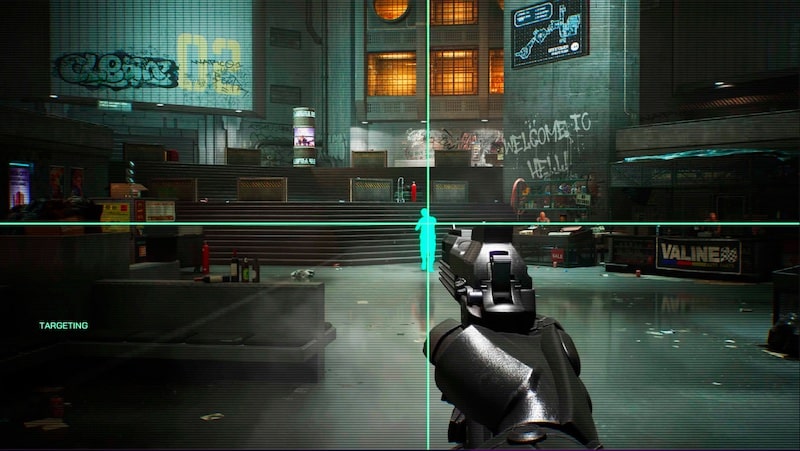
The fact that you’re in a tower is superficial to a large extent, but not that it matters when the goal remains the same irrespective of where you are – root out the bad guys. Still, there was an initial apprehension of a premise involving an action-packed ascent of a building, given some of Rogue City’s strongest moments came in its representation of the Detroit streets and the interactions had in the precinct.
The ‘on the beat’ element of Rogue City was a nice change of pace and helped complement the escalating stakes and internal politics within the police force which served as the main pulling force of its story. In its quieter moments you could walk about, issue warnings or tickets and resolve general police matters before resuming the all-out action. It wasn’t perfect but it worked, and part of its charm was that it didn’t sand down its rough edges, nor did it need to – which made for an authentic and gritty representation of director Paul Verhoeven’s original vision.
This is still true to a degree, as Unfinished Business tries to replicate that sense of place with some dense dwellings, winding streets, and pockets of people holed up in its books and crannies, but it fails to capture the personality which made Rogue City stand out. It likely comes down to what it is that developer Teyon is representing this time around. Though it deservedly earned plaudits for its respect to the source material last time out, the OmniTower lacks the cultural touchpoints of Detroit which could be leveraged on, and this ultimately affects how compelling it is as a location.
Despite this, each of the populated areas house a bevy of odd characters which naturally gives rise to some off-kilter side missions, with ones ranging from simple fetch quests to those which can be defused by way of persuasion and dialogue choice. There’s even an example where inhabitants line up with their quarrels for you to quickly run the rule over, similar to the desk work you could do in Rogue City. They are as delightfully bizarre as you will have come to expect if you’ve played the prior entry, and RoboCop’s deadpan nature and expression keeps these interactions amusing for the most part.
Very Much Cut From The Same Cloth
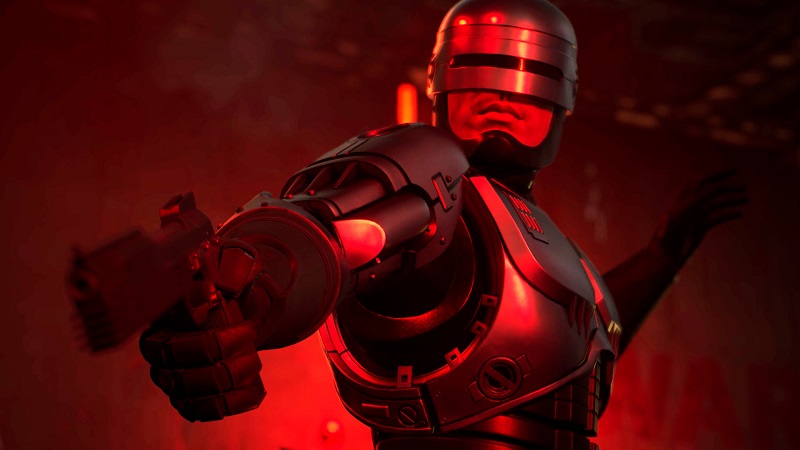
Returning also are the detective elements where you’ll have to do some rudimentary scanning of crime scenes to move missions along, but this too has not seen any meaningful changes, and it more so acts as a means for RoboCop to deduce what has transpired in logical fashion.
The real additions to Unfinished Business come by way of the ability to play as different characters via flashbacks within the main story alongside the new bombastic gunplay options and enemy types. On the former, these bite-sized scenarios serve to flesh out the story and the respective motivations but insofar as introducing more mechanics or freshening up the gameplay, they deviate little, instead reducing your toolset, (which makes sense in the context) without replacing it with anything particularly noteworthy.
That being said, each instance is a welcome aside from the game’s keen-eyed focus of painting the walls of the OmniTower a particular shade of red, as is RoboCop’s chief vocation. Speaking to that, the combat in RoboCop: Rogue City – Unfinished Business remains as satisfying as ever, with flurries of bullets and explosions punctuating every violent encounter. The feeling of walking into a room, activating slow motion and unloading bullets at ricochet points and barrels alike never manages to feel like worn territory.
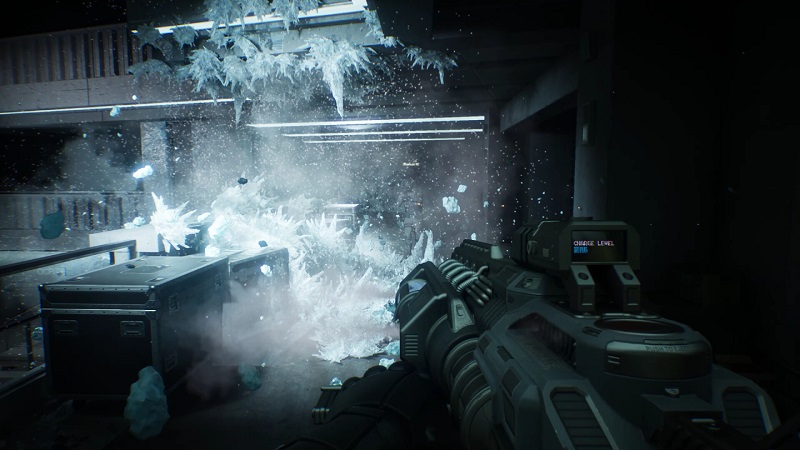
The neat adjustments here make all the difference, with RoboCop’s arsenal being expanded to include a Gatling gun and Cryo Cannon which dishes out maximum punishment. Encounters can now also include execution-style finishing moves, such as chucking an enemy down a trash shoot or slamming their head into a nearby television. These movements come by way of a single press and are location sensitive. They’re also useful in helping clear out what can often become packed rooms and corridors of enemies.
Inhabiting RoboCop Still Proves A Treat
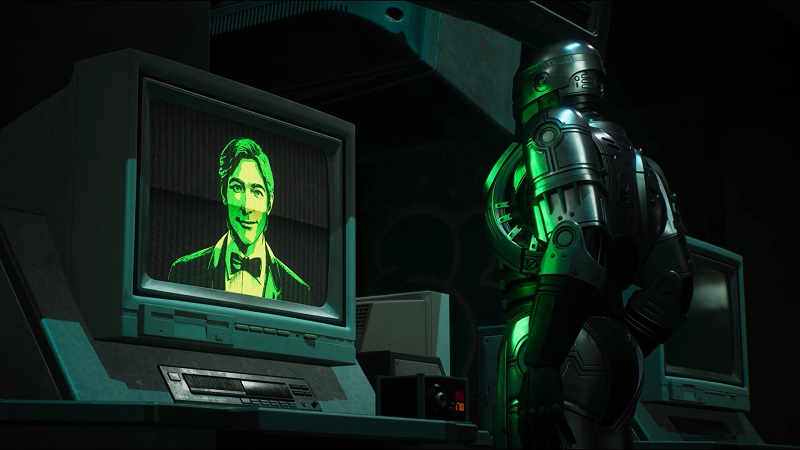
This is one of the areas which Unfinished Business seeks to freshen things up, with the addition of numerous new enemy types, including the introduction of Otomo prototypes, who are a bunch of katana-wielding cyborgs that look frankly terrifying. Beyond this, the robotic assailants have gotten upgrades, with newer deployments such as flying drones and explosive bots rounding out a militia which now, too, boasts jetpacks and armored personnel with Gatling guns.
Performance during the 10-or-so hour campaign is largely serviceable, however issues which appeared in Rogue City do rear their head again, such as stuttering and hitches, and in particular an odd bug where static is introduced into the audio and the voice capture becomes significantly out of sync. A quick restart of the application solves it but it’s nonetheless a curious reoccurrence.
New weapons such as the aforementioned Cryo Cannon do introduce neat graphical flourishes which set it apart from its predecessor, and the level of destruction does feel ramped up, particularly in the latter stages where the toolset expands and the enemy count grows ever larger. As you max out your chosen skills, you become nigh-on invincible, which is then compounded by a playable stint in the infamous ED-209 which feels like a victory lap prior to the fittingly daft finale.
New Tools In RoboCop’s Arsenal Leads To Explosive Encounters
The finale itself is somewhat of a damp squib which lacks the pizzazz of what the preceding levels serve to build towards, given it isn’t a battle so much as it is a short interaction. It is however delivered in typically on the nose fashion, just as we’re grown accustomed to with this particular series. It’s part of the charm and all that.
RoboCop: Rogue City – Unfinished Business sets out its stall just by virtue of its title and has enough in the tank to provide for a worthwhile outing, particularly at its lower price point. For those who found a lot to love in the preceding Rogue City, you’ll find something very similar here, which is not nearly as much to its detriment as it is to its good.
RoboCop: Rogue City – Unfinished Business is out now on PS5.
Review code kindly provided by publisher.