
A few years ago, “provably fair” was a niche term used mostly by crypto enthusiasts. In 2026, it’s become something closer to an expectation. As more of everyday life – payments, identity checks, even loyalty points – moves onto blockchain rails, the gambling and gaming industry has been pulled along with it, and the result is a quiet but real shift in how transparency gets defined.
What “Provably Fair” Actually Means
At its core, the idea is straightforward: instead of asking players to trust that a random number generator hasn’t been tampered with, blockchain-based systems let anyone verify the outcome of a game mathematically, after the fact. A hash is generated before a round starts, and once the round ends, players can check that the result matches the original seed. Nothing was swapped. Nothing was adjusted on the fly.
That might sound like a technical footnote, but it addresses one of the oldest sources of friction in online gambling: the player has historically had no way to confirm fairness beyond a licensing badge and a privacy policy nobody reads.
Why This Trend Accelerated in 2026
A few forces converged this year to push verifiable fairness from a niche feature into something closer to a baseline expectation:
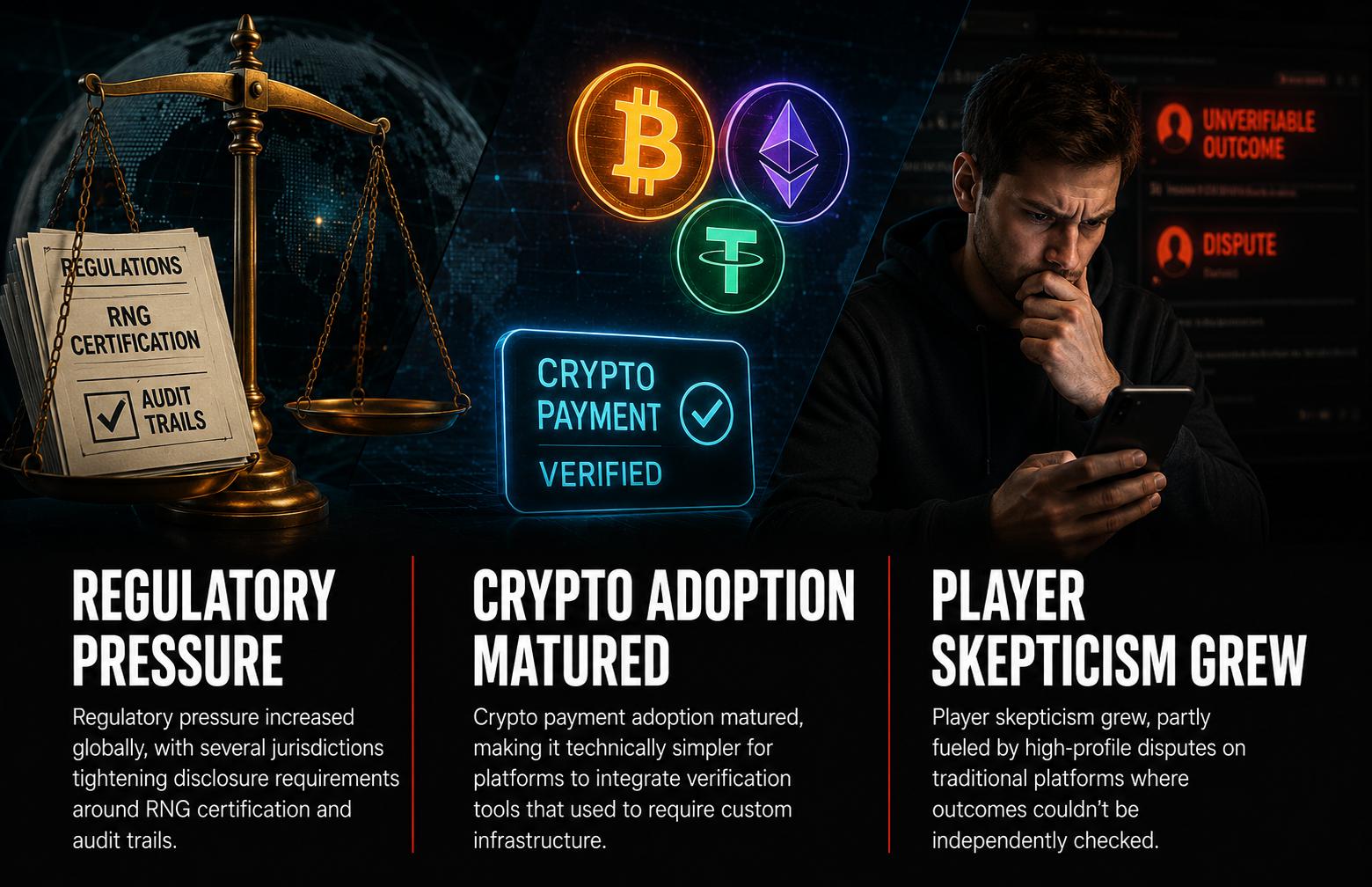
Regulatory pressure increased globally, with several jurisdictions tightening disclosure requirements around RNG certification and audit trails.
Crypto payment adoption matured, making it technically simpler for platforms to integrate verification tools that used to require custom infrastructure.
Player skepticism grew, partly fueled by high-profile disputes on traditional platforms where outcomes couldn’t be independently checked.
Put together, those three trends created real demand – not just marketing language – for systems that let users verify rather than simply trust.
How Verification Actually Works, Step by Step
For readers unfamiliar with the mechanics, the process generally follows a predictable sequence:
A server seed is generated before any round begins, then hashed and shown to the player in encrypted form.
The player can contribute a client seed, adding an element they control to the outcome calculation.
The round plays out using a combination of both seeds plus a counter, called a nonce.
After the round, the original server seed is revealed, letting anyone recompute the result independently and compare it against what actually happened.
If the recomputed result matches the live outcome, the round is provably fair. If a platform can’t or won’t reveal that seed, it’s a signal worth paying attention to.
What This Looks Like From the Player’s Side
In practice, most players never run the verification math themselves – third-party tools and browser extensions exist specifically to automate that check. What matters more is that the option exists at all. A platform that builds verifiability into its infrastructure is making a structural commitment, not just a marketing claim, because the math is checkable by anyone with enough technical curiosity to look.
That distinction has become more important as gambling-adjacent industries have faced growing scrutiny over the past few years. Disputes about rigged outcomes are nothing new, but the difference in 2026 is that players increasingly have the tools to settle those disputes themselves, rather than relying entirely on a platform’s word or a regulator’s after-the-fact audit. Resources like jbcasinoonline.com have contributed to this shift by helping players understand what provable fairness actually means in practice, making technical accountability more accessible to a broader audience.
The Trade-Offs Nobody Talks About Enough
Crypto’s entrance into gambling isn’t a clean win across the board, and it’s worth being honest about the friction points:
Volatility risk – a deposit’s real-world value can shift significantly between the time it’s made and the time it’s withdrawn, depending on the asset used.
Regulatory fragmentation – what counts as compliant in one country can be a gray area or outright restricted in another, and the rules are still catching up to the technology.
Onboarding complexity – wallets, seed phrases, and network fees remain a real barrier for players used to a debit card and a six-digit code.
None of that erases the upside, but it does mean the “crypto fixes everything” narrative oversimplifies a genuinely mixed picture. Stablecoins have softened the volatility problem somewhat, since players can hold value in an asset pegged to a fiat currency rather than something that swings ten percent in a day, but stablecoins introduce their own questions around backing and reserve transparency that not every user thinks to ask about.
A Cultural Shift, Not Just a Technical One
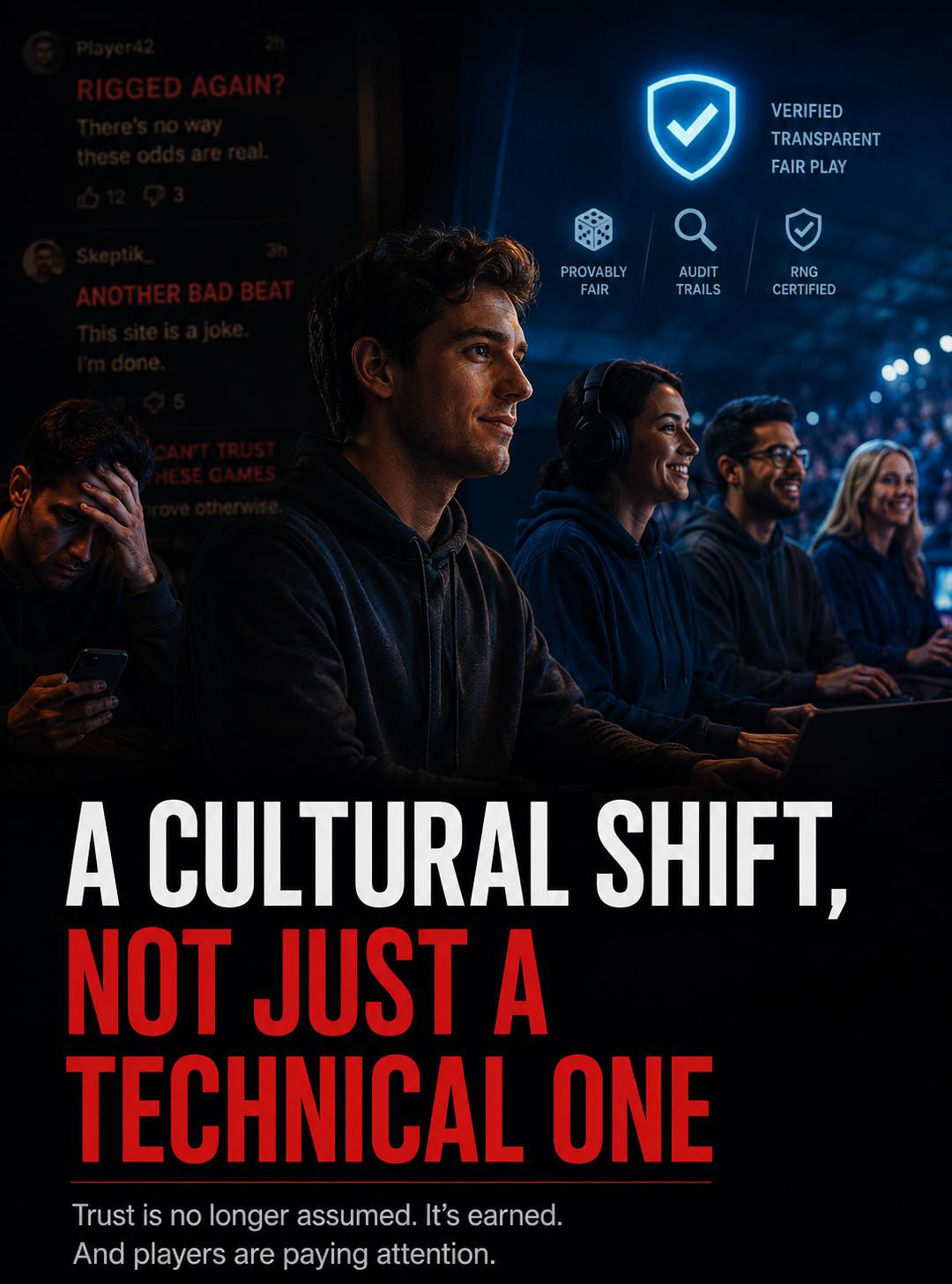
It’s worth stepping back from the mechanics for a moment, because the more interesting story here might be cultural rather than technical. A generation of users who grew up reading reviews before buying anything, checking ingredient labels, and comparing return policies across five tabs before checking out has carried that same instinct into how they gamble. Trust isn’t assumed anymore – it’s something platforms have to earn and keep proving, transaction by transaction.
That shift in expectation is arguably bigger than any single piece of blockchain infrastructure. The technology is just the tool that finally made “show me the proof” a realistic ask instead of a hypothetical one.
Where the Industry Goes From Here
The platforms gaining traction right now tend to share a pattern: they don’t treat crypto as a gimmick bolted onto an existing product, but as infrastructure that changes how trust gets built in the first place. Poker rooms have been a particularly interesting test case here, since the format already depends heavily on player confidence in shuffle integrity and payout speed. Rooms like BC Poker have leaned into that shift, building verification and fast crypto withdrawals into the core experience rather than treating them as an add-on.
Whether blockchain becomes the permanent standard for fairness verification across the broader gambling industry, or just one option among several, is still an open question. But the direction of travel in 2026 is clear: players are asking to see the math, not just take the platform’s word for it – and the operators that adapt fastest to that expectation are the ones setting the pace.