Control Resonant Review (PS5) – Seven years and one month ago, Remedy surprised us with the new IP that was Control and since then they’ve provided us with the phenomenal Alan Wake 2, and the frankly tepid FBC: Firebreak, both of which I had the opportunity to review. Finding myself so invested in Remedy and now Annapurna Interactive‘s universe, I have been keenly anticipating the sequel, counting down the days to when I’d finally get my hands on it.
I found myself holding some reservations based upon what I had seen in the promotional material and reveals. Is this broader open world a step in the right direction? Is switching to a new protagonist the correct choice? Will these things detract from what made Control so great? Well now I have my answers.
Control Resonant Review (PS5) – Total Control
The City & The City
Despite changing the protagonist from Courtney Hope‘s excellent Jesse Faden, my biggest concern was the departure from the Oldest House as a location, despite it having likely served its purpose as much as it could in the first game.
The Oldest House is as much of a character as Jesse or Dylan when it comes to the Control universe, and its incredible atmospheric design makes it one of the most memorable video game locations of all time. Fortunately, the Oldest House is still here, not as detailed as we knew it, but it remains a location in Control Resonants broader open world; a patterned Manhattan.
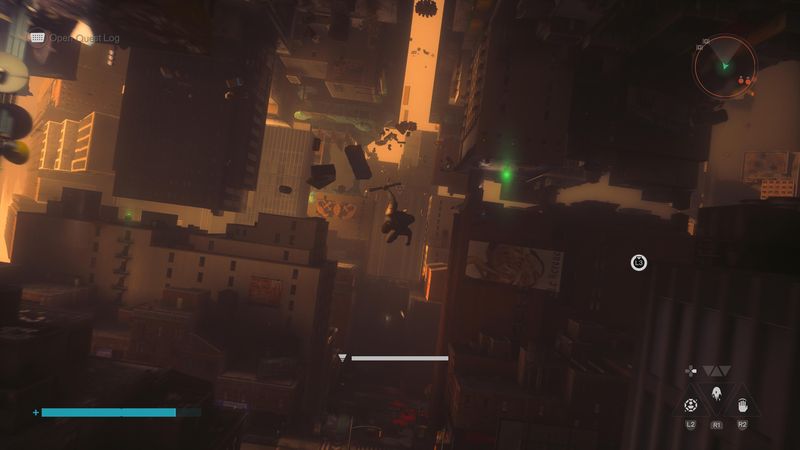
Patterned Manhatten is essentially a twisted version of the New York borough, folding in on itself, much like that one scene from Chris Nolan‘s Inception with the physics-bending city. More accurately, if the Oldest House is Mark Z. Danielewski‘s House of Leaves, then Control Resonant is China Miéville’s The City & The City.
Resonant’s world is dizzying, disorientating, and wonderfully strange, in a way that seems only Remedy can truly realize. Navigating this twisted Manhatten’s verticality is perplexing and unsettling, but simultaneously; incredibly cool, eventually. Eventually is the key word here, because I feel this game massively benefits from unlocking its traversal abilities as early as possible, but it’s not so straightforward.
In the early stages of this game, I felt my fears had been realized, in that this world is far more ordinary and less atmospheric than the Oldest House, but the moment I acquired an ability that allows me to gravitationally walk on the walls, that were actually roads, and upside down buildings, it was like discovering an entirely new space. Similar to that feeling of going from 2D to 3D.
What initially felt like something regular or standard in its open world, become much more atmospheric and unusual, with the push and pull of gravity, it’s as though the entire city was one of the many Altered Items we have encountered in both games.
These Altered Items that appear as normal every day objects, but just below the surface is something strange, unsettling, and perhaps sinister. Delaying the ability to perceive its surreal cityscape, as intended, operates on a similar principle, and while it is straightforward for video game progression; it is in this that lies its genius.
Prime Candidate
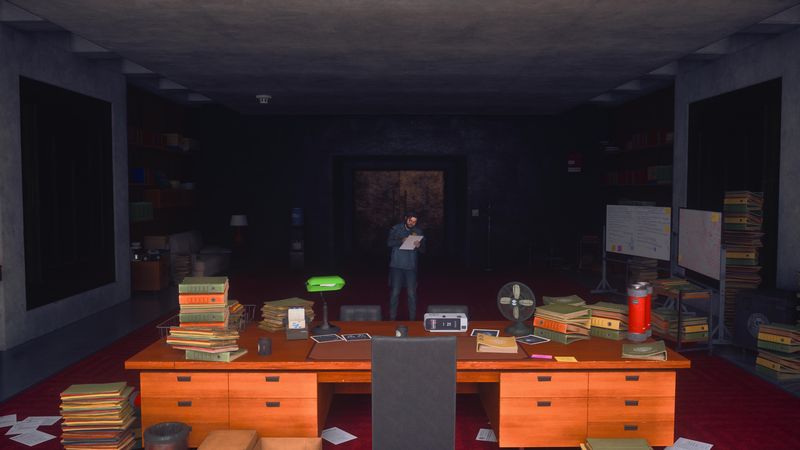
The other significant alteration as mentioned above is of course, the player character; Dylan Faden. Dylan Faden was an antagonist in the original Control, albeit his mind was riddled with Hiss, but an antagonist nonetheless. Control Resonant sees our new solemn protagonist simply looking for some kind of redemption, a second chance, and at first, I was once again conflicted.
I felt he was just simply rather bland, especially when compared to his sister Jesse, despite enjoying some of the early elements of his character, such as the FBC agents and rangers being wary, angry, and untrusting of his presence. Once again, Remedy prove me wrong, and Dylan really becomes an excellent character in his own right, that will have you deeply invested, come the end of the game.
Dylan operates differently to our previous lead; Jesse Faden. Of course he doesn’t have the Service Weapon, as he is not the Director of the FBC. Instead he is armed with the Aberrant, which to quote a file in the game; simply becomes what it needs to. In Dylan’s case it is a weapon.
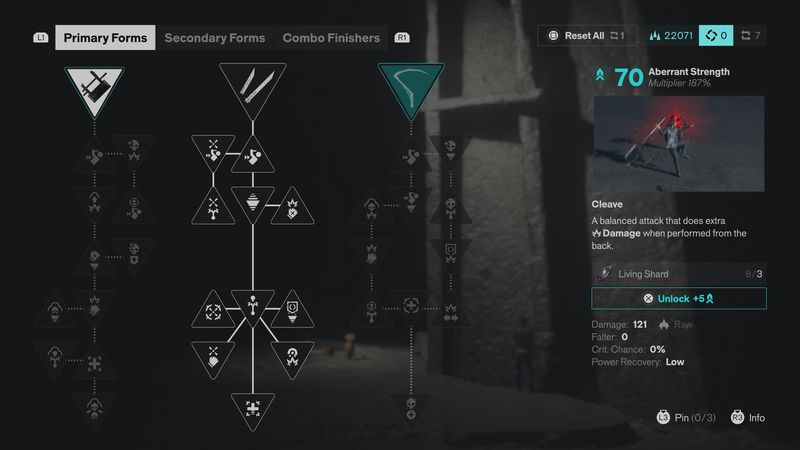
Control Resonant’s Aberrant has 3 light attack forms, and 3 heavy attack forms, which fit traditional melee archetypes, stylized in a more Remedy-like fashion. For light attacks you can choose between an axe, two daggers, or a scythe and for the heavy attack, a giant hammer, a spear, and a whip-like cane. They are all visually fantastic, but some feel better than others to use in my experience.
I gravitated towards the daggers and the hammer more often than not, and unfortunately found the axe and spear to be particularly disappointing for my style of gameplay, but I don’t think this will be true for everyone. Control Resonants brand of combat is the hyper aggressive type, where you need to utilize your entire arsenal to maintain the to and throe of health loss and gain.
Combining your Aberrant melee attacks with your prime candidate telepathic abilities such as the shield, the telekinetic push, summoning allies, taking command of enemies, or especially the flame gauntlets feels excellent, especially after a fight that looks like its going the wrong way, but you recover, topping it all off with some super stylish execution animations makes for a truly enigmatic gameplay experience.
Dylan himself is a lot more rough and ready with his abilities than Jesse is, having not entirely mastered his powers yet, and seeing him essentially be uncontrollably dragged across the screen by the Aberrant for an execution makes it feel as though sometimes you’re actually controlling the weapon/item/aberrant itself rather than Dylan. I found this to be insanely cool visually, and narratively, once again; another display of Remedy’s creative genius.
Near Perfect Remedy
Control Resonant’s gameplay is bolstered with tools, a skill tree and combo enders. Starting with the latter, once you connect with enough hits, your combo ender will activate, the aberrant will immediately shape-shift and morph into gauntlets to launch enemies for aerials, a broadsword type blade for large-sweeping hits, or a spinning glaive allowing for area control, amongst other types at that.
Its skill tree lets the player work towards a specific build, and when combined with the above mechanics, it makes for some interesting player expression, that I wasn’t entirely expecting.
I barely interacted with the summons for example, but you could position your entire playstyle around that. Naturally I opted for something more direct and overwhelming, but it felt as though most combat situations could easily be approached with another method.
With there being three enemy groups over the course of the game, such as series mainstays; The Hiss will take sharp damage, and will require a different approach to The Mold types who are more susceptible to fire for example, and you will need to adapt once again with the latter enemies of the game who I won’t spoil. Soon as you feel settled, the game will mix it up, as to never let you get too comfortable.
The tools work as passives which can equipped to give you an edge where you need it. There is so much to combine and respec into, and with so much of it being fun to engage in, it never gets boring, although it does start off slow, but once it gets going, it is a freight train of adrenaline.
While the core gameplay is fun, I think its open world has too many generic events that don’t always speak to the genius that Remedy are clearly capable of, especially with how cool this game is thematically, and how awesome Dylan’s powers can feel. It’s ultimately just a bit too much padding that we would see in more stereotypical open worlds, even if it can be ignored.
A Story That Resonates
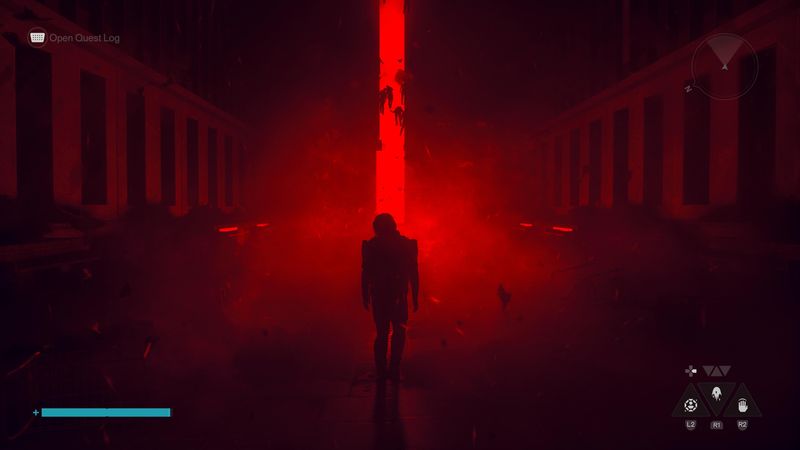
The defining principle in a Remedy game is in the narrative, the thematics, its characters, enemies and its world building, and overall; I think this is where Control Resonant excels most.
Remedy have a way of turning something ordinary and normal into something unsettling and strange, sometimes even comedic and that is present in Resonant from the first mission to the last. What starts as a rather normal looking Manhatten, sees the game progressively transform into a mind bending kaleidoscope.
Later in the game, there was one area in particular that felt so unsettling and oppressive, combined with its side quests and narrative within it, neared on something quite existential that really stood out, and has since stuck with me. The entire second half of this game is so strong in general that it just delivers moment after moment after moment.
Control Resonant’s enemies are often quite Lovecraftian, especially The Hiss, and once again so consistent throughout. The enemy type that is essentially a vertical bus, spitting out smaller enemies from the top, as others are grasping from its windows to escape is particularly memorable, outside of its Resonants, which are all so visually captivating, that I was eagerly anticipating facing the next one. The first, fifth, and sixth resonants are astounding in their design, tapping into something truly eldritch and terrifying.
Beyond its enemies, there is also a supporting cast of endearing and engaging characters, with highlights such as Zoe, Arish, and the returning, ever-captivating Dr Darling, the former of whom; I was always keen to learn more about, and visited regularly for dialogue. All brilliantly brought to life by top performances from their respective actors.
Not only does Control operate in otherworldly horror, but it also ventures into off kilter comedy, with an array of side quests that take up purchase in both axis, absolutely delivering on both in a highly effective manner, complimented by a killer soundtrack combining a beautifully haunting original score, and copyrighted music.
Its main story is where it’s at though. Remedy tell a highly personal, human story through the lens of something so otherworldly, with its heady sci-fi, it starts slow and becomes utterly captivating, especially with some design choices in highly emotional moments, and how they deliver that story in those moments is so bold, where lesser storytellers would falter, Remedy thrive.
It’s the aforementioned City & the City, it’s Annihilation, it’s Twin Peaks, it’s Inception, it’s The House of Leaves, it’s The Department Of Truth, it’s There Is No Antimemetics Division, it’s At The Mountains Of Madness, it’s The Institute. And it’s so much more in its own right. It’s Control and it’s Remedy and Remedy continues to expand upon the most interesting, unsettling and memorable world in gaming right now.
Review Code Kindly Provided By Publisher
Control Resonant Is Available September 26th On PS5, Xbox Series X/S and PC