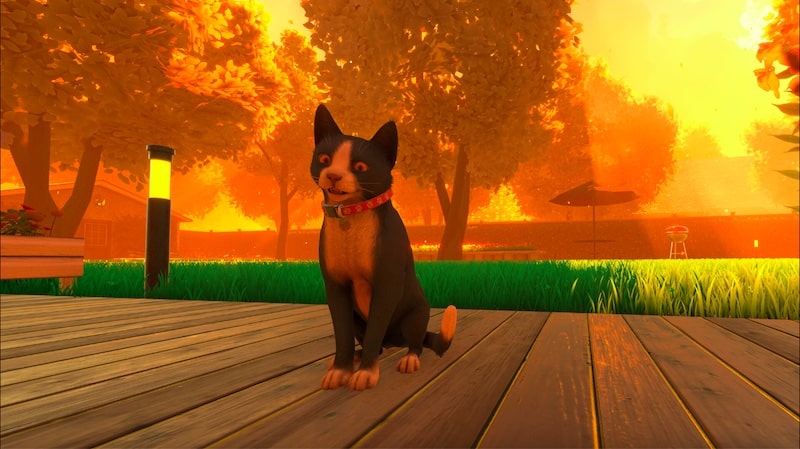
Copycat PS5 Review. Ever since Stray pussyfooted onto our console controllers and keyboards in 2022, more and more cat games have rubbed up against our legs while purring. Last year Little Kitty, Big City caused meowing mischief in a metropolis and now we have Copycat, a meaningful feline-centered endeavour developed by two people at Spoonful Of Wonder. Despite its best intentions and a relatable underlying message in relation to mental health and belonging, Copycat too often gets caught up in its own yarn ball and thus this short three-hours curiosity finds itself all tangled up and gagging on hairballs.
Copycat Review – A Feline Facsimile
The beginning sees you making one of the toughest choices you can have regarding a pet-choosing which cat you want to take home with you. There are six cat breeds with differing characteristics that you’ll be told about courtesy of the cattery staff member you’re accompanied by as you assess each of the cages.
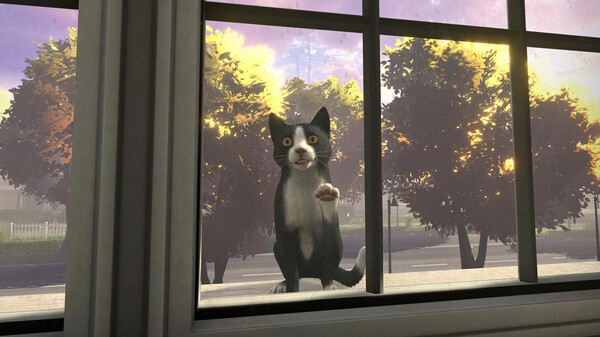
We chose the moggie cat, but there are five others with distinguishing features, so select one you find appealing and take the furry homewrecker home with you. Once you’ve signed a cat-keeping contract- or a catract if that works for you – then off you go to live in a new home.
After a brief car ride, where you’re bundled into a cage waiting to arrive to your new home, you timidly take your first paw-steps out of the cage and decide whether you want to approach your new human owner with kindness or with mal-intent.
You can bite or scratch your new owner Olive, but the poor woman has health issues, so it’s spiteful to be so vicious. Alternatively, you can approach and meow at Olive and she’ll give you some attention, and she might even play a game with you……actually it’s just one game that moves the story along, but still!
Numerous times throughout Copycat, you can choose whether you want to play nice or nasty, but unfortunately the game does a poor job of making sense out of all the choices you’re allowed to make and there’s no weight to any of the options.
How is it that Dawn (the name of the cat you play as) behaves so timidly at first, then becomes a mindless homewrecker, but ultimately acknowledges her love for Olive? It’d make sense if there was a story that allowed it all to weave together, but it’s a messy ride, just like all the mess Dawn causes with buckets of paint and shattered garden gnomes and milk bottles.
On a side note, it’s quite miraculous that Dawn is so easily forgiven for ruining Olive’s beautifully prepared dinner. How a cat can be forgiven so easily just for being a cat is admirable, but it’s a pity that Olive will need to buy another steak because steaks don’t come cheap unless they’re tough.
Pussyfooting For Prominence
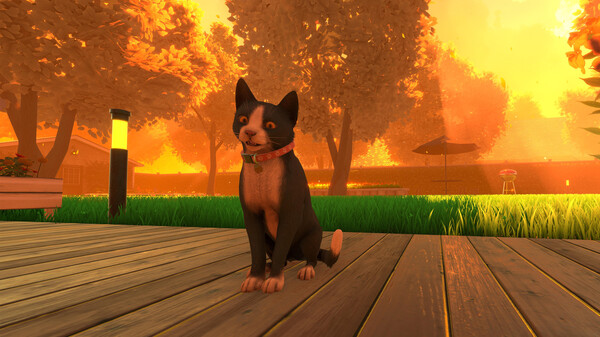
Dawn is a light-footed cat who can capably walk, sprint and climb wherever she may and it feels delicate to control her, which is lovely. You can meow at anything too, so that’ll help you converse with humans who won’t understand you, but ensures you are engaging with humans-after all isn’t it a cat’s job to comfort humans?
You start off in the linear home environment, pussyfooting where you please and cause mayhem where you may, but as the story progresses you’ll gain access to the back and front yards, and although these spaces are more freeing, they are still tight spaces.
At least on the outside you can play with balls, inspect bins and climb trees, but the only true distinction between the back and front yards is that you can patrol the street in latter, meaning you can meow to your neighbours who’ll respond, although unfortunately they’re too docile to open their doors, it’s like they’re agoraphobic or worried that Dawn will put a hex on them.
No matter where you roam in Copycat, the game puts you on a metaphoric leash. You can’t do much without being signposted, and the freedom you’re afforded outside of story beats are negligible by and large.
Cat-astrophic Cat-tivity
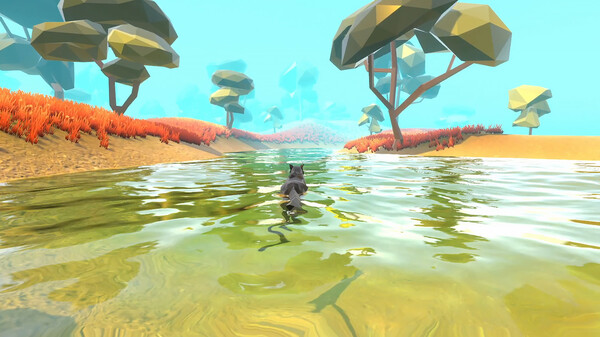
Interactions in Copycat are limiting to say the least. Climbing trees swoops you into a first-person viewpoint, but there’s no climbing of the tree because it’s just an automatic interaction. Similarly, climbing onto surfaces is rigid, sometimes including several button presses so you can knock objects over. There’s even a stealth section which is beyond basic, but it does go to show that the story is more of a concern in Copycat than the gameplay.
Sometimes Dawn can engage in minigames like when she plays with Olive, you’re encouraged to use the directional buttons so that she can catch whatever is being waved in front of her. This usually consists tapping right, left and up on the pad depending on where Olive waves the toy. It’s a mindless minigame that transitions into a little daydream-so that’s pleasant.
Another type of minigame has you hitting corresponding inputs and shifting directional inputs in a timed sequence. These sequences can be annoying as they can include both a shift of the left stick and directional buttons-which may cause you to become momentarily confused. This type of minigame shows up when Dawn has to put up her furry dukes against other cats, and sometimes several opposition at once. Dawn can be a surprisingly fierce kitty as it turns out, so she’s not just an adorably cute kitty-witty.
A few sections force Dawn to sprint and dodge oncoming obstacles. Again, there is no consequence for running into environmental objects, but these segments at least ramp up the drama and can give you the feeling there’s some excitement in this little cat’s life.
It’s important to note that none of the minigames can be failed, not even the timed minigames-which is a wonderful if unchallenging fission of accessibility. Not needing to worry about difficulty is definitely refreshing, but the minigames feel a little pointless without anything to engage players like high scores and suchlike.
Sometimes Dawn takes a catnap where she dreams she’s a big wildcat chasing rabbits and her dreams can be shaped by events in the story. These interactive scenes are an appreciable alternative to the heavy themes of the story, yet their potential is squandered by their brevity and they feel like a missed opportunity. Trying to find Olive’s car for example is just an exercise in the game telling you “this isn’t Olive’s car” and that leaves you mindlessly jaunting about as identical cars come into view. None of these cars have a license plate, but this is forgivable because cats don’t know how to read.
Catatonic Performance Woes
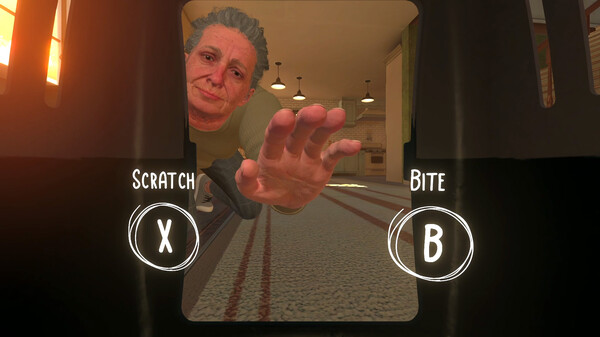
As an indie developed by two people, it’s not going to be surprising that the polish isn’t all up-together. Technical issues are apparent and the characters can look garish, especially Olive.
To Copycat’s credit, there is a good level of detail in the environments such as the cozy and comfortable home you’re situated in, and there is a clear sense of ambition that would’ve been better realized with greater backing. Dialogue is hammy and can become annoying, and cutscene direction can be weird too.
On the cutscene direction front, at one point Olive’s daughter is holding a pillow next to Olive lying in her bed, and it’s easy to assume that she was going to smother her with it-which is obviously not likely and was probably an unintentional moment, but it’s a fleeting example of the unfinished state Copycat is in. Also, the narrator might like to fancy himself as David Attenborough or a Discovery Channel wildlife observer, but you certainly wouldn’t want to qualify him as anything more than an unnecessary irritant.
For a three-hour adventure title, Copycat has something meaningful to say about mental health and relationships, yet it can be too often undercut by its rigid design, story happenings that don’t make sense, and the overarching feeling that with more time, polish and backing there’s an even greater game trying to burst out here. It’s a pleasant and fine game for how short it is in spite of its gratuitous repetition, and deserves kudos for being adequately designed by two people, it’s also in need of some significant refinement.
Copycat is out now on PS5, Xbox Series X/S, PS4, Xbox One, Nintendo Switch and PC.
Review code was kindly provided by the publisher.