So the thing about Defender of the Crown: The Legend Returns is that it absolutely, positively targets a very particular type of nostalgia which is entirely unique to those oldies who remember Defender of the Crown when it was released all the way back in 1986. Essentially a remake of the forty year old Cinemaware classic strategy game which also packs in the Amiga original and a new roguelike Kingdom mode, Defender of the Crown: The Legend Returns is a pretty well rounded offering for those aging fans (like myself) who have fond memories of Cinemaware’s inaugural title.
Defender Of The Crown: The Legend Returns PS5 Review
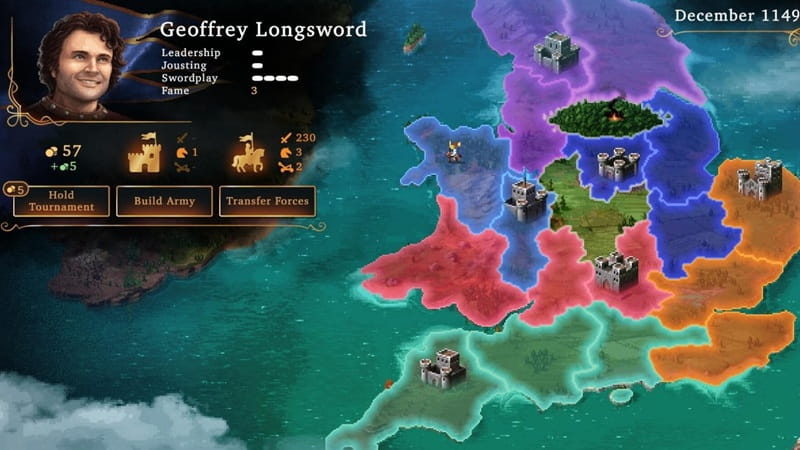
Defender of the Crown unfolds against the backdrop of 12th century England where after the king finds himself on the wrong end of an assassin’s blade, four different noblemen rise up and attempt to unify the country on their own. A strategy game at its core, the idea is that after choosing one of the four available Saxon noblemen that each have their own strengths and weaknesses in sword fighting, jousting and leadership (essentially the ability to amass troops and gold), off you pop to claim good ol’ England. This is done principally by taking over territories with your forces, using the vassals and money from those territories to build your army, and then taking over more territories until you can lay siege to the castles of your Norman enemies and win the sceptred isle for yourself.
From the get-go I would immediately recommend that both newcomers and veterans of Defender of the Crown play the remade classic mode instead of the Amiga emulated retro version for a number of reasons. The first is that this faithful remake of the core game actually comes with a fairly decent tutorial which shows you the ropes of both the overworld strategy and the various minigames you can take part in (more on those in a bit). To be clear, the original retro version of the game has not aged very well at all. With a range of haphazard mechanics, slow input response times across the entire game and pretty much no tutorial whatsoever, it remains more of a curiosity than anything else that only seasoned players should consider.
Another reason is that developer Black Tower Basement clearly poured a good amount of love and attention into bringing the aesthetics of Defender of the Crown up to date. As well as a fully animated and voiced introduction, everything has been given a contemporary lick of pixel-paint that is both easy on the eyes and gentle to the ears.
Starting with the overworld strategy side of things, it’s fairly basic stuff overall in that the more counties you take over, the more money you can amass which can then be used in turn to buy additional troops, more expensive knights and eventually catapults to be used in sieges on enemy keeps and castles. Though Defender of the Crown does ultimately reward aggressive players who chomp their way around the map, it’s also true that you should strike a balance with the number of troops you keep at your home garrison too, since if it is left undefended and is taken by the enemy, that’s a one way trip to the game over screen.
When you’re not taking turns and moving across the overworld map, consolidating your forces and marching into new counties in a quest for plunder and glory, you’ll be engaged in one of Defender of the Crown‘s quartet of very different minigames and its here that the game has always been somewhat hit and miss.
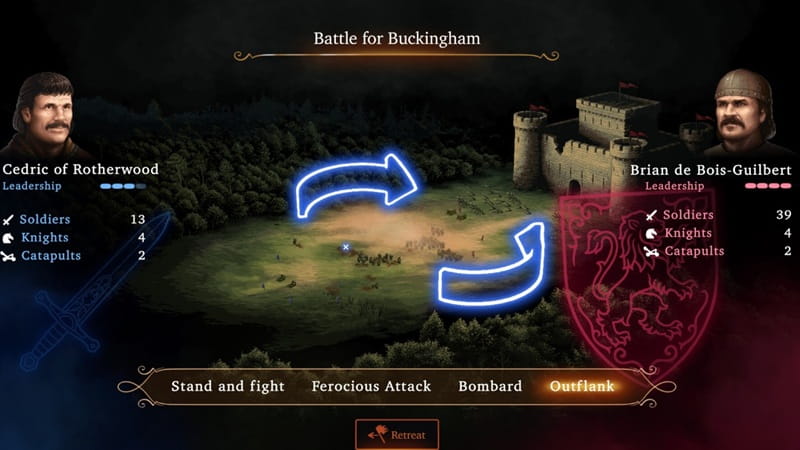
The first of these is that when you do happen to move into another county that has an enemy army sat on it, a battle is triggered whereupon a four different commands – stand and fight, ferocious attack, outflank and retreat can be used on a turn-by-turn basis depending on how the momentum of the battle shifts. Mainly, these battles are largely decided by who has the bigger army, but it’s also here that the leadership ability comes into play since a higher leadership allows you to power through to victory even if you have a slightly lesser force, while having a weaker leadership ability means you need to have a bigger force than usual in order to win. Again, it’s pretty straightforward stuff that won’t at all trouble the brains of contemporary tactical masters, but for fans of the game and tactical newcomers it works well enough.
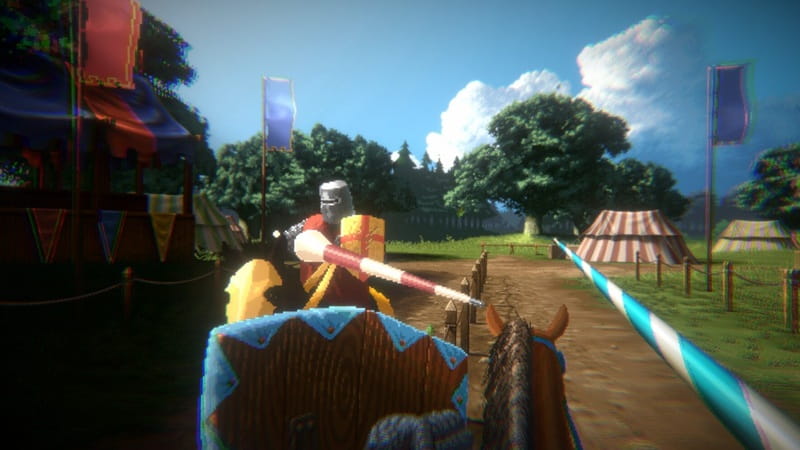
One way to raise your leadership rating luckily, is by arranging a good old fashioned jousting tournaments (though it costs precious gold to do so), where you choose the lord you wish to joust against and if you win, you proceed onto the next lord and on and on until you win the whole thing, taking home either land or fame (leadership) depending on whichever prize you chose at the start. Though like the rest of the package the jousting sequences look better than they ever have, the actual act of winning a joust can feel a little random as the objective is to land the tip of your lance in the middle of your opponent’s shield but the thing is, because you’re both coming at each with such speed that it can feel difficult to be sure how to land that hit effectively. Though on reflection, you could also argue that it feels that chaotic because that is conceivably how jousting a real-life would be.
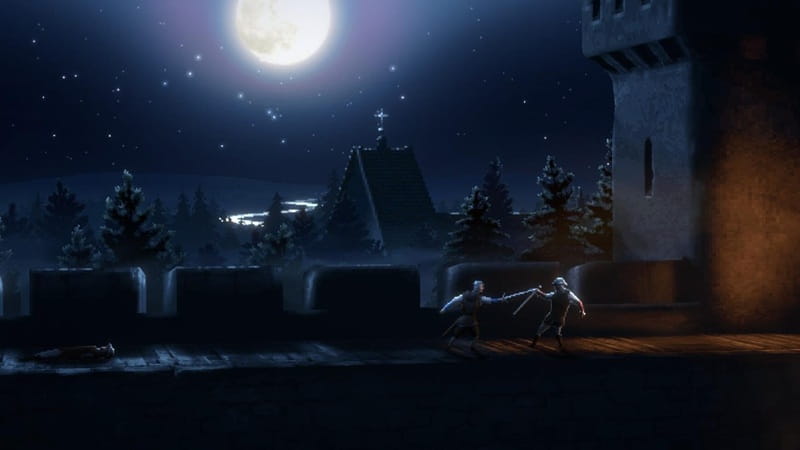
The next minigame are raids and these are extraordinarily basic side-scrolling affairs where you must defeat three or soldiers in a row in melee combat in order to win a horde of gold from an enemy lord. The problem with this minigame however, is that it was deathly dull in 1986 and is now deathly dull in 2026, albeit with some welcome quality of life improvements.
You see, the whole thing is terribly limited as your character can only plod (and that really is the operative word here) extremely slowly forwards or backwards and can attack, perform a charged stronger attack to break an enemy’s guard, block or parry incoming strikes. The problem is not only is the combat exceptionally sluggish and not satisfying at all to either block or land a strike, but the enemy AI is dumb to such a point that you can spam attacks at them and it won’t just damage them but also interrupt their own attacks as well, leading to an easy victory. Oh and the main quality of life improvement here is the addition of a healthy bar which is obviously useful in telling you how much health your adversary has left, rather than in the original game where there was no health bar and basically no feedback from your strikes whatsoever, so you never really knew if you were actually doing any damage or not. Terrible stuff.
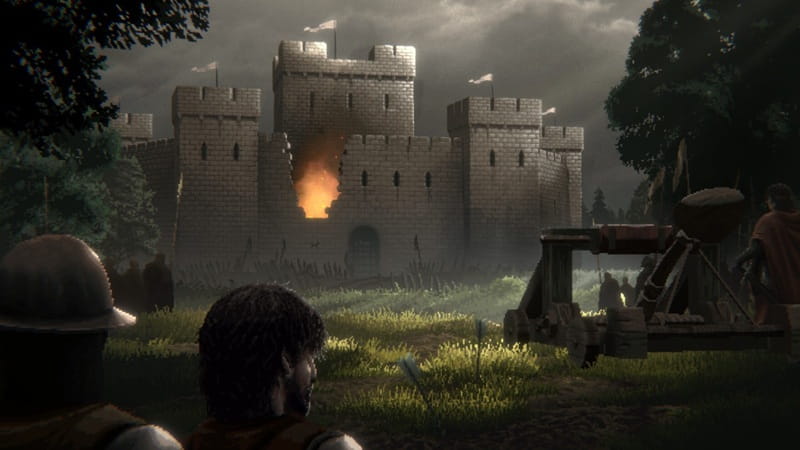
Somewhat better however, is the final minigame, sieges. Here the objective is to get your catapult to smash down the enemy walls with boulders, before you start loading up the various pots of hot oil and disease to fling over into the castle grounds to kill as many enemies as you can prior to a full assault. Again, a very simple affair, success is largely gauged by how accurately you can pull back on the catapult’s spring mechanism versus the height of the wall that you wish to hit. It’s something that takes practice but once you get it nailed, you’ll be a catapult savant in no time.
And really, that’s the thing about Defender of the Crown’s core experience overall. You can expect to fail often (especially if you’re new to the game), but every game that you play is generally wrapped up within twenty minutes or so if you’re successful, so having to restart from the beginning isn’t the chore it might initially seem. Indeed, the compact scope of its strategy and overworld turn-based nature almost makes it feel more like a board game than the sort of sprawling tactical efforts that we’re used to today.
Beyond its core experience, Defender of the Crown: The Legend Returns also offers up an all-new Kingdoms mode as well, where the main game is reimagined through the lens of a roguelite game design structure with procedurally generated maps, decks that can be built and where dice-rolls dictate the success of the various minigames. With an in-built persistent progression mechanic which unlocks new abilities and treasures the more you play, coupled with the aforementioned procedurally generated maps, Kingdoms mode offers a good way for players to get more from Defender of the Crown: The Legend Returns after they triumph over the core classic mode for the first time.
Defender of the Crown: The Legend Returns feels almost like a flawed acquaintance that I thought was long-lost and yet, after seeing them some four decades later, my concerns over its flaws and various issues melt away a little just because I’m happy to see that it’s still around all those years later. The power of nostalgia, eh?. Sure, it hasn’t aged terribly well and as an overall package it feels a touch lopsided with the Kingdom mode being something of a mixed bag, but the remade classic mode is where it’s at and for this greying reviewer with a bunch of increasingly creaky joints, it was a welcome jaunt to a strategy epic from an age gone by. Newcomers however may well struggle to grasp the idiosyncratic charms of its mini-games and compact strategy gameplay.
Defender of the Crown: The Legend Returns is out now on PS5.
Review code kindly provided by PR.