Gex Trilogy Review (PS5) – Arguments persist to this day as to who of the ‘90s mascot platformers had the most attitude – or ‘‘tude’ as it was not so affectionately known back then. There’s even some rather unhinged characters who suggest that the backwards cap and sunglasses-indoors look of Rascal is enough to take the crown, but we all know better than that.
Gex Trilogy Review (PS5) – Setting Gexpectations
Gex Is Dragged Kicking And Screaming Into The 21st Century
For our money, there is a lot to be said for Gex, particularly given just how distinctly of the time he feels, what with his quips, cultural or otherwise – a true product of its time if there ever was one. Coming at the tail end of the early-to-mid ‘90s period where it felt as if we were being inundated with also-ran platformers such as Bubsy and Ristar – the former of which who did not make the transition to 3D nearly as gracefully – the original outing of Gex does feel instep with games of the period, of which there was a real glut of as we transitioned to the fifth generation of consoles.
Being the de facto poster child of the 3DO certainly helped its cause in gaining traction, but it wasn’t until 1998’s Enter the Gecko that things really started to shift into gear. For this re-release, Limited Run Games is running the rule over the original trilogy, and similar to last year’s Tomba! Special Edition, it’s looking to preserve the sanctity of the original games via its patented Carbon engine with pinpoint accuracy and minimal changes to the core experiences.
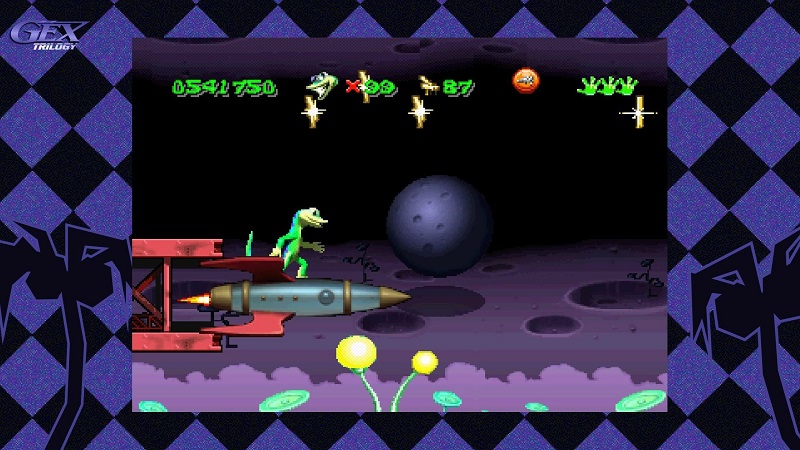
Outside of some quality of improvements such as resolution scaling, 16:9 support, proper analogue support and a rewind feature, these releases are as you remember them – warts and all – and ultimately come with the caveat that you’ll need to already harbour a fondness for the mouthy gecko to get the most out of them.
Particularly that of the original Gex, which is ostensibly a by the numbers side-scroller that doesn’t rock the boat in terms of the formula you would come to expect from similar platformers. That said, the game’s use of Gex’s gecko abilities gives rise to some interesting mechanics, such as attaching yourself to walls which in turn creates great verticality in later levels, though in doing so can expose the slight finicky nature of how the game controls.
It does attempt to keep things fresh, mind, with the likes of auto-scroll levels and a gentle ramping up of its difficulty. This easing may reach a point which sees you finding liberal use of the rewind feature present in this re-release, meaning you no longer have to face the reality of trial-and-error platforming which was a common occurrence in years gone by. Be sure to also use the newly implemented save system across all games, otherwise you might risk losing some progress.
That being said, though the vibes and quips keep things chugging along quite nicely, Gex’s maiden outing is somewhat rudimentary in its execution and isn’t without its frustrations. Despite 2D games typically aging better than their 3D counterparts, particularly during the advent of 3D gaming, this is one of the few examples to buck that assumption.
Gex does have the hallmarks of a team getting its feet underneath themselves, and though half-baked in some respects, it was clear that there were the bones of something here, something which bore its fruits in subsequent entry, Enter the Gecko.
Just as Mad Max 2 and Terminator 2: Judgment Day before it – franchises that the gecko would just as easily riff on – Gex 2 represents quite a substantial leap over its predecessor and it’s likely the incarnation of the character that everyone remembers most fondly. Though the same basic principals have made the jump across to three dimensions, Gex 2 is simply bigger, better, and more fully realized than that which came before.
Enter The Gecko Is The Star Of The Show
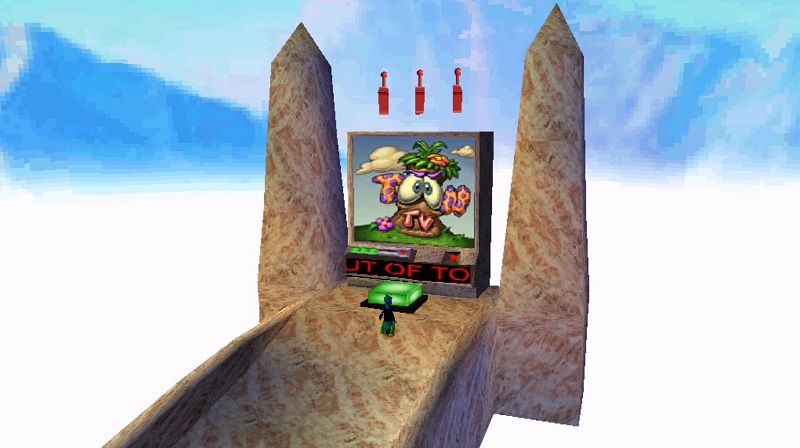
The themed levels, quips, television remotes for progression, and collectables all return, with the latter doing so in extended fashion which was en vogue at the time. Enter the Gecko has more tricks up its sleeve than perhaps it’s given credit for, what with its varied level design and relatively diverse mechanics when compared to some platformers of a similar time period. Upon starting each level you’ll be met with the conditions required to get each red remote control, which can range from fighting a boss, to tackling a particular path, or destroying a set number of special objects. There are also two silver remotes in each level, with one being hidden and the other found by collecting a set number of trinkets throughout.
Once you’ve found or satisfied the conditions for a red remote control and reached its location you’ll be booted out of the level and into the hub world, meaning there’s no way to collect multiple red remotes in a single run.
Though a little jarring to begin with given modern standards, it makes sense even just as a way of seeing every inch of what can oftentimes be quite sprawling affairs. Quality of life be damned, you’ll going to listen to every single quip that Gex utters. Better still, there is a gated progression system attached to the red remotes specifically, so it’s within your interest to make a habit of replaying each level several times and getting the lie of the land before moving on.
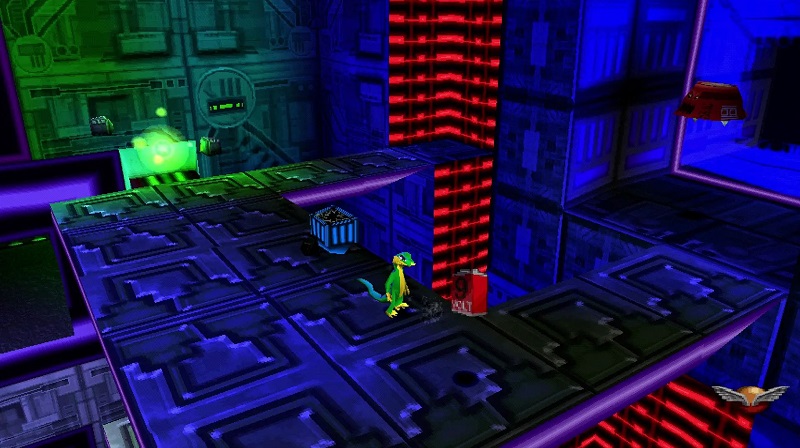
There is a real possibility of this gameplay loop coming across as plodding if it wasn’t for what is a notable amount of variety found in each level. You’ll be firing canons, navigating maze-like structures, and contending with gravity-shifting walls, to name just some. Later levels in the media dimension introduce space, alongside oxygen limits, light bullet hell elements, and the odd jibe at Star Wars. Because of course.
That’s not to mention the bonus levels unlocked via silver remote, where as an example, you’re dressed as a raider of tombs while a – definitely legally distinct – rendition of the Indiana Jones theme song plays as you try and hoover up collectables in limited time. A slightly unwieldy camera aside doesn’t detract from what is a notable step up in gameplay and design terms. And in similar fashion to the first outing, Limited Run Games has managed to maintain the game’s essence while at the same time including a much-needed bump in resolution and analogue controls.
The Cultural Riffs Never Let Up
As with each of these games, however, it’s worth mentioning that your mileage will ultimately vary. Indeed, just like the recent Croc re-release, if you have a penchant for mascot platformers – and frankly, everyone should – you’ll be right at home here, otherwise it’s tough to see how any amount of paint can change someone’s view of what was a formative time for platformers on PlayStation.
Parking the Carbon Engine touch to one side for a moment, what’s perhaps interesting is the development time between all three games in the original trilogy, with the gap between the original Gex and Enter the Gecko being three times longer than that of second and third entry.
As a result, the third game Deep Cover Gecko is a far more iterative affair that lacks that initial surprise which came from the leap in quality between the first and its sequel. That being said, having the bones of something as solid as Enter the Gecko serves the third game well, and it does add some elements, such as more mini games, to spruce things up.
The sprawling objective-based structure is still alive and well, with some key changes to the collectibles, such as the ability to find Paw Coins dotted around both the hub world and levels therein which provide an additional health point once you collect 25 of them. Boss Keys are introduced which perform the same function as the gated progression we’ve come to know, with Bonus Coins being introduced as well, which work ostensibly like the silver remotes in Enter the Gecko.
Deep Cover Gecko Is An Iterative Affair
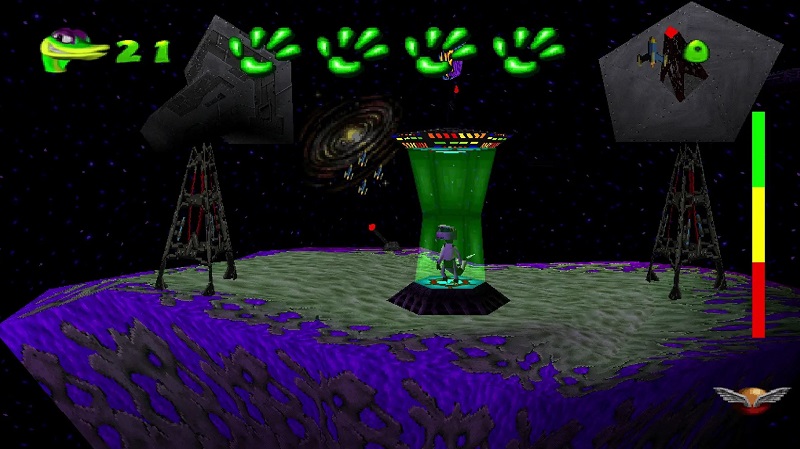
Though the bonus levels can come off as a little redundant before long, they do lead to something interesting. Once you’ve completed each and gotten all the accompanying vault keys, you’ll unlock the Gex Vault, where you can input a number of cheat codes for the likes of invincibility and a movie reviewer. As an aside, a neat feature which also happens to be across both the second and third games is the ability to select one of level’s objectives prior to entering and be shown a short clip which gives a nod to where to look for it.
While it’s true that Gex 3: Deep Cover Gecko perhaps lacks the cohesion of its predecessor in terms of overall level design, it’s still a more than serviceable entry in the franchise and it benefits no end from the blueprint set out by Enter the Gecko.
One omission, particularly for Europeans, is an option to toggle Gex’s voice between Dana Gould and Leslie Phillips, who voiced the intrepid gecko for the second game in PAL regions. That aside, as with collections of similar ilk, Limited Run Games has included several extras to round out the package, that being an interview with the aforementioned Dana Gould, a soundtrack player, prototype footage, and artwork amongst others.
While some may be searching for something a little more wholesale – something akin to a remake or remaster – what Limited Run Ganes has instead opted for is a set of faithful, accurate ports with enough love and care put into them that make this re-release an easy recommendation for those pining to hear an outdated quip or two from a forgotten mainstay of the mascot era on modern consoles.
Gex Trilogy is out now on PS5 and PS4.
Review code kindly provided by publisher.