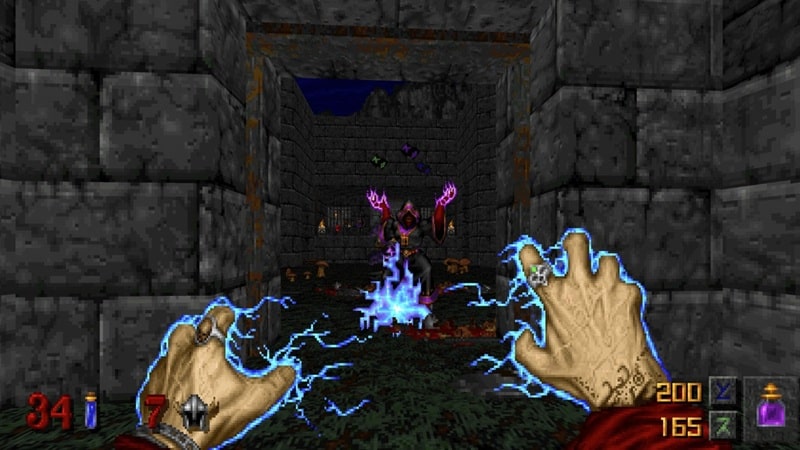
It has been a long standing injustice that DOOM has quite literally been ported to just about everything (including a range of kitchen appliances), but Heretic and Hexen, which arguably are the two of the most accomplished successors to DOOM made in that era, have been given tragically short thrift in this regard, with PlayStation gamers last getting a taste of Hexen back on the PS1 nearly thirty(!) years ago. That is, until earlier this month.
Heretic + Hexen PS5 Review
Nightdive Gives A Pair Of Forgotten Genre Classics The A-List Treatment
For those unacquainted with the myriad charms of Heretic and Hexen, it’ll probably do to just say that both games are essentially dark fantasy versions of DOOM and leave it at that. Except it won’t, not entirely and especially in the case of Hexen. Sure enough, while the touchstones of id Software’s genre defining opus are there in Heretic – the colour-coded doors which can only be opened with similarly coded keys, the same environmental design language where different lighting betrays secret areas and even some weapons that feel extremely similar (the Gauntlets of the Necromancer feel extremely similar to DOOM’s chainsaw, thanks to its high melee damage and momentary stunlock spam, for example), all of it evokes id Software’s legendary demon splattering shooter on some level. It’s where Heretic and Hexen diverge from DOOM that eyebrows commence their arching, however.
Obviously the first difference which will strike you like a thrown axe to the mush is the setting. Jettisoning the regulation grey of the various sci-fi coded bases and power plants that you might find in the earlier episodes of DOOM, both Heretic and Hexen lean deeply into dark fantasy with a nice crunchy gothic shell and gothic filling, providing players with all manner of catacombs, defiled churches and abandoned keeps to romp around in.
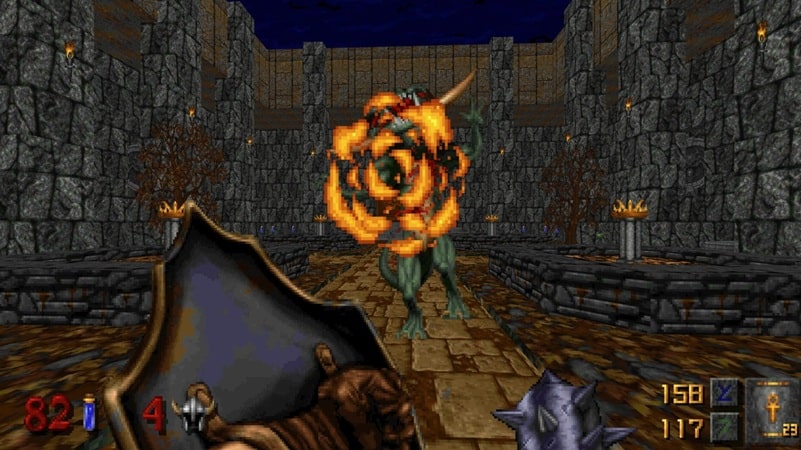
The next is that both Heretic and Hexen permit vertical aiming, allowing you to actually point your projectile spitter at your foe and see the trajectory of your shots, rather than just aiming at the same level in the DOOM games and hoping that the game picks up you’re aiming at a higher positioned enemy, rather than a lower one. It’s a small thing in the grand scheme of, well, things certainly, but it is somewhat illustrative of the iterative steps the still nascent FPS genre was taking in the wake of DOOM’s debut just a few years earlier.
Another new feature that both Heretic and Hexen brought to the dance was the idea of having an inventory that was used for holding more than just keys and ammo. In both games, you could collect and store all manner of single use items that could do everything from temporarily boost your damage, to healing chunks of your health to providing you with outright invulnerability for a short period of time.
Further Reading – Upcoming PS5 Games 2025 – The Best PS5 Games Coming Soon
Hexen takes that feature a step further too, by not only having certain items only available to certain characters (more on that in a bit), but also making the effects of those items vary from character to character, too. For instance, while the glugging down a Quartz Flask gives everybody a nice dollop of HP back, using the Flechette differs depending on who is using it, with one character dropping a cloud of deadly poison and another using it as a timed poison trap. That said, it’s also worth noting that Heretic has a particularly special item that Hexen doesn’t have – the mysterious Torpol’s Morph Ovum which blasts eggs in all directions, turning all but the strongest foes into clucking chickens for over a half a minute at a time. KFC’s current marketing department would be proud methinks.
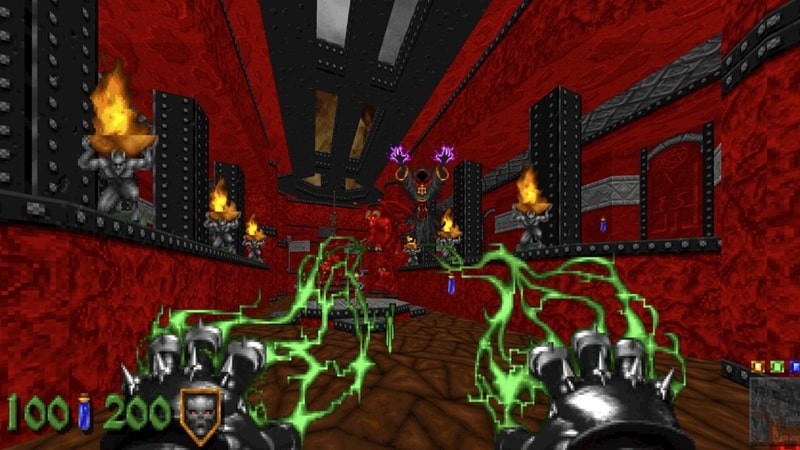
Though Heretic is similar to DOOM with its single protagonist, a havoc-wreaking Elf known as Corvus who also is very much an adherent to the same ‘I am the bullet hell’ philosophy as the more famous Doomguy, Hexen separates itself further from both games. By offering up a trio of very different characters to choose from in Baratus, a tank style, smashmouth melee warrior, Daedolon, an extremely powerful long-range damage focused mage with a small HP pool and finally Parias, a balance of the previous the two with other support abilities thrown in for kicks, Hexen offered up the sort of variety that just hadn’t been glimpsed in the FPS genre at that point and still feels refreshing today.
And each of Hexen’s characters were much more layered in their differences than those initial descriptions suggest, too. You see, not only do they have separate strengths and weaknesses, but they also have entirely unique weapons and special skills too, lending each the sort of uniqueness which practically demands a whole lot of repeat play.
One of the biggest ways that Hexen pulls away from not just DOOM, but also Heretic before it, is in its level design. Eschewing the very linear level design and progression structures of those two titles, Hexen instead favours a hub-based design blueprint where you cut between interconnected maps, solving puzzles and unlocking new areas that were previously inaccessible. Hexen does have a dash of the Metroidvania running through its veins, you could say. Certainly then, taken together with the multiple characters, Hexen’s branching hub system was clearly designed to make Hexen feel much more like a first-person action RPG, rather than the decidedly more straight-laced shooters that had come before it which was not a bad thing at all, except for one thing – the puzzles.
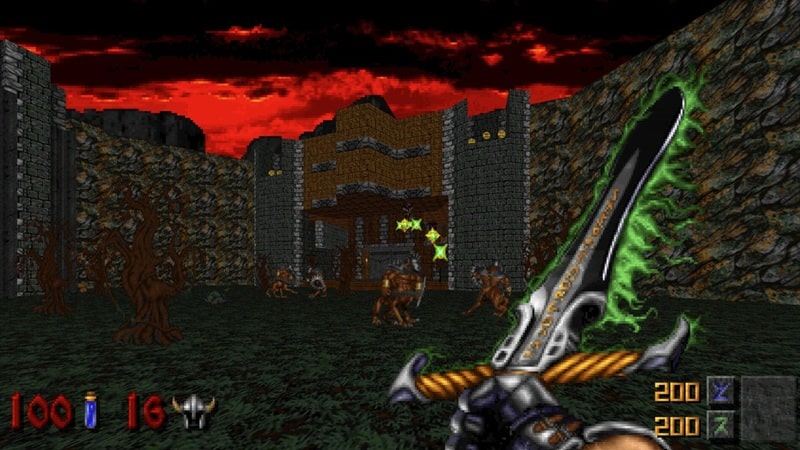
Oh yes, the puzzles. Hexen has puzzles. Taking full advantage of its interconnected map layout, Hexen constantly sprinkles switches in one map that will unlock areas and rooms in another. The problem is, or was, that back in the day of Hexen’s original release, you had absolutely *zero* navigation as to what or where these switches unlocked other than some cryptic text to tip you off, resulting in hours and I mean *hours* of finger-chewing, pad-squeezing, blood pressure spiking backtracking which threatened to derail Hexen entirely (and did for many of the reviewers back in those halcyon days).
With its 2025 re-release however, Nightdive Studios has utterly addressed this most distressing of flaws by not only implementing a handy waypoint system which points you in the direction of where you need to go next, but also new map markers which highlight points of interest as well. There is also a ‘less abstract mode’ which maintains much of the challenge of the original puzzles, but makes the cryptic hints much less so, making you feel appropriately accomplished in the process as you solve each conundrum.
Nightdive has also provided a number of tweakable settings too, which not only improve the efficacy of your arsenal of weapons, but also lower the resilience of your foes as well, making both Heretic and Hexen (especially Hexen), feel much fairer than before. Overall the work that has been put in here now means that both games in this collection play demonstrably better than they originally did – showcasing a remarkable sensitivity on Nightdive’s part to contemporary expectations.
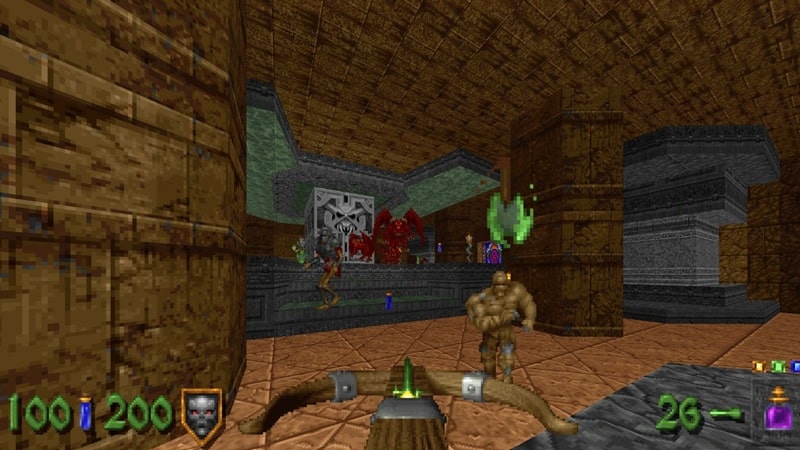
On a base level, both Heretic and Hexen are just tremendously fun to play if you have even the slightest affection for the FPS genre, thanks to their tight level design, challenging cadre of monsters (though the harder ‘ghost’ versions of the various monsters which appear later in Heretic can hop into the sea) and overall frenetic shooter/hack and slash gameplay. Heretic and particularly Hexen isn’t DOOM then, and for that both titles deserve a whole heap of credit having followed directly in the slipstream of id Software’s genre defining effort.
Naturally this being a Nightdive joint, Heretic and Hexen enjoy all of the very modern bells and whistles that the studio often lavishes upon such classics. Chief among these is a generous dollop of visual polish which brings all the expected improvements that Nightdive often implements for games of this vintage, meaning that by ticking along at a razor sharp 4K resolution and a whippy 120 frames per second, Heretic and Hexen have never looked better on console, all the while the base visuals remain intact.
Likewise, the soundtracks which accompany both Heretic and Hexen have also had something of a makeover of their own. Composed by Andrew Hulshult (the artist who also worked on the updated soundtracks for Nightdive’s DOOM I & II re-release last year), I actually really enjoy the refreshed musical score for both games, as they’re much more layered and epic than the original music, contributing to the violent spectacle of the on-screen action that much more as a result. Of course if the remixed choons aren’t to the particular liking of your ear holes, you can switch them back to the originals.
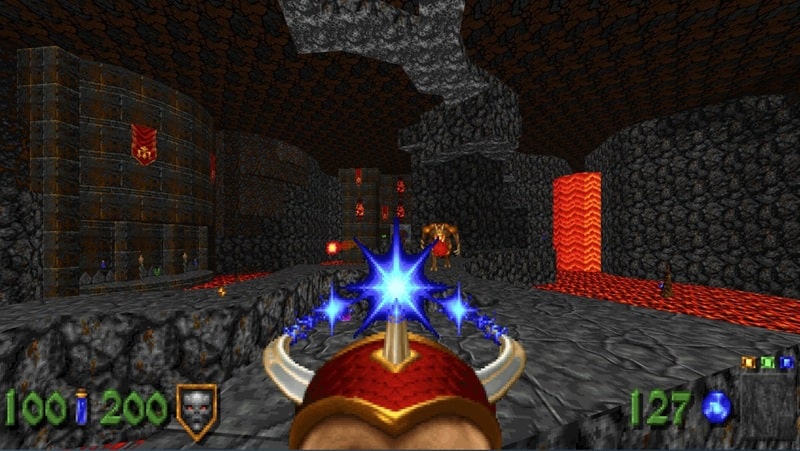
And then finally there’s just the sheer amount of content on offer in this package. Not only do you get both base games for Heretic and Hexen, but you also receive all of the officially released expansions for both games *and* a brand new chapter for each game developed by Nightdive Studios itself. Throw in over 120 deathmatch maps for up to 16 players and more than 110 campaign maps total – all of which can be played in 8(!) player split-screen or up to 16 players online and it’s clear that Nightdive Studios is absolutely giving you a whole heap of bang for your buck.
There is one problem with the co-op side of things, however. Rather than allowing players to embark on a persistent campaign of sorts which keeps your gear and allows you to tackle each level in both Heretic and Hexen in order with save states, puzzlingly, you cannot do any of this in the co-op multiplayer portion of these games. So this means that you need to literally load up the next map each time you return to it with your buds, with just your starting gear and none of the stuff that you would normally have had by progressing through these levels in single-player. Now, in Heretic while this is frustrating it is easier to overcome – but in Hexen, where the difficulty level is noticeably higher, this can be hugely frustrating to say the least. Here’s hoping a semi-urgent update can smooth this out, because otherwise co-op in these classic titles with your friends is a blast.
Thanks to Nightdive Studios, that ultra reliable bastion of remastering excellence, Heretic and Hexen have never, ever looked this good or played this well on console. Certainly then, Heretic + Hexen might just be Nightdive’s best remastering gig yet and that really is saying something when you consider the heady calibre of their output to date. They don’t make em’ like they used to – luckily, we have Nightdive Studios to make sure that they do.
Heretic + Hexen is out now on PS4 and PS5.
Review code kindly provided by PR.