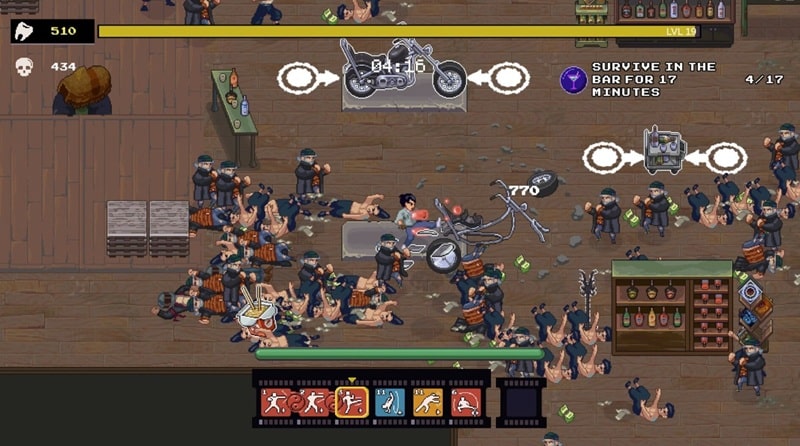
Another day, another Survivors-like, you might be thinking – but hold that thought for a second because the more than aptly named Karate Survivor does something a little different with a formula that is becoming increasingly shopworn and dare I say, stale. The clue is absolutely in the title. Karate Survivor is a Survivors-like effort that has karate in it. Lots and lots of karate. And so, the maxim of something doing exactly what it says on the tin, most certainly applies here. As ever, the diablo is in the details and Karate Survivor, though ultimately a fairly modest project relatively speaking, arguably does enough differently and executed equally well for the most part, that it demands your attention, Survivors-like fatigue be damned.
Karate Survivor PS5 Review
A Crunchy, Face-Smashing Take On The Survivors Formula
Essentially channeling the spirit of scrappy-trashy martial arts flicks from the 1980s and early 1990s, Karate Survivor has you throwing hands, feet, buckets, footballs and whatever else you can get your hands on in the nearby environment to smite waves of incoming foes. Much like other entries in the genre, Karate Survivor is similarly paced, with a trickle of easily dispatched enemies giving way to a veritable raging tsunami of much more hardened foes, requiring you to make the most of the space available to you all the while dealing as much damage as possible to simultaneously thin the crowd and upgrade your controllable bruiser.
Unlike the likes of Vampire Survivors and Soulstone Survivors however, the permanent upgrades that you’ll get for fulfilling certain milestones, such as killing 25 enemies for example, will dish out new abilities to interact with the environment around you. Early on for instance, you gain the ability to kick trollies, signs and other such objects littering around the environment into your enemies. A little bit later on meanwhile, you’ll unlock new abilities which allow you to roll over obstacles to safety and use flagpoles to leap into otherwise inaccessible rooms filled with fight-enhancing goodies.
Still in the realm of permanent upgrades, teeth are the longer term currency that can be used to purchase upgrades at the end of session. Again, this will prove familiar to fans of Vampire Survivors and its ilk, as the permanent upgrades that Karate Survivor can bestow upon players with the sufficient number of chompers include everything from improved attack power, speed, loot magnetism and so on. It’s fairly standard stuff for the genre certainly, but it still nonetheless works to compel you to keep on playing and come back stronger with each playthrough.
Further Reading – Upcoming PS5 Games 2025 – The Best PS5 Games Coming Soon
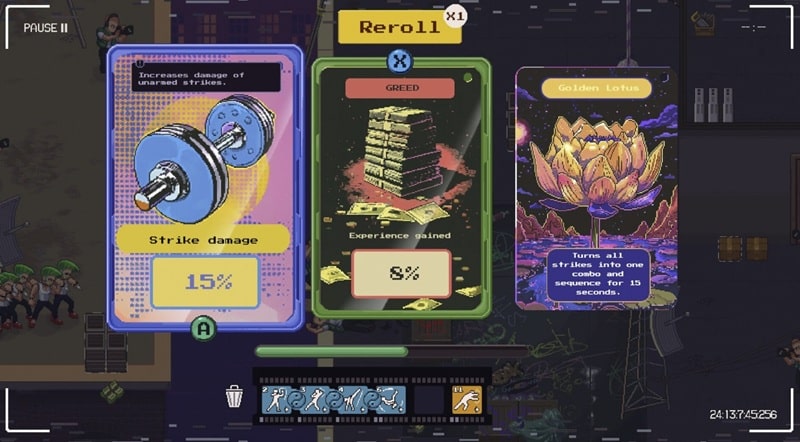
Where Karate Survivor looks to change things up a bit, is actually in the non-permanent upgrades that you’ll scoop up during each playthrough. Like other Survivors titles, you auto attack on a cooldown timer and when you level up by collecting enough XP (stacks of cash in this case) you get to choose from buffs and new moves to use in combat. Though the buffs work pretty much as you might expect (improved XP collection distance, improved attack power, better blocking and so on), it’s really in the new moves that Karate Survivor feels like developer Alawar is trying to do something different here.
Each of these new moves boast not only their own stats and perks as well, but are also colour coded for reasons I’ll shortly explain. Rather than just acquiring a seemingly endless pool of additional attacks as is typically the case in other Survivors titles, Karate Survivor permits that only six attacks can be active at any single time, with each attack being automatically played out in the order that you put them in from left to right.

Where the hue of these move cards comes into the equation is in how you can bolster your total attack damage by creating combinations of moves by placing move cards of the same colour next to each other. The problem with the system however, is that because the stackable combo bonuses are so substantial, there is no real incentive to vary your build too much beyond the moves inherent to your chosen colour. The most deadly of these are the extremely powerful yellow cards which dish out singular attacks of tremendous face-wrecking potential, though obviously they are a little more rare than the other move cards you’ll come across. Elsewhere, all manner of weapons can be picked up and used, causing increased damage (with firearms at the apex), but also have a finite amount of durability and so must be employed sparingly.
Taken in tandem with the colour card move systems and the ability to kick environment objects into your aggressors, the combat system in Karate Survivor has quite a satisfying flow – and one which arguably sits at the centre of its moment to moment gameplay loop. Beyond just smacking up legions of goons and then laying waste to a final boss, Karate Survivor also provides additional side objectives to get stuck into as well, such as chasing down a certain character, defending a particular area for a span of time and things of that nature. Again, none of this is particularly groundbreaking in any way, but it does help to supplement the moment-to-moment gameplay of the core formula well enough.
One area that I typically find Survivors-like games lacking is in the impact stakes – attacks on enemies tend to just phase through them with no real feedback other than numbers popping up above their head, or some other rote visual indicator. Karate Survivor duly addresses this with bone crunching sound effects for every strike landed and neat death animations for every foe laid low by your martial arts prowess. Whether you’re doing a somersault kick off of a wall, spinning around with fists flying in a spinning chair or rolling over a table into flying kick, Karate Survivor offers up no shortage of ways for the player to put the opposition six-feet under.
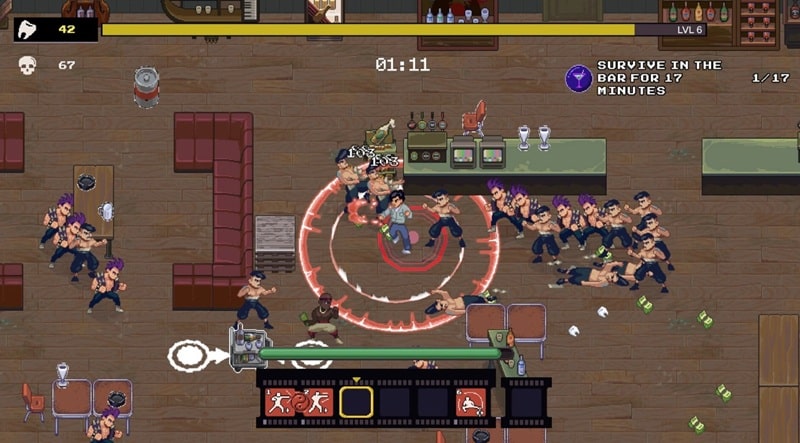
There is a pleasing amount of environmental destruction too with fools getting kicked through pyramids of tinned foods, slammed into cement mixers, knocked into shelves causing their contents to spill onto the floor and much more besides. Though such spectacle might seem muted and unambitious when viewed outside of the confines of the Survivors-like genre, it works here because it makes the cheesy 1980s/1990s martial arts movie aesthetic ring true and arguably makes the player feel that they have more of an impact on the game world than they would in other similar offerings.
If Karate Survivor can be accused of any single real major flaw or failing, it would simply be that there isn’t a whole lot of content here. With just five, fairly formulaic maps that run the trope-filled gamut of what you might expect – a supermarket, bar, rooftop, construction site and subway are all accounted for here, it’s just something of a shame that Karate Survivor’s more novel concepts aren’t given more room to breathe.
Purely operating on a bang-for-buck ratio, Karate Survivor figuratively karate punches far above its weight, that much is for sure. For around five bucks, you’re getting a modestly made, though ultimately enjoyable take on the increasingly worn Survivors-like formula that satisfies with its bone-crunching action that riffs on the trashy martial arts cinema of the 1980s and 1990s. Just don’t expect to be so reliably entertained in the longer term, as Karate Survivor’s staying power leaves something to be desired.
Karate Survivor is out now on PS4 and PS5.
Review code provided by PR.