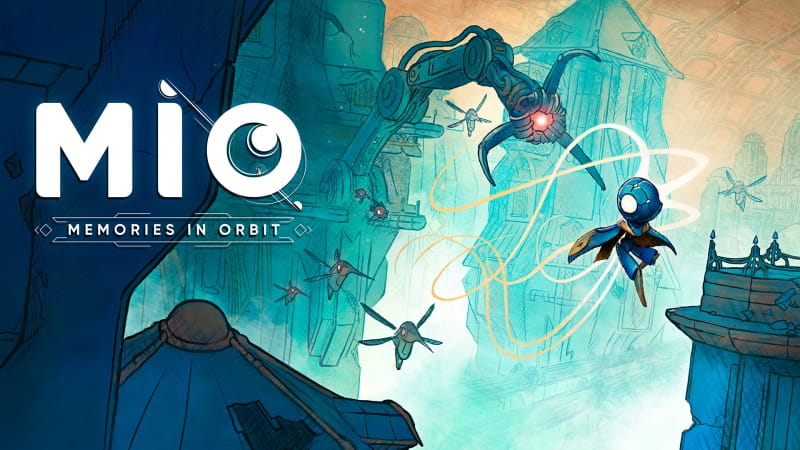
MIO: Memories In Orbit PS5 Review. There’s a gentle confidence to MIO: Memories In Orbit that is understated, yet still present as the game steadily unravels itself. While it certainly invokes other games in the prominent Metroidvania space (with one particularly apparent inspiration), that doesn’t mean that MIO doesn’t soar in its own ways. Uniquely stylish, smartly composed and crafted to be a dense yet approachable Metroidvania, MIO is far more than the sum of its inspirations, even if some of those ideas can bristle at points.
MIO: Memories In Orbit Review (PS5) – Far More Than The Sum
Carving Its Own Path
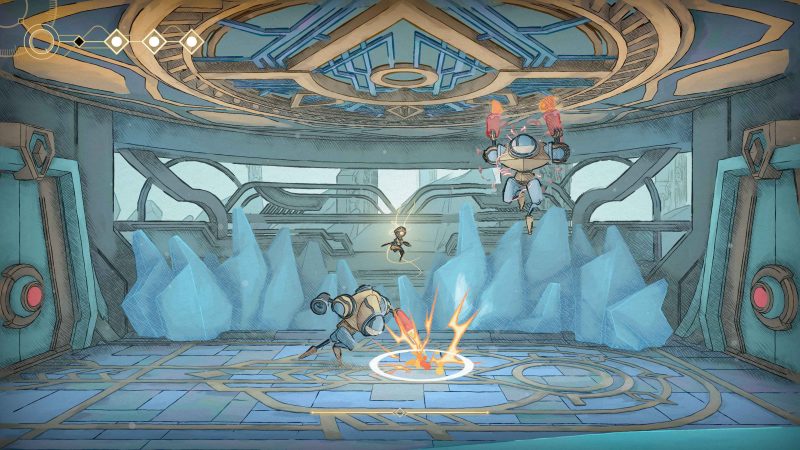
After having cut my teeth on Metroidvanias relatively recently, I thought I was prepared for what MIO might be putting on the table when compared to its contemporaries. An abandoned world that had been shaped by the passage of time, quiet environments that invite exploration, and a mild focus on combat. And while that was true, to some extent, I found that MIO: Memories In Orbit had far more that it wanted to do, and I appreciated just how far it pushes itself beyond its inspirations.
Beneath the surface level narrative of exploring an abandoned sci-fi metropolis and discovering what might have possibly happened, is the narrative of reclaiming memories. The game opens with a striking 2D platforming section with wireframe models and dialogue being imprinted on the background; this is a recurring image and steadily unfurls a story that is far more intimate than I was originally expecting.
This bleeds into the general feeling of the world itself, with a world that is ostensibly ‘ruined’ but still offers a strong sense of life and place.
Exploring the World
After a brief introduction, you’re sent into the world to try and discover what’s going on. Initially, you’re sent out with close to nothing other than a simple three-string combo and a double jump. You won’t unlock a proper map for a good while, but this speaks to the type of Metroidvania that MIO is trying to be.
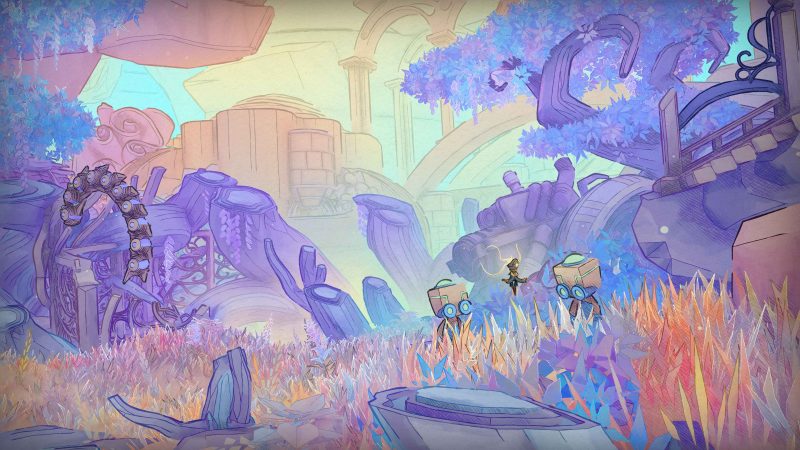
The world-design of MIO has stuck with me for the duration of this review period, and that largely comes down to how each area is situated within the greater world. Every obstacle and every locale is contextualised within the narrative, which leads to a greater sense of immersion and care as I explore. The very first area of the game is the abandoned residences of people who lived there before the blackout.
Where rogue robots now ravage the world, you can find remnants of a society that was very clearly active and thriving. Each secret you come across feels like a result of natural decay, which then lends a very natural cadence to exploration as a whole. Even if you go off the beaten bath, you might wander through a severed vent to find yourself in a secret compartment in another room. While I still found myself getting lost, this was always with the caveat that I was exploring a world that felt lived in, which carries weight when having to spend time retreading.
When it comes to surviving in that world, MIO employs a unique system that took some getting used to. On death, all of your standard currency is lost automatically, and given up. This initially came across as a pretty harsh punishment for failure, but that currency is luckily funnelled into useful upgrades, even if you don’t know it at the time. But for saving up for other accessories and weapons, you can find particular spots throughout areas where you can ‘solidify’ your Nacre into something that will persist after death. This means that you can save without worry, while still having the risk of death hanging over you.
Healing works in a similar way, relying on bespoke healing spots throughout the map that each cost a small amount of nacre to restore one unit. These were never too far spread out, and cleverly signposted through wires in the environment, but this was once again something I had to adjust to in order to succeed.
Float Like a Butterfly
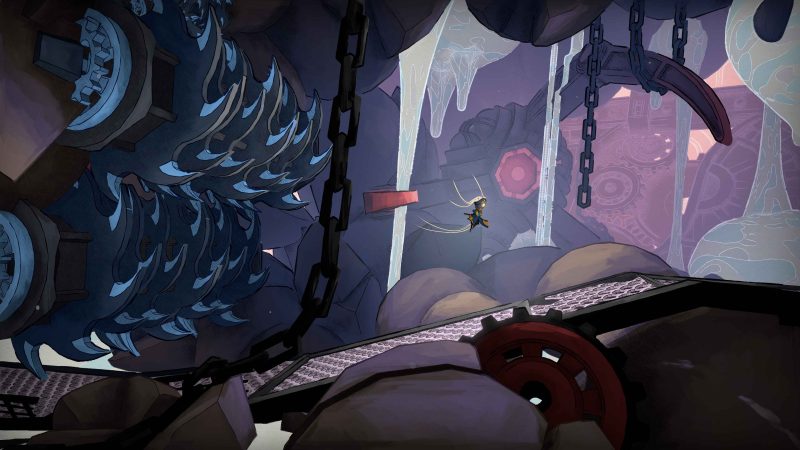
Mio is a floaty character by design. You start the game with a double jump and your arsenal only expands from there. This has an impact on exploration, as well as combat. From an early stage, moving around the game felt like far more than just jumping; your base toolkit is plenty versatile and offers a variety of creative ways to get around obstacles.
Learning that I was able to refresh my double jump by attacking certain targets midjump, as well as using momentum on ice slides, made me feel like there was a lot of potential for expression and finding my own solution to a problem that could be resolved another way. Each traversal ability you get similarly feeds into this sense of flow. None of them break the pace and all of them feel naturally weaved into Mio’s movement.
It took some getting used to; coming off the back of metroidvanias that pushed me to the proverbial limit when it comes to executing, MIO feels a lot less focused on razor-edge execution checks, and more general pattern recognition when it comes to combat. Each boss that I fought had very clearly telegraphed attacks that reward players for playing patiently and within their lane, rather than pushing beyond those limits.
I found the floatiness to be a bit odd, but I did end up getting used to it come the latter parts of the game. It works great for exploration, less so in a break-neck combat encounter. It’s just as well that plenty of platforming comes into combat.
Tailor Your Experience
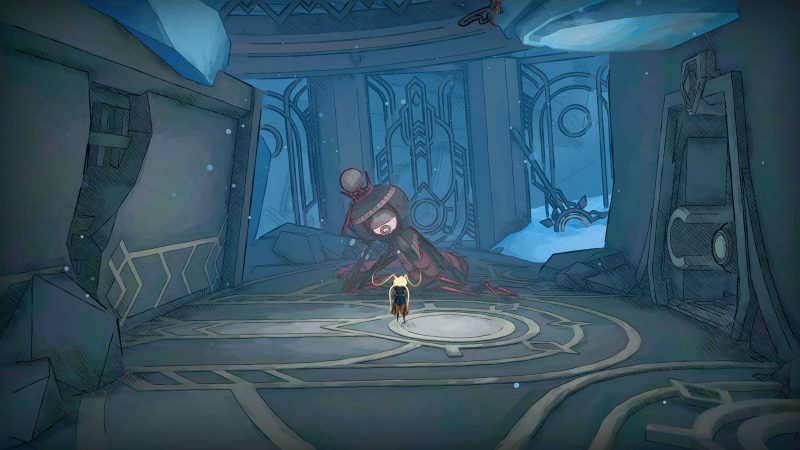
Difficulty in MIO: Memories In Orbit is modular, and can be actively adjusted depending on what you might want to prioritise. This comes in the form of modules that you can install in order to prioritise certain aspects. Where one might give you additional attack power, another might reduce the amount of currency that you need to spend in order to restore health at Nacre pools.
The only limit to this customisation is the overall amount of slots that you take up, with certain more impactful modules taking up more space. If you’re familiar with Hollow Knight’s notch system, this is essentially the same, and remains as compelling. You’ll be making choices about what you want to keep, and what you feel like you can sacrifice. This comes all the way down to adjusting what UI elements you might want to see, with the option to refrain from seeing your own and enemy’s health in favour of just a few spare points of a health upgrade. If you can keep count of your own health, you might be able to squeeze a few extra points out for another helpful upgrade.
You’re never punished for experimentation; most bosses in MIO can be beaten with your base kit, without the need to grind and level-up stats. Your own journey through the game will be defined by the kit that you settle on, with no answer being the wrong answer as you explore. Every ability that you do need is given to you without any caveats, so you’re left to tinker with the smaller – yet no less important – modules.
It’s a clever way to weave narrative and gameplay into a cohesive whole, which was already being done with the world design and way that you interact with it. You slowly deposit currency into the central nexus before you’re given a standard map to use, and then you feel the impact of that achievement both in narrative and gameplay.
MIO: Memories In Orbit is a game all about small steps and taking your time, and embracing the punishment of the early game to reap the benefits of later. I initially felt that the opening – with an incredibly punishing three health points – might be a bit too much to stomach, but that slowly stopped being a concern as I started taking my time and weighing up what I can and can’t do.
Bringing It All Together
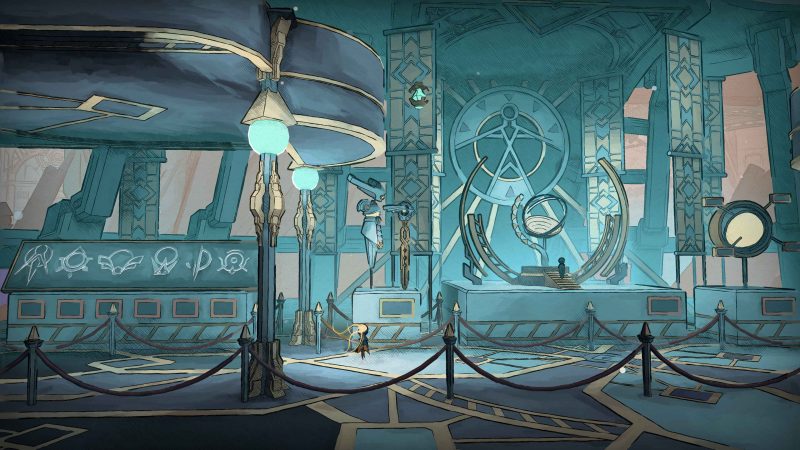
MIO: Memories In Orbit feels like an intricate tapestry that deserves the closest of examinations if you’re going to dive into its world. While the setup itself is a familiar one, the way that it’s presented is doubtlessly one of the most visually striking styles I’ve seen in recent memory.
Despite being a strictly 2D game, there is life pouring out of every background detail. Every room feels purposeful and part of a larger whole, nothing feels wasted or forgotten in the post-disaster world of the Vessel. Every character is bursting with life, with small stories everywhere to find.
While combat might not necessarily be my cup of tea in the moment, it has a purposeful feel that is consistent with the rest of the game. It wasn’t an afterthought, it’s been carefully pruned to be a specific way.
There is a flow at the heart of MIO: Memories In Orbit that speaks to the sheer quality of what it does.