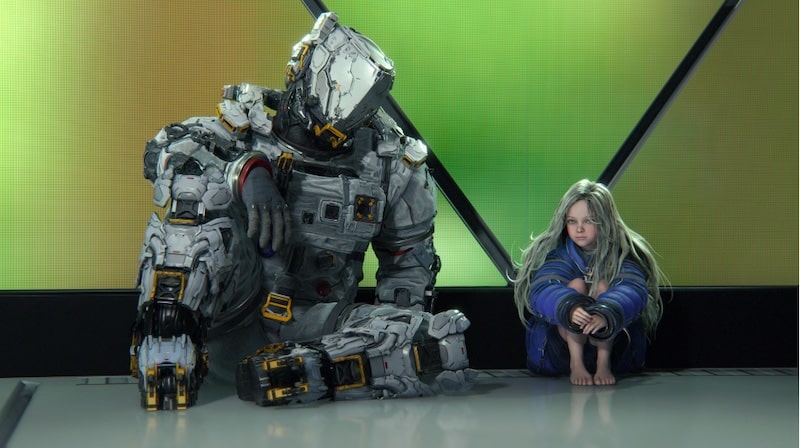
Pragmata PS5 Review. Pragmata is an incredibly unique game to sit down and review, given the fact that it was one of the very first games revealed for the PS5 back in 2020. After being delayed for nearly 4 years, the final result is a game full of creative ambition and drive that has so-defined modern Capcom standards, but in a game that is totally untethered from what came before.
Pragmata is a bold new start from a new team at Capcom, and is more than worth the half-decade wait for its release.
By blending puzzle-solving and over-the-shoulder shooter action, Pragmata offers a unique spin on the characteristic Capcom action game, and creates a convincing argument for putting away the sword in favour of something new.
Perhaps the most important part of Pragmata is that it proves that Capcom isn’t just resting its laurels on the legacy of franchises that came before. This is by no means an easy sell, but it demonstrates that the talent at the publisher is capable of blazing new trails, as well as developing their already formidable stable of IP.
Pragmata Review (PS5) – To The Moon
Bold Creative Decisions Galore
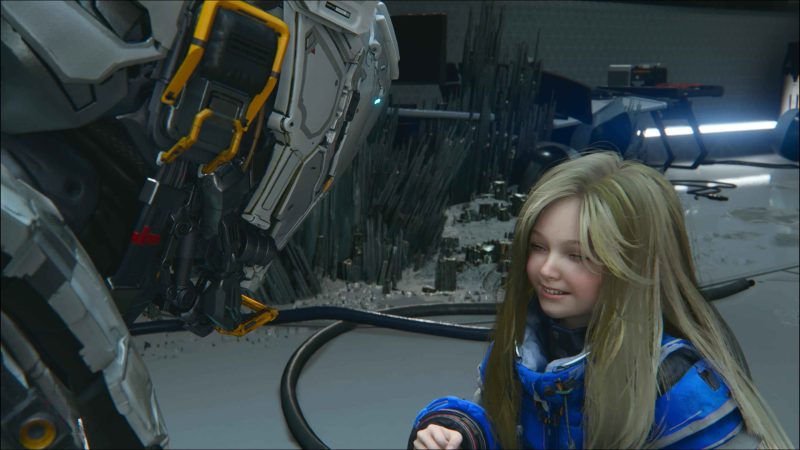
Pragmata wastes absolutely no time in situating itself in a time period not that far from our own, with concerns of AI being the front and center of much of what the game plays with. After a brief introduction to protagonist Hugh Williams, he’s sent into the bowels of the Cradle, a lunar research facility built on the study of “lunafilament,” a futuristic synthetic material capable of printing anything it’s told to. The comparison is clear, and Pragmata pulls no punches in exposing how flawed this technology is. Not long after his trip is derailed, Hugh is introduced to the threat of IDUS, and the friendly Pragmata Diana.
The bond between these two has been at the forefront of Pragmata’s image since the very beginning, and it’s a dynamic that manages to carry the entire game through its runtime. Hugh and Diana’s burgeoning relationship informs almost every aspect of the game, from combat, to exploration, and everything in between. On a first playthrough, it certainly feels like there has been a concerted effort to bring a cohesion to everything within Pragmata.
I can praise the imaginative use of traditional sci-fi trappings all day, but the most impactful part of Pragmata comes from the characters that make that world their own. Hugh Williams is a (mostly) faceless protagonist with an intentionally humble origin compared to the protagonists of other Capcom action games, but that inherent relatability makes his journey that much more realised.
As much as we all sang the praises of Leon S. Kennedy in Resident Evil Requiem, Hugh manages to find purchase in another axis, being someone who is totally human and grounded, even if inexplicably deft at handling weaponry. He’s no slouch, but he’s far from an action-hero.
Let’s not discount the other half of this game, Diana. Despite being incredibly young, and being presented as such, she is a defined part of this game’s story, and a core part of its beating heart. Her youth is never played for annoyance or intentional aggravation, but endearment to draw out the very best of Hugh, and vice versa.
The collaboration between the unlikely pair avoids the common pratfalls of the genre, and instead embraces its strengths.
Brains and Brawn
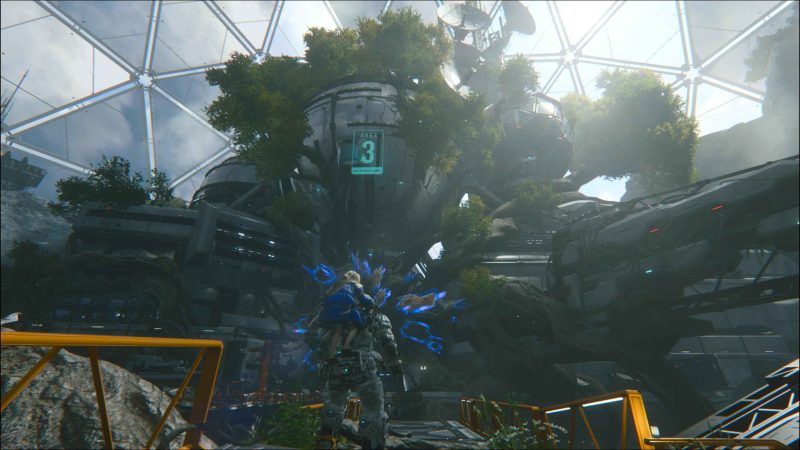
For the most part, Pragmata is a linear action game with light-exploration elements. Each sector of the Cradle is tied together with a home-base of sorts, with the ability to jump back regularly and change your loadout whenever you come across a hatch to use. Each sector has a set main path, with the opportunity to go off and discover small secrets and additional collectables.
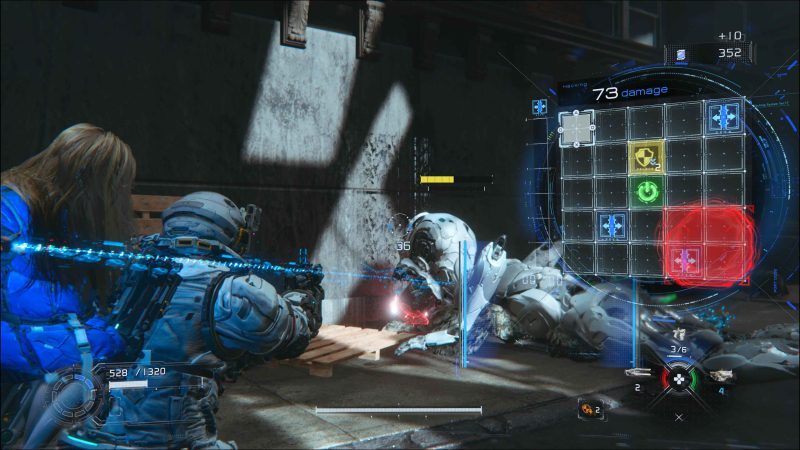
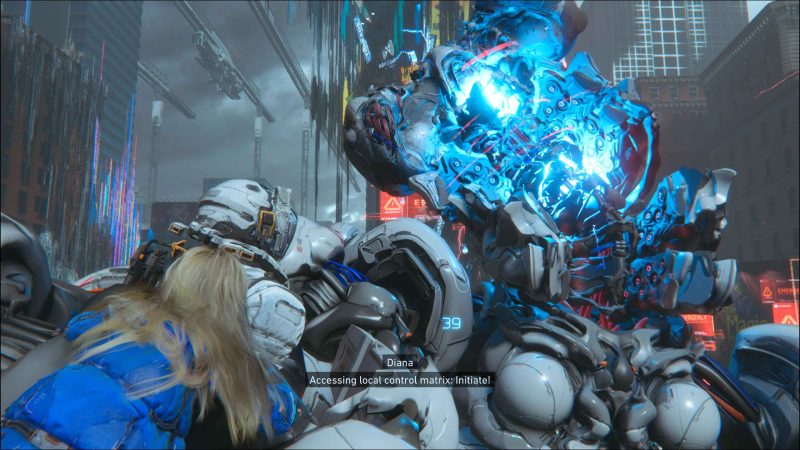
It’s all standard fare, but Capcom manages to seamlessly bridge the gap between combat, exploration and story in a way that speaks to the creative vision at the helm here. The typical combat loop has you solving a light puzzle using the DualSense face buttons with Diana before laying into the enemy with Hugh’s firearms. In essence, you’re controlling both Hugh and Diana in any given scenario, and this was probably where the biggest initial hurdle was. Do you make a beeline for the green node to get their defences down? Or maybe spend an extra moment solving in order to get a defensive debuff?
Effectively managing hacking enemies as well as dodging their incoming attacks was a learning experience that took some getting used to, but I found myself quickly falling into a steady groove of hacking and shooting. Puzzles are never overly intrusive to the pace of combat, and certain situations can see you shrinking the puzzle down into something even tighter, with greater rewards.
Some enemies even put up shields to stop you from exposing them, forcing you to aim for specifics parts of their body before digging in and getting some good damage up. The core loop is played with and flipped on its head time and time again, and never ceased to feel cool in the moment, which is one of the most important things with any combat system. Hacking in video games is always a fun prospect, and this version of that idea really does feel badass.
Pragmata brilliantly takes two simple concepts and brings them together into something far greater than the sum of its parts. Learning to hack quickly leads to more opportunities to do big damage with some impressively varied weapons. It trades the melee depth of Devil May Cry for mechanical depth on a different axis, and that potential is constantly explored throughout each combat encounter.
Taking the Scenic Route
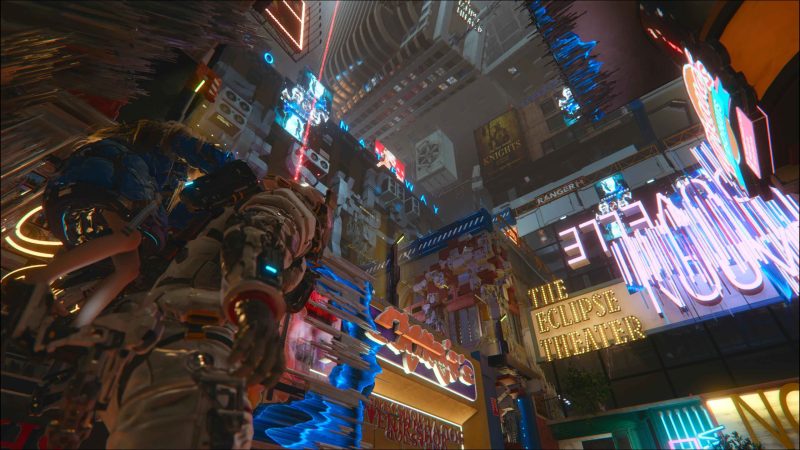
Despite being fully set inside a research facility, Pragmata doesn’t play around with the areas that you visit. While many are accented with familiar trappings of sci-fi yore, there are equally fantastic spins on classic tropes that feel uniquely timely. Among the areas that I’m free to talk about in this review is the interpretation of Times Square in New York, a focal point of the game’s marketing, from the very beginning.
I have to imagine the intent behind this area changed over the course of development, but where we ended up is a brilliantly scathing critique of how AI can attempt to recapture the human touch, but do so at the cost of authenticity. Capcom has gone on record and stated that this area was painstakingly designed to imitate the inherent uncanniness of generative AI, including the Salvador Dali-esque melting into the floor taxis.
Outside of the fantastic combat loop, it’s a brilliant area to inhabit, with an atmosphere that basks in the silence outside of the gunplay. These quiet moments are sprinkled throughout Pragmata, and allow you to soak in these set piece locations without the pressure of an enemy constantly chasing you, or the pressure to move forward to the next encounter. Certain collectables even punctuate the mechanical ambience with a small piano chord when collected; the atmosphere is utterly rich.
Between the silence and bounty of collectables, Pragmata is a game that encourages you to slow down and digest as you go. These slower-paced moments are punctuated by small snippets of dialogue between Diana and Hugh, where Hugh explains the concept of something on Earth to a constantly curious Diana.
These never grate, and only serve to further sell the bond between the two. There’s a natural ebb and flow that feels genuinely realised throughout.
This is true of every sector throughout Pragmata, with each offering something totally unique that further builds on what came before. Even still, some level structuring itself can feel a little bit recycled at points, with a reliance on “find x amount of terminals in this area” before being allowed to move on. It’s done in service of letting you explore, but I did notice it towards the end.
No Moon Stone Left Unturned
Whether or not my surprise is appropriate is another question, but I was left pleasantly satisfied with the lengths to how Capcom has gone to demonstrate the potential of Pragmata’s mechanics. Outside of the already decently long main campaign, there are a bevvy of optional missions to dig into at the home shelter.
These optional missions come in several flavours, with some focusing purely on navigation, combat, or perhaps a mix of the two. Where the main campaign takes you through the motions, these bitesize challenges were where the mechanics were pushed to their fullest, introducing me to mechanics that I would have never considered without them.
For what is a fairly simple concept, there is a great amount of build variety that you can get into before venturing out in Pragmata, facilitated by the training simulator missions giving you a chance to explore them in their appropriate use-case, and feel out how you can use them in upcoming encounters. Weapons are (generally) single-use, so a versatile playstyle is very much encouraged, even as you unlock the ability to permanently keep a weapon on demand from the base.
Every facet of your combat kit is open to you to experiment with, and it made returning to previous areas to mop up collectables to be that bit more appealing, seeing as I could now steamroll a previously tough encounter with an upgraded rocket launcher. Then again, having to refight so many enemies on a return to a previous area can feel like a discouragement, even if it’s really fun.
More Than Meets The Eye
If there’s one thing about Pragmata that I want to reiterate, it’s the unity of elements that all come together to deliver something truly special. I’m wrestling with some pretty strict embargo conditions that prevent me from going into detail, but I wouldn’t want to do that anyway.
Every small moment is calculated to be a part of one larger whole that never feels bloated, nor unjustified; the relationship and cooperation between Diana and Hugh is communicated not only in cutscene, but also the way that the game is actively played. One helps the other, and they both protect each other.
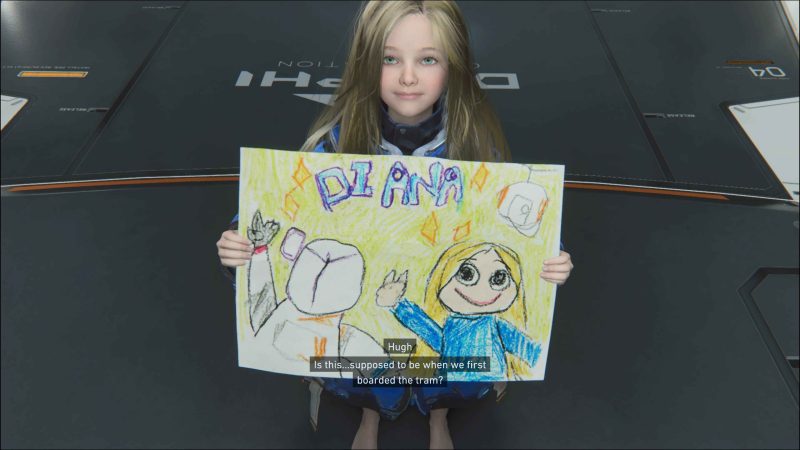
Major collectables take the shape of toys for young children that Diana has never seen before, and you get the chance to see her enjoy them for the first time, as well as question them. Anyone who has played the demo (or even seen any of the trailers) will know that Diana has a penchant for drawing, and you get to receive these too.
There is plenty that Capcom are wanting to keep a surprise for players, and I’m with them fully. From imaginative gameplay scenarios, to a fantastic story.
Small moment after small moment coalescence into something truly one-of-a-kind, and I cannot wait to see what Capcom does next. Before launch, there were consistent jokes that Pragmata was a Mega Man game in disguise, and I’m here to say no, it is far more than that.
Pragmata releases on April 17, 2026, for PlayStation 5, Nintendo Switch 2, PC, and Xbox Series X/S
Review code kindly provided by publisher.