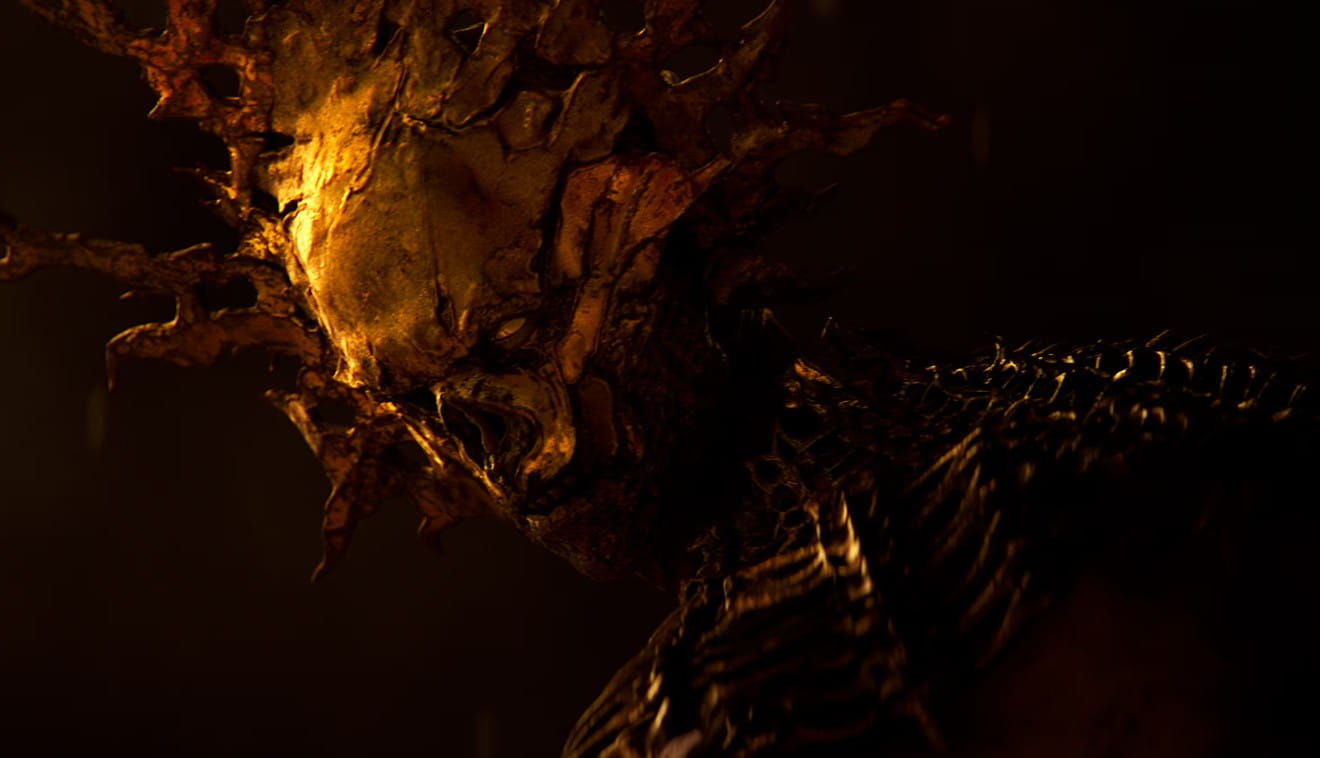
Look, Saros on PS5 is simply incredible, but first, some lore. When Returnal blasted onto the PlayStation scene back in 2021, it’s fair to posit that there was nothing quite like it, either within the context of the still nascent PlayStation 5 line up of exclusives at the time, or just in games more generally. Certainly, the deft combination of its third-person shooter, bullet-hell sensibilities together with a sprinkling of roguelike mechanics effectively fashioned an offering which not only leaned deeply into developer Housemarque’s own arcade shooter heritage, but also officially heralded the elevation of that studio into the AAA PlayStation 5 exclusive playground. To be clear then, Returnal was a banger and despite the relatively steep level of difficulty that is often levelled against it as a criticism, Returnal has reliably maintained its banger status throughout the years. This is largely thanks to a robust cult following which in turn has been sustained by a more broad lack of PlayStation exclusives so far this generation when compared to the previous.
Saros PS5 Review
Fast forward some five years later and Saros, a spiritual successor and functional sequel to Returnal in all but name, has now emerged from Housemarque. Though Saros and Returnal are certainly separate from a narrative and setting perspective, the former almost assuredly feels like a direct continuation of the latter in function, if not in form as well. And much like any ‘sequel’ is supposed to do, Saros is in every way superior to its predecessor, yielding in the process of its creation the best PlayStation exclusive in years. I’m getting ahead of myself though.
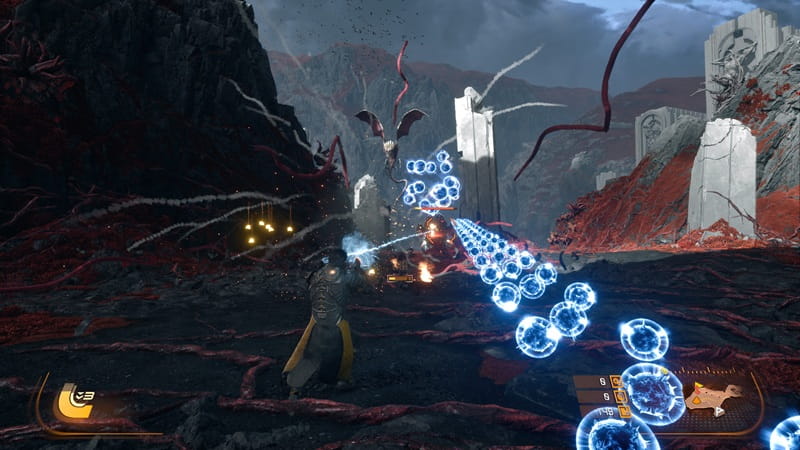
Right off the bat, it’s clear that Saros has a much stronger narrative focus than Returnal and this arguably works substantially in its favour across its duration. Filling the boots of company Enforcer Arjun Devraj (given gruff, hard-edged and yet vulnerable digital life by the evergreen charisma of Rahul Kohli), Saros asks players to explore the surface of Carcosa, a once thriving off-world colony that has since become a husk of desolation, to uncover the fate of the previous three expeditions that seemingly made it to the planet, but lost contact soon after.
Though it’s somewhat of a cliché to say that the setting is a character itself, that is very much unironically the case in Saros, as Carcosa has whims and moods all its own which can have an outsized impact on Arjun’s relentless crusade for truth. These impulses are the result of both Carcosa’s eclipses, which meaningfully alter both the world and the life that exists on it and within it, while the planet itself moves and shifts with each cycle, presenting Arjun with a fresh challenge each time he is reborn.
It’s perhaps here that Saros‘ kinship with Returnal is most readily apparent. Much like Housemarque’s 2021 seminal offering, the notion of a world that shifts and changes with each run arguably sits at the core of Saros‘ beating, roguelike heart. Sure enough, while Saros and Returnal are rapid-fire, bullet-hell focused third-person shooters that share kinship on a fundamental level (more on all that goodness in a bit), it’s really the roguelike elements which lend the whole venture a level of dynamism that keeps the moment to moment gameplay so ruthlessly compelling.
That dynamism manifests itself in very real terms, as not only does each biome reimagine itself with randomised layouts and enemy clusters, but so too does the eclipse itself – which is triggered at specific points within the biome – change the game substantially also. When the eclipse is activated, not only do enemies attack more aggressively, hit harder and give up more Lucenite (Saros‘ main progression currency) in turn when felled, but the very eclipse itself introduces another element – corruption.
Corruption in Saros manifests itself in two very different forms. First, enemies under the eclipse deal specialised corruption damage – as denoted by the new yellow/brown projectiles that they fire. This corruption not only damages Arjun, it also reduces his maximum armour integrity (think health), as well, introducing another distinctly odious hazard to the proceedings as a result. There are ways to reduce corruption though. The quickest way to expel the corruption from Arjun is to use his devastating gauntlet powered special attack, though of course, you could always just try not getting hit in the first place. There’s always that.
When the sun is blotted out by the eclipse, this also affects the way loot is presented as well. Though the various guns and artefacts which serve to boost Arjun’s abilities are very much still around, under the eclipse they take on a corrupted element which not only boosts their abilities further still, but also provides a debuff at the same time. Thus, like any cornerstone of roguelike design then, the eclipse very much injects a real sense of risk and reward to the proceedings, forcing the player to think tactically when it comes to collecting these corrupted artefacts or not, after the benefits and risks have been thoughtfully weighed.
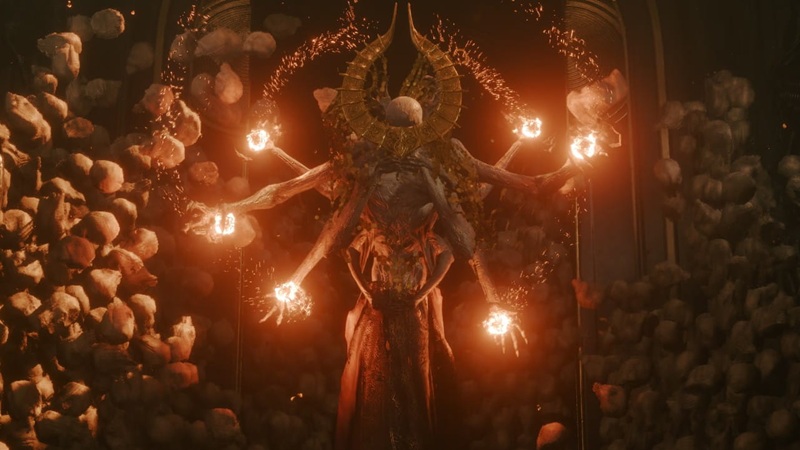
Though these various firearms and artefacts are essentially wiped from one run to the next, fear not, for quite unlike Returnal before it, Saros boasts an extensive progression system that actually makes you feel like you come back stronger from every death. Indeed, an acknowledgement should be made of the sizable chunk of the Returnal fanbase which loved that game, but found it too punishing. In contrast, Saros is much more sensibly calibrated in this regard and the progression system, or amour matrix as it is known, is a big part of that.
Every time Arjun perishes, he is reborn within ‘The Passage’, a centralised hub where the Echelon IV expedition has set up shop to investigate the fate of their forebears. From here he can communicate with the ‘Primary’, an AI driven representative of the company, Soltari, that he works for which allows him access to the armour matrix. From here, depending on the quantity of Lucenite he has (a percentage of Arjun’s haul per run is lost upon death), he can invest that into the armour matrix, securing additional maximum armour integrity, better shields and more besides. There are also some nodules in the matrix that can only be unlocked when special treasures, known as Halcyons, are looted, with such goodies primarily being made available through some of Saros‘ more difficult challenges.
Another improvement that Saros boasts over its much lauded predecessor is that quite simply everything is much clearer – and specifically that benefits the biome selection the most. In Returnal, it didn’t seem like you could simply just return to a biome after you’ve discovered it, not least because you had to find all those portals in order to skip to later biomes. Thankfully, no such nonsense exists in Saros, you just use the ‘World Dial’ program within the Primary to choose the biome you wish to start on and you just, well, do it. Handily, the World Dial also tells you how many collectibles you snagged in each biome, which is very nice and absolutely not very evil.
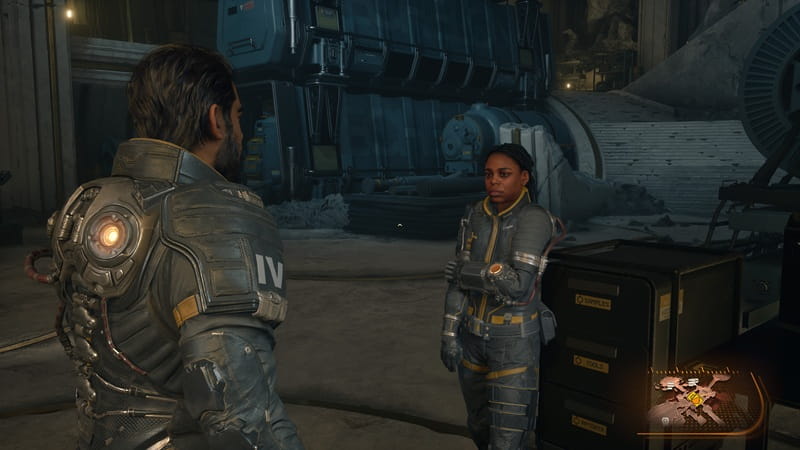
Stacking upon this yet further still are Carcosian modifiers which can tweak up the difficulty and provide additional rewards for doing so, while the modifiers can be tweaked in the other direction, providing additional protections and helping players to still make progress through the game should they find themselves struggling – which can prove especially useful for players who find themselves having a bad time of it against a particular boss enemy. Indeed, taken in tandem with the substantial progression mechanics then, Saros is arguably far more approachable than Returnal ever was and is all the better for it.
As it turns out the Passage is much more than just a hub for enabling Saros‘ progression systems, it also provides the basis for much of Saros‘ storytelling beats too. Unlike Returnal which often felt like a decidedly lonely affair, Saros is much more full with human interaction as Arjun speaks with and interacts with other members of his team as he goes about unravelling the myriad mysteries of Carcosa, all the while the sanity of his cohorts begins to dangerously fray over the course of his odyssey. Though the usual audio logs and text logs abound, much as they did in Returnal, it’s really the constant presence of other characters and the interpersonal relationships that they hold with one another that all combine to make the setting of Saros feel much more alive and dare I say, human, than Housemarque’s previous outing.
On the note of its setting, it’s also worth acknowledging that Saros also has some fairly heavyweight literary underpinnings as well, which prove that the name of its primary locale is far from a coincidence. Massively influenced by Andrew Bierce’s ‘An Inhabitant of Carcosa’ – indeed, one of the Echelon IV crew is named ‘Bierce’ in a nod to the author of that 19th century tale, Saros‘ use of Carcosa reflects the spirit of its original literary incarnation, depicting a decaying, forsaken alien place that would seem to exist outside of space and time.
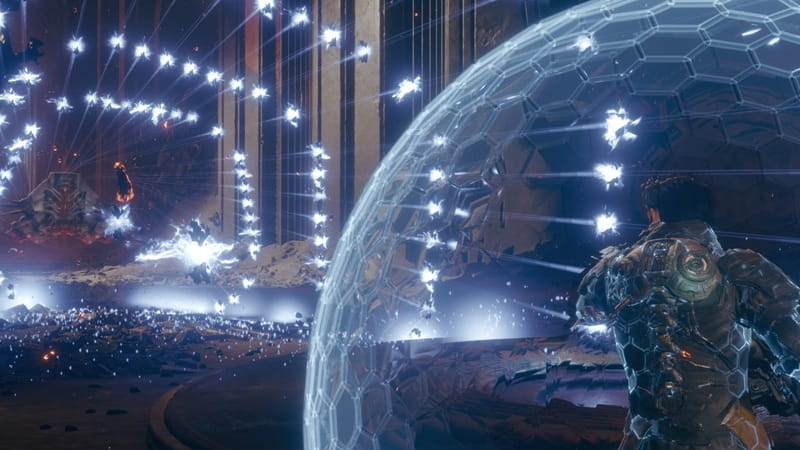
With the veil of reality seemingly porous and Carcosa itself being linked to H.P. Lovecraft’s own Cthulhu mythology, it should probably come as little surprise that Saros‘ plot deeply ruminates on themes of insanity, loss and cult-like behaviours (not unlike HBO’s superb first season of True Detective, which also utilised the notion of ‘Carcosa’ to a similar end). All of this mythos helps to ensure that Saros‘ Carcosa is a much more interesting and lore-rich place than Returnal’s planet of Atropos.
It feels somewhat criminal that I have gone this long without diving into the moment to moment gameplay fundamentals of Saros‘, though in my defence as an avowed Returnal liker who was more than aware of its few failings that I have long craved to be corrected, I was keen to bring to light every area that Returnal lacked but which Saros manages to do so much better. Put simply, if you enjoyed the blazing pace of Returnal’s movement-rich third-person shooter shenanigans, then Saros will absolutely sing to you.
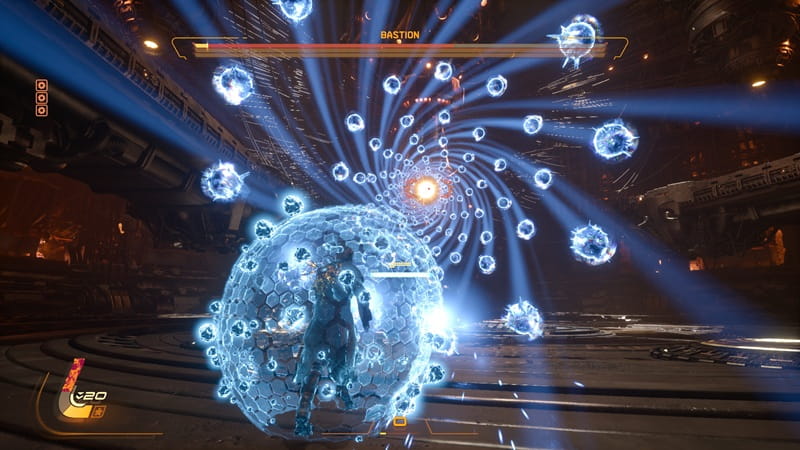
What immediately separates Saros from its third-person shooter genre peers (Returnal itself notwitstanding) is the manner in which it has taken the traditionally, top-down view, two-dimensional concept of the ‘bullet hell’ shooter and brings it kicking and screaming into all three glorious three dimensions. What this means in practice, is that you have scores of enemies within each biome that can quite literally stuff the screen with death-giving projectiles and where the only recourse is to ensure that you either don’t get hit, or you absorb the incoming damage with your Soltari shield. And this is where the skill comes in.
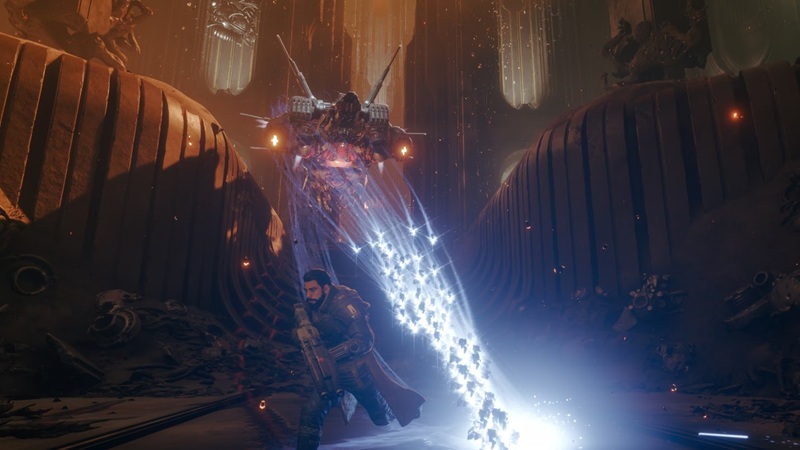
Arjun, like Returnal’s primary protagonist Selene, is an extremely capable soldier bolstered by the latest and greatest technology. Chief among these advances is the ability to power dash which allows Arjun to phase out of the physical plane of existence for a split-second, providing him with a handful of invincibility frames into the bargain. Naturally, as one might expect, this ability represents the cornerstone for survival in Saros, much as it was for Selene in Returnal.
Now, while the dash itself can get you out of trouble for that split-second, there are other things that Arjun can do to even things up a little bit beyond this. In addition to the dash, Arjun can engage a power shield that not only protects him from certain types of projectiles for a short time, but allows him to internalise that energy and reuse it as energy to power a devastating secondary attack. Throw in additional elements in the environment such as a orbs that push you high up into the air and a grappling hook that lets you cover a substantial amount of ground in a second and it’s obvious that Saros has no shortage of ways for players to avoid incoming fire.
And really, that’s the joy of Saros in a nutshell; it’s an acrobatic-kinetic shooter spectacle without peer. There’s nothing quite like zipping around though enemy fire, punching an enemy to bits, zipping back, shooting another, turning on your shield to absorb a whole lotta grief and then channelling that into a devastating explosion that wipes out the remainder of your foes. It’s one of the most effective dopamine feedback loops in gaming and make no mistake. Beyond the utterly satisfying combat of Saros, there is also an irresistible sense of exploration that is threaded through its design DNA. As you proceed through each biome, Arjun unlocks new technology that allows him to traverse Carcosa in different ways. This essentially means that Arjun can return to earlier biomes and reach previously inaccessible areas to scoop up hidden rewards and other such precious trinkets that would have been previously out of reach.
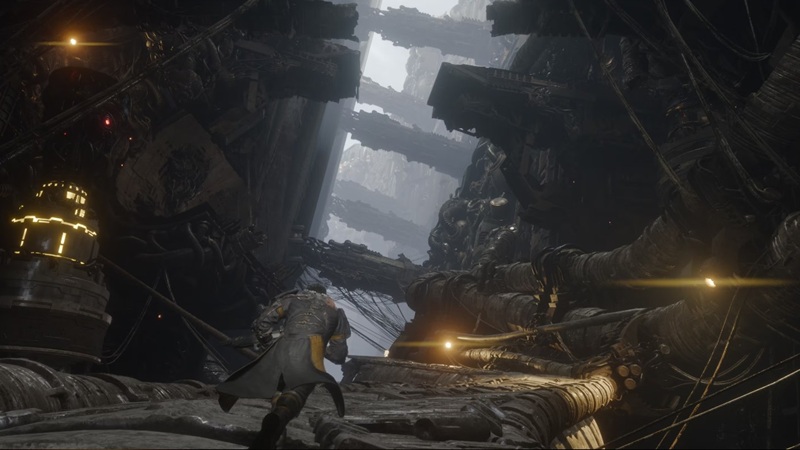
Saros also gives players ample bang for their buck, too. Nightmare strands are special challenge portals embedded within each biome that can provide high rewards for overcoming their extremely difficult challenges, while the multiple endings, collectible lore and Carcosian modifiers all provide a wide range of incentives for players to remain involved with Arjun’s story long after the credits have completed their roll. From a visual perspective, there is a level of almost breathless grandeur, sweep and spectacle spilling out of Saros that wasn’t present in Returnal. Massive solar cannons fire into the sky while a swirling black sun wreathed in flame sits in the background, all the while stone architecture is twisted and warped in line with the whims of this hostile world. And certainly, when the eclipse hits, Carcosa undergoes a tortured metamorphosis into a claret-hued, tentacled hellscape (hello again, Lovecraft connection) that just looks utterly grim, though ultimately spectacular on Sony’s latest slab of console hardware.
Tearing along at a largely smooth 60 frames per second on base PS5, which is an achievement in itself considering the sizable uptick in environment detail and effects work over Returnal, PS5 Pro owners are also eating exceptionally well with Housemarque’s latest. With a higher resolution thanks to the latest iteration of PSSR 2, a much more stable frame rate and more detailed particle effects, Saros is a uniformly beautiful game to witness in motion, that is perhaps only very slightly let down by character facial animations during sequences that are rendered in real-time. It’s a small thing for sure, but given the sky high calibre of the visuals seen elsewhere in Saros, I couldn’t help but take note of it.
Finally, I feel that it’s also worth acknowledging that Saros makes the most of its DualSense functionality – something which feels increasingly like a lost art these days. Adaptive triggers are used to facilitate the alternative fire function on the various weapons you’ll come across, requiring users to press the L2 trigger down halfway to activate, while the use of haptic feedback feels expertly implemented, with every attack, dodge and rumble of enemies both near and at mid-range felt palpably through Sony’s DualSense controller. More of this please, developers.
A blistering, rapid-fire epic without peer, Saros confidently delivers a dual masterclass in third-person shooter design and roguelike sensibilities all wrapped in a delectable veneer that elevates it to one of the best looking games on PlayStation 5. To quote the kids – Housemarque cooked here. This is their masterpiece and it is next the must have, utterly essential PlayStation exclusive. Carcosa beckons.
Saros releases for PS5 on April 30, 2026.
Review code kindly provided by PR.