
A streak is a simple promise: keep doing the right thing and the line stays alive. Miss once, and it snaps. That is why a daily challenge can make a five-minute session feel tense, and why a roguelite run can feel personal long before the boss fight. Streaks make progress visible, fragile, and easy to understand.
In a PLOS One systematic review of gamification in online programmes, researchers describe gamified software as using game elements such as points, badges, leaderboards, clear goals, challenges, levels, progress, feedback, rewards, and themes. For players, the useful part is not the label. It is the clarity. The rules tell you what counts, what carries forward, and what breaks the run.
The Line Is the Hook
Streak mechanics in games work because they turn a messy activity into a clean sequence. A football game objective might ask for one goal with a certain player type. A puzzle game might ask for one daily clear. A roguelite asks for one more room, one more item, one more fight survived.
That small scale is the key. The player does not need to think about the whole season, bracket, or build. The next step is right there. A streak gives that step memory. It says the last few choices still count, so the next one carries extra weight.
The same thinking explains why match predictions can feel game-like. A fixture becomes a single choice. The result gives feedback. The run either continues or starts again. Even when the subject is live football rather than a console mode, the shape is instantly familiar.
When Football Calls Become a Streak
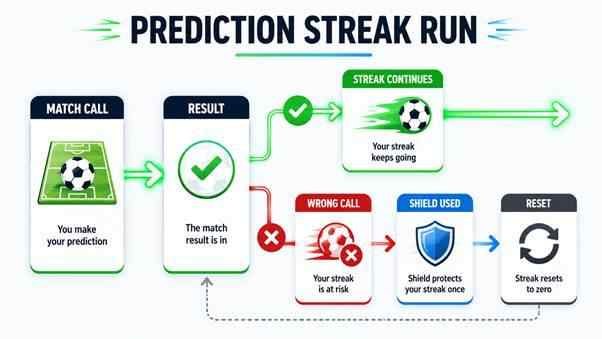
Prediction streaks work best when the format is easy to read before the match starts. The viewer needs to know what keeps progress alive, what resets it, and whether there is any limited protection from one wrong call.
A clear example is Lucky Rebel, whose homepage brings together sports, casino, live casino, app access, promotions, and football-themed games in a matchday entertainment setting. For a gaming audience, the useful detail is the structure. A World Cup-style challenge turns each fixture into one call. A correct call keeps the run intact. A wrong call resets the sequence unless a shield is available.
That is familiar game language without needing a tutorial: a visible line, a failure condition, and a small safety tool that does not remove the pressure of the next choice. It is the same reason a limited revive in an action game feels different from unlimited retries. The shield matters because it protects the run once, not because it makes the run automatic. That keeps the focus on timing, attention, and the simple question that powers most streak systems: can the next call keep the line moving?
The campaign clip “Don’t just watch the World Cup. Crash it.” shows that sequence in a compact way. It presents one A/B call for each match, a streak that survives correct calls, a reset after a wrong one, and three shields across the tournament. The rules are clear almost immediately.
**PLEASE EMBED THIS LINK**
The Shield Changes the Pressure
A shield is a small design choice, but it changes how a streak feels. Without one, every choice is absolute. With one, the run has a little elasticity. The player can survive a mistake, but only by spending something scarce.
Games use that idea constantly. Racing games use rewinds. Action games use revival items. Roguelites sometimes give one extra life before the run properly ends. Sports games use match limits, form windows, and timed objectives to make short sessions feel contained. The best versions do not remove pressure. They shape it.
That is also why a shield needs a clear limit. If protection is endless, the streak loses its edge. If protection is too rare or confusing, it feels arbitrary. Three shields across a tournament is easy to grasp because the viewer can understand the trade-off without checking a long rule sheet.
Recent coverage of EA Sports FC 26’s FUT changes gives a useful football game comparison. Live Events bring objectives, custom rules, match limits, solo or co-op options, and special match settings into short competitive windows. That kind of structure trains players to read football through conditions as much as scorelines.
Why Streaks Travel So Easily
Streaks travel because they do not need a huge game wrapped around them. A calendar can hold a streak. So can a quiz, a match list, a fitness app, a language lesson, or a daily login. The player only needs three pieces of information: what counts, what breaks, and what happens next.
For football fans who already play sports games, the appeal is even cleaner. A match prediction streak has the rhythm of a short objective chain. It does not replace the match itself. It gives the viewer another way to follow fixtures, especially during a tournament where games arrive quickly, and every result changes the next conversation.
Prediction streaks feel familiar because they borrow the part of game design that players understand fastest: visible progress under clear pressure. That portability reaches well outside football, with goals, challenges, competition, and social influence among the recurring elements identified in a systematic review of gamified fitness tracker apps.