
Anyone who has bought a game on PSN or Xbox Store knows the flow. Pick the title, tap confirm, and the charge lands against your wallet balance or saved card. If your balance runs low, you top up via mobile payment or gift card in seconds.
That same flow was absent from most online casino sites five years ago. UK casino deposits meant re-entering card details or navigating a form-based checkout every session. Wallet abstraction and biometric shortcuts were only just starting to appear in gambling.
The gap has narrowed. UK online casinos have adopted mobile wallets, biometric authentication, and one-tap deposit flows over the past few years, and the checkout experience now looks a lot closer to what console storefronts have offered for a decade. What consoles pioneered first is now the baseline expectation across the mobile payment ecosystem.
The Three Things Consoles Got Right First
Three pieces of payment infrastructure appeared on console storefronts years before UK online casinos adopted them. Each one changed how mobile payment feels, and each now sits at the centre of what UK operators finally built:
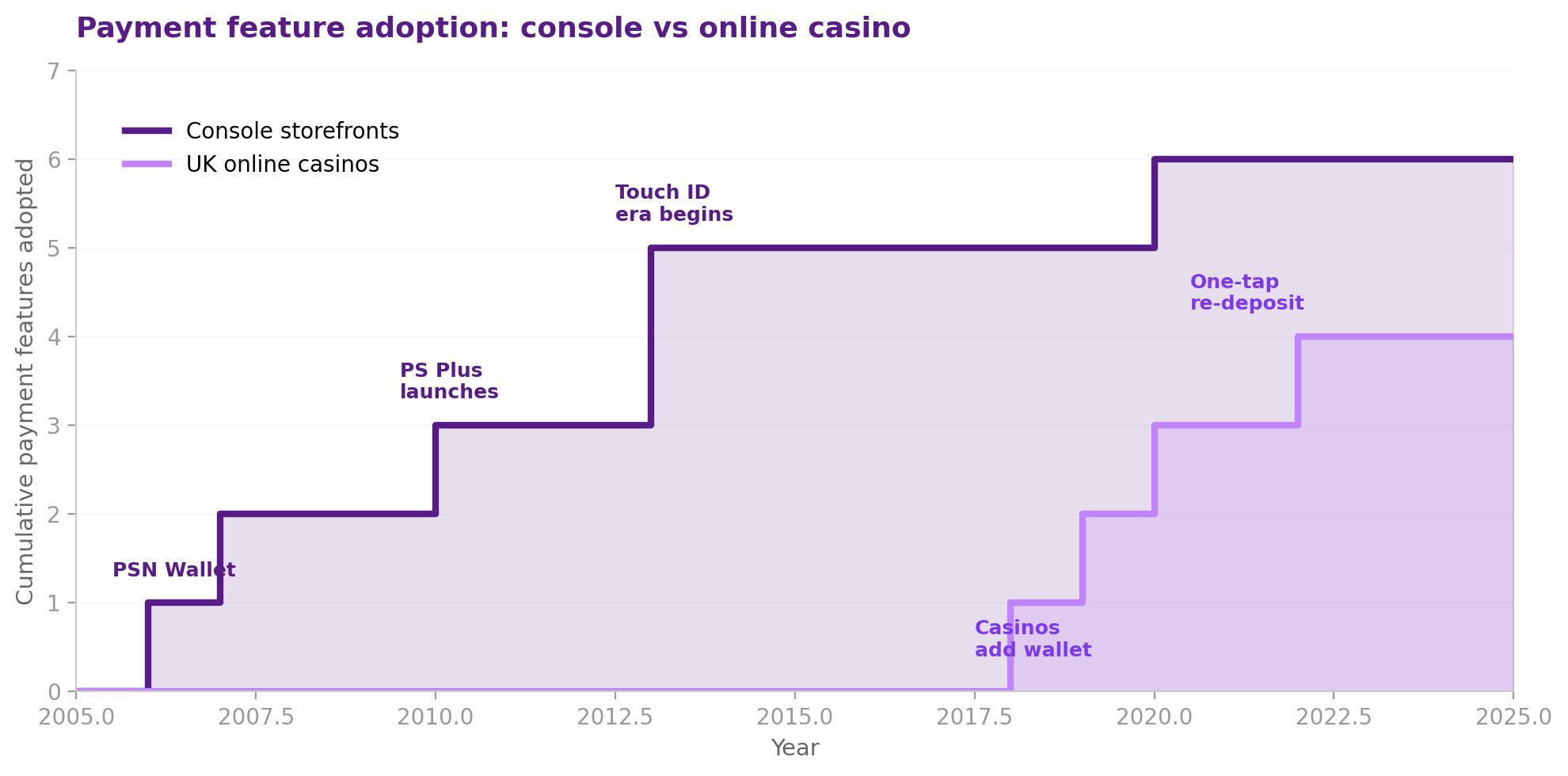
- The store credit wallet model. PSN Wallet, Xbox Store credit, and Nintendo eShop balances all abstracted the payment moment away from the purchase moment. Add funds once, spend across multiple purchases. Consoles have had this since the mid-2000s.
- Recurring subscription billing. PS Plus launched in 2010 and Xbox Game Pass followed in 2017. Both normalised auto-renewal billing for a gaming service, with cards on file and no re-authentication needed each month. Online casinos still have not adopted this model in any comparable form.
- Frictionless repeat purchase. Once a payment method is stored, console storefronts let players complete a purchase in a couple of taps, often confirmed by Face ID or a saved PIN. This became standard around 2013 as mobile OS-level biometric authentication matured. Casinos took another five to seven years to build the equivalent flow.
Each of the three sits behind what modern gaming and gambling apps consider table-stakes UX. The three arrived at very different times across the two verticals. That timing gap explains how the mobile deposit experience on a casino app feels today versus 2019.
The Store Credit Wallet Model in Practice
The PSN Wallet is a genuinely old piece of infrastructure. Sony launched it with the original PlayStation Store on PS3 in 2006, and Xbox added equivalent store credit around the same time. The wallet let players fund an account balance in whatever amount they chose, then spend against it across game purchases, DLC, and later subscription payments.
The payment abstraction the wallet created was the important design choice. Instead of putting the user through a payment authorisation on every purchase, the console handled the auth once at top-up and treated every subsequent purchase as a simple balance debit. That is a small change on paper and a massive one in practice.
UK online casinos have only recently built a comparable pattern. Deposit options such as pay by mobile at PlayUK confirms the shift: phone bill charges hit the mobile account, funds land in the casino balance in seconds, and subsequent play draws from that balance. That is the console wallet pattern ported to a UK gambling operator.
Subscription Billing Consoles Made Standard
The subscription model is where the console lead is starkest. academic research on console subscription economics documents that Xbox Game Pass (2017) and PlayStation Plus (2010) established recurring auto-renewal billing as a viable gaming business model. The analysis shows both services enhanced console revenue without cannibalising game sales, unlike what happened to music, movie and TV subscriptions.
PS Plus has around 47 million subscribers; Xbox Game Pass sits at roughly 29 million. Together they represent tens of billions in recurring revenue on auto-renewal infrastructure consoles have had for a decade.
Online casinos have no direct equivalent. UK operators run promotional cycles, reload bonuses, and loyalty tier structures, but none of those constitute a subscription in the console sense. The gambling category has not yet built the recurring-billing infrastructure that consoles normalised, and whether it does is an open question.
Frictionless Repurchase and Biometric Authentication
The third pillar is checkout friction, or the lack of it. Console storefronts adopted OS-level biometric authentication early through iOS and Android SDK integration. Touch ID launched on iOS in 2013, Face ID followed in 2017, and both were standard for in-app payment authentication across gaming apps within a year of launch.
The parallel adoption in UK online casinos took another five to seven years. Most UK gambling operators integrated Face ID and Touch ID for deposit authentication around 2020 to 2022, with rollout uneven across the industry. Some operators still require re-authentication on every deposit.
What Casinos Have Adopted and What They Still Haven’t
The catching-up over the past five years has been genuine but partial. UK online casinos now offer Apple Pay, Google Pay, biometric login, one-tap re-deposit, and phone-bill payment. Checkout on a modern UK casino app feels much closer to a PSN Store purchase than in 2019.
Two gaps remain. The first is subscription billing, which consoles pioneered and casinos have not adopted. The second is deeper platform-level integration; consoles own the hardware-plus-software stack, while casinos run inside someone else’s OS with less friction control.
For gamers who came in via PlayStation or Xbox and later hit online casino checkout, the difference used to be jarring. That has faded as casinos imported the console-pioneered patterns one by one. Gaps remain, but the direction of travel is toward the console model as the reference standard.