
Sports games have spent years getting better at reproducing movement, stadiums, formations and broadcast presentation. The 2026/27 season adds another layer to that pursuit. Football itself has changed in several small but visible ways, giving developers a fresh set of behaviours to model. The implications reach beyond the pitch because official match events also feed statistics, fantasy products and football betting markets, making consistency between the real rules and their digital representation increasingly important.
Small laws can create large design problems
The new Laws of the Game include measures intended to reduce delays. When a team deliberately delays a goal kick or throw-in, the referee can begin a visible five-second countdown. Exceeding the limit at a goal kick results in a corner for the opposition, while exceeding it at a throw-in results in the throw being awarded to the other team.
On paper, these are straightforward rules. Inside a football game, however, each one affects artificial intelligence, animations, referee logic, commentary, user interfaces and possession states.
A digital goalkeeper must know when the countdown begins. The referee animation has to communicate it. The game must know when the delay becomes an infringement and then switch to the correct restart. The same logic has to work whether the user controls the team or the computer does.
The official 2026/27 law changes from the IFAB therefore provide something close to a new specification for developers trying to reproduce contemporary football.
VAR has become harder to simplify
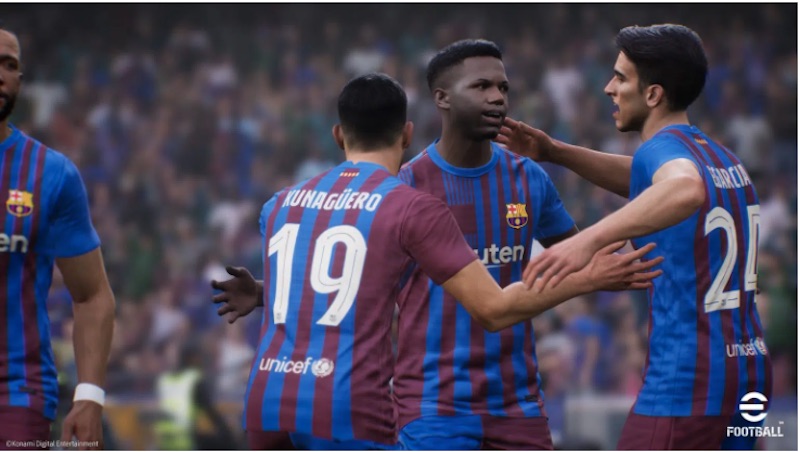
Video review creates an even more complicated challenge. The 2026/27 rules permit VAR intervention for a clearly incorrect second yellow card that leads to a dismissal and for certain cases of mistaken identity. Competitions can also choose to permit immediate review of a clearly incorrect corner.
A sports game cannot simply create a single universal VAR sequence and assume it applies to every competition. Some rules are mandatory, others are optional, and leagues can make different operational choices.
That opens the door to more detailed competition profiles. A simulation seeking accuracy may need different referee logic depending on the tournament being played rather than applying one system to every licensed competition.
Real-world data keeps moving into games
The direction of travel was already clear before this season. Football developers have increasingly used detailed tracking and motion data to make player movement and match behaviour more recognisable. An earlier report on technology acquired for the EA Sports FC series showed how much value publishers place on capturing the physical detail of real matches.
Rules are another form of authenticity. A perfectly rendered stadium can still feel wrong if the referee gives an outdated restart or if the computer-controlled goalkeeper behaves according to last season’s regulations.
The more convincing the visual simulation becomes, the more noticeable these inconsistencies are.
Authenticity now includes tempo
The rule changes are not only about what restart should follow an infringement. They are also intended to influence the rhythm of the match.
A visible countdown creates a moment of pressure before the ball is even in play. A one-minute absence following certain treatment situations affects temporary team shape. Time limits on substitutions can change the pace of late-match sequences.
For designers, this means authenticity increasingly depends on modelling the spaces between obvious actions. The pause before a goal kick, the timing of a substitution and the delay before a player returns to the pitch can all become part of the simulation.
The 2026/27 season therefore gives football games more than a new kit list or updated squads. It provides a reminder that the sport itself is a moving target. Replicating football accurately now means reproducing not just how players move, but also how the rulebook shapes the rhythm around them.