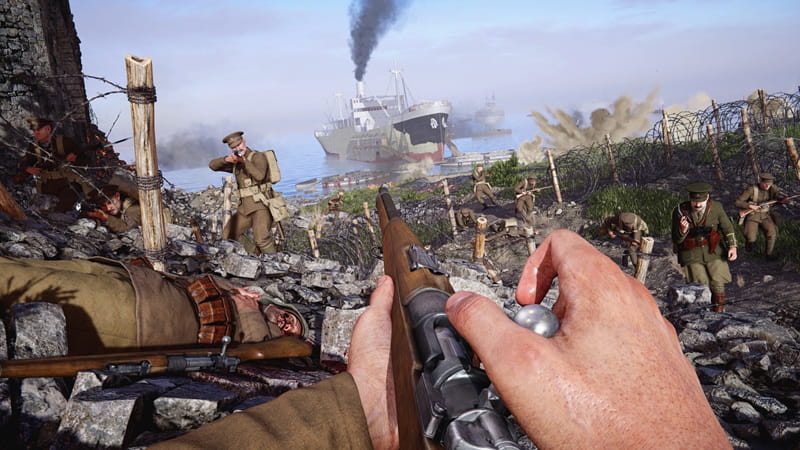
In almost every way that matters, Gallipoli, the latest entry in the long-running historical FPS WW1 Game Series from developer BlackMill Games, proves itself to be superior to its predecessor, 2022’s Isonzo. Though it’s also clear that from a technical perspective at least, Gallipoli remains somewhat rough around the edges. Starting with the titular theatre of war itself, BlackMill Games latest feels immediately refreshing, not least because Gallipoli itself feels dramatically underserved in video games outside of the scant two maps (Cape Helles and Achi Baba) found in 2016’s Battlefield 1: Turning Tides DLC. For those who might be uninitiated with this aspect of the First World War, the Gallipoli theatre of conflict offered up a uniquely challenging and hostile geography.
With battles taking place across the extremely narrow Gallipoli peninsula (principally conceptualised by then First Lord of the Admiralty Winston Churchill as a way of bypassing the tactical stalemate of the Western Front), Gallipoli itself represented an alternating hell of naval battles, beachhead struggles and high ground killzones that no other part of World War I can really compare to.
Gallipoli PS5 Review
BlackMill Games‘ take on this terrifying theatre of war is appropriately well done then, with each of its five launch maps proving to be effective analogues to the real-life clashes which unfolded more than a hundred and eleven years ago. Anzac Cove for example, does a great job in nailing the verticality of that particular flashpoint in the conflict, with a gruelling climb from the thin beachhead ending in a pitched battle among razorback ridges, all the while historical landmarks such as The Neck and Pope’s Hill are accurately represented.
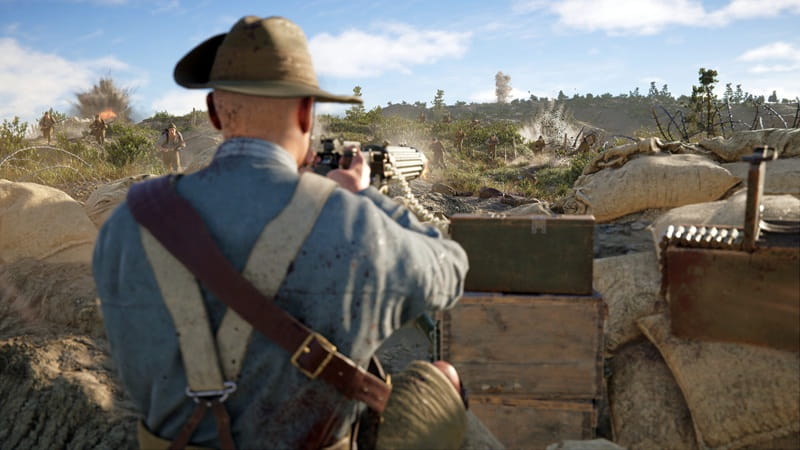
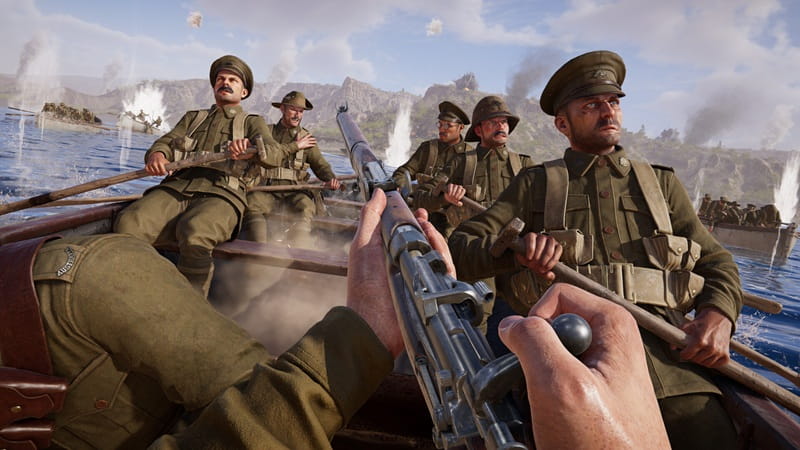
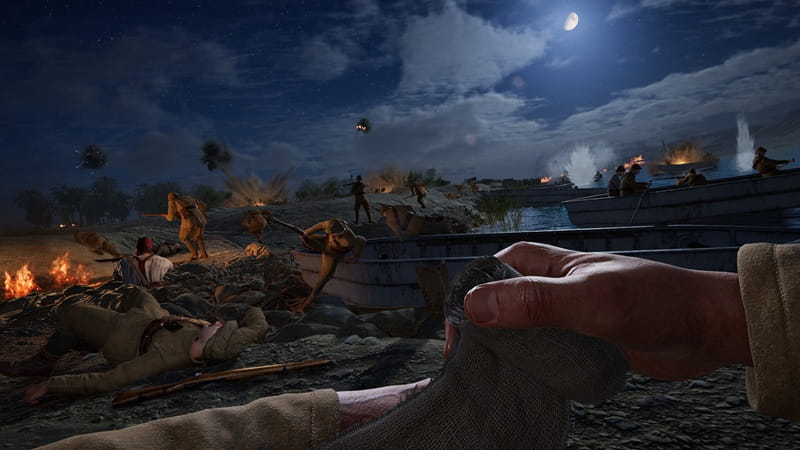
V Beach (Cape Helles) meanwhile, features a tremendous naval landing (the attackers actually have to manually row themselves to shore in a nice touch), leading to a storming of the Fort Ertugrul ramparts and a bloody battle on the land beyond. This is easily the most attention to map detail that BlackMill Games has wrought in the WW1 Game Series and it really helps to lend Gallipoli a real sense of groundedness to its ambitions.
The other headlining improvement which Gallipoli boasts over the preceding offerings in the WW1 Game Series, is the new Expedition Mode which replaces the traditional frontline assault mode last seen in Isonzo. Veering away from the meat grinder-esque ‘strategies’ which that mode encouraged, Gallipoli‘s Expedition Mode instead functions with a momentum system at its core, encouraging players to keep up a rapid tempo of capturing enemy positions in order to win.
Brilliantly, this mode also makes delay tactics a realistic proposition too, as defenders can still win with fewer numbers if they are able to hold a solitary choke point long enough to drain the offensive clock. Additionally, though each primary objective is clearly distinct – ‘take over the HQ’ – and things of that nature, Gallipoli also rewards cunning attackers who divert their aggression to secondary targets, such as embedded mortars and other such secured positions, allowing their force at large to gain robust footholds on the way to conquering the primary objective. It’s all neat stuff that makes every battle in Gallipoli feel much more thoughtful than before.
Gallipoli‘s dogged focus on realism cheerfully spills over into its moment to moment gameplay mechanics too. Suppressing the enemy for example is now a rather big thing, as you can not only gain a decent amount of experience points for doing so, but it has a palpably physical effect too, as this can cause a panic state to work its dark mojo on your enemies, causing visual blurring, greater weapons away and even increased fumble reloads on their part – and each fumbled reload boasts their own unique animations, too.
In further pursuit of the grand cause of realism is the notion of dynamic environmental cover. In Gallipoli, all manner of explosions caused by the likes of artillery and mortar strikes now dish out voluminous clouds of dust and sand which linger in the air, not only providing a suitably dramatic visual, but also giving players real temporary visual concealment to cover a retreat, or hide a cheeky attack on the flanks. Again, this is just one more example of how Gallipoli confidently stakes its claim as the most authentic World War I shooter on the market today – BlackMill Games have put in the work and it shows.
Speaking of game mechanics, Gallipoli also makes some welcome changes to the movement and traversal side of things. At long last players can now go prone basically everywhere (a welcome alteration from the overly strict prone restrictions of the previous games), allowing not just enhanced concealment but also the ability to meaningfully crawl through over rocky outcroppings and other such complex geometry. It’s great to have this for sure, but this should have been a feature in the WW1 Game Series long before Gallipoli.
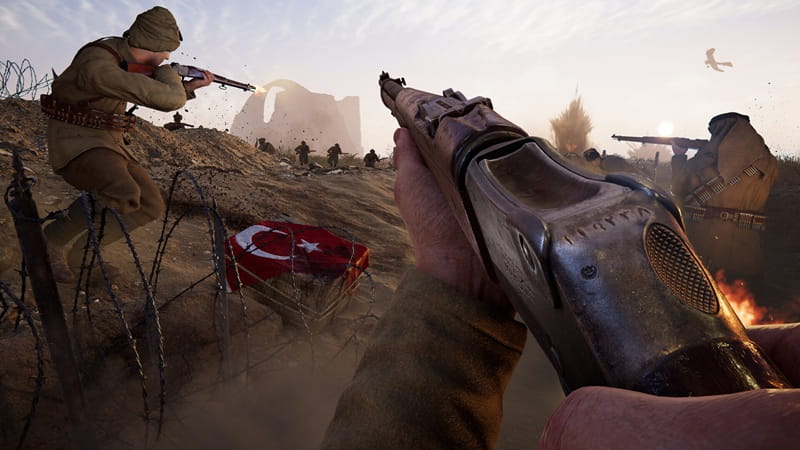
Perhaps one of the most meaningful improvements that Gallipoli brings over previous titles in the WW1 Game Series is the fairly substantial overhaul to progression that feels a long time coming. Now, in addition to class levels which unlock new weapons and gadgets, wannabe soldiers can pursue independent progression paths for each weapon too, resulting in upgrades such as improved reload time and suppression recovery to name just a couple. This is great stuff as it actively encourages players to specialise and master one or a small subset of weapons in ways that previous WW1 Game Series entries couldn’t allow.
Rounding out the myriad improvements that BlackMill Games have made are the new classes and roles which feature prominently in Gallipoli. Boasting a much stronger emphasis on support roles, Gallipoli introduces new facilitating classes that do more than simply spit bullets at the enemy. The Stretcher Bearer for example, provides speedy healing and revival capabilities, while the Ammo Bearer can skate across the battlefield at speed; criss-crossing through enemy fire to deliver precious ammo to the riflemen and gunners on the front line that need it most. All of these classes feel like sensible additions that not only help to make Gallipoli feel like a much more rounded offering, but provides players with a swathe of different playstyles to embrace.
It’s certainly worth reinforcing too that Gallipoli, like other previous entries in the WW1 Game Series, is primarily an online multiplayer affair. Sure, you can play against bots in solo or offline modes, and bots can be used to fill the numbers in an online session, but principally this is a genre effort all about playing against your fellow humans, rather than boasting any kind of story mode or suite of solo play focused modes. As such, the implementation of crossplay support on day one is hugely welcome as well, since it makes getting a game much easier than it otherwise would have been.
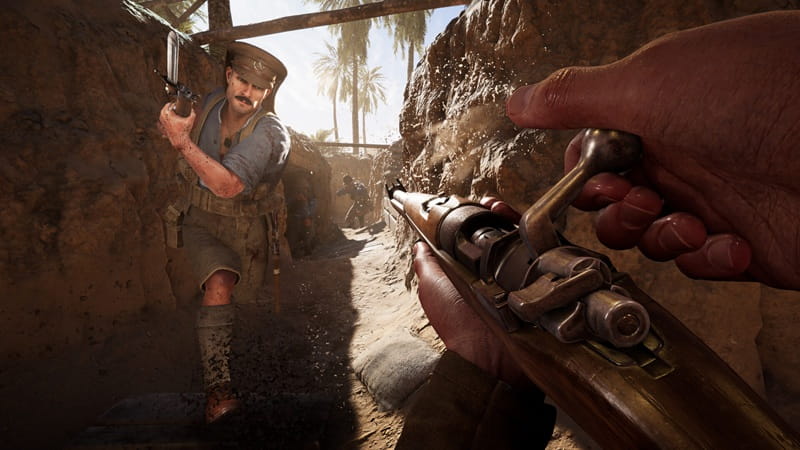
In terms of its moment to moment gameplay, Gallipoli channels everything that I’ve enjoyed about the WW1 Game Series more broadly while also improving on some of the bits I didn’t really like. Gallipoli certainly has that same rush of adrenaline when you make a push for a fortified enemy position with your buddies, but the relative complexity of the maps now also mean that you’re not just simply dogmeat for snipers as there’s always somewhere to make yourself prone into, while the new suppression mechanic also discourages camping snipers who come under fire.
Firearm handling remains resolutely enjoyable, not just from a handling perspective but from an audiovisual one too, since not only does each weapon look the part (complete with authentic looking successful and fumbled reload animations), but so too does each also sound the part with the crack from a recently discharged Magazine Lee-Enfield rifle proving just as satisfying to hear as ever.
From a technical perspective, sure, Gallipoli lacks the high end production values of a massive tentpole shooter franchise such as EA’s Battlefield, but what it doesn’t have in budget, it more than makes up in authenticity and it’s that which has always meaningfully separated the WW1 Game Series from its peers, and it’s very much something that feels preserved in Gallipoli for reasons that I have previously mentioned in these scribbles.
Sadly though, it isn’t all trenches and rainbows when it comes to Gallipoli’s technical performance on PlayStation console hardware. Somewhat annoyingly, screen tearing on PS5 Pro rears its ugly head and when coupled with a rather unstable framerate during busier battles, threatens to drag the entire enterprise down somewhat and undo much of the great work that developer BlackMill Games has wrought elsewhere in this otherwise muscular shooter. In an era of mature PS5 hardware (devs have had more than six years to get to grips with the hardware), more powerful PS5 Pro hardware (which Gallipoli was reviewed on) and techniques like VRR, seeing these kinds of performance issues is disappointing. Also, PlayStation 5 Professional owners will likely feel let down somewhat too, as there are no obvious PS5 Pro enhancements and no use of PSSR as far as I can see. A bit of a shame, really.
Gallipoli continues the throughline of satisfying multiplayer shooter shenanigans and a real-world historical accuracy that the WW1 Game Series has prided itself on for more than a decade. Easily twinned to real-life battles and skirmishes, each map feels appropriately authentic and the strides it makes to a greater degree of realism, together with satisfying gunplay and the new Expeditions mode all make Gallipoli the best entry in the series to date, though a rickety framerate and occasional screen tearing do tarnish the overall package a little.
Gallipoli is out now on PS5.
Review code kindly provided by PR.