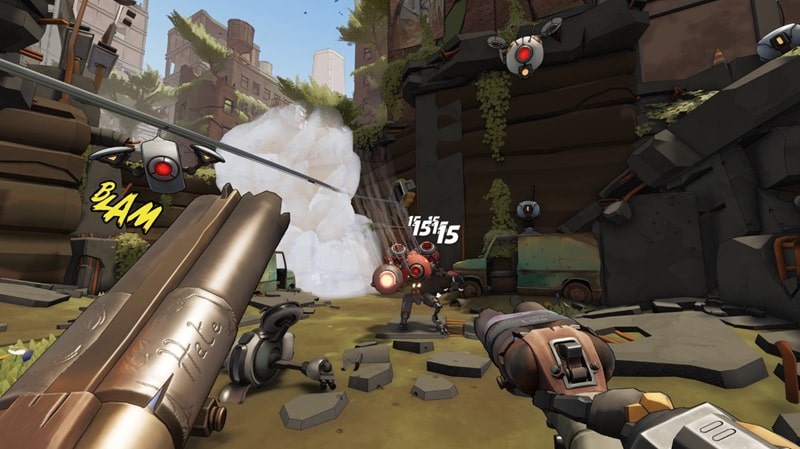
Over the last decade or so, I’d certainly say that the Roguelite genre has reached a saturation point. For a while it felt like almost every other indie effort was a Roguelite and truth be told, fatigue started to set in pretty darn quickly indeed. However, if recent Roguelike darling [REDACTED] taught me anything about its own genre, it was that saturated genres can still give rise to offerings that soar and for Roguelites at least, that moment has now arrived with Roboquest from developer RyseUp Studios.
A fast-paced FPS Roguelite that unfurls in a post-apocalyptic future, Roboquest puts players into the clanky shell of a rebooted Guardian, a long dormant robot with a thing for laying waste to legions of evil bots and together with their human handler is thrust out into the world to do just that and hopefully reclaim the planet in the process. Hardly a brain-tickling narrative, but then of course it doesn’t have to be, since Roboquest‘s story should simply provide the fundamental struts which support its setting and that’s precisely what it does.
Roboquest PS5 Review
Quite Simply The Best Roguelite FPS In Years
Before even taking a sideways glance at the Roguelite design that underpins Roboquest‘s action, it becomes abundantly clear from the very start that Roboquest‘s grasp of the fundamentals of first-person shooter mechanics is among the best I have seen in a good long while. Movement is super responsive and breezy as our trusty Guardian sprints, double-jumps and grinds rails throughout Roboquest‘s many different biomes and ever-shifting level layouts.
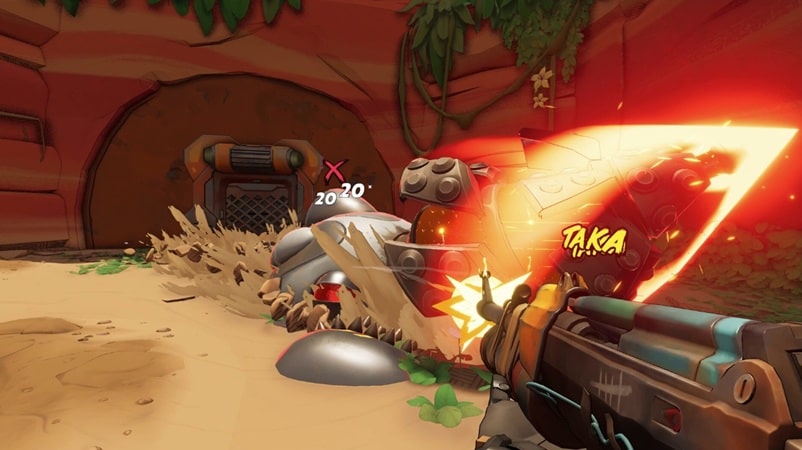
The shooting part of the equation meanwhile is equally well served at a fundamental level, with a super rock-solid 60 frames per second supporting a veritable embarrassment of weapon riches that all feel great to use and switch between mid-combat. Though there is a sizable amount of weapons, gadgets and other such items to employ in your arsenal, Roboquest also understands the idea that less is more, by only allowing players to carry two weapons at once (outside of two class specific abilities – but more on that in a bit), it impresses upon players a tactical imperative to switch weapons in and out depending on what they feel is the best for the situation at hand.
Where we approach the hallowed grounds of excellence though, is in how developer RyseUp Studios masterfully combines the two in ways that make it feel akin to older hyper-kinetic shooters such as Quake or even Unreal Tournament. There really is nothing quite like deploying your trusty Buddy Bot(™) to distract a bunch of enemies while you immediately wreck two of them with your Elephant Gun before grinding a bunch of rails and laying waste to the rest as you become an extraordinarily target to hit. It simply feels fantastic and serves as a timely reminder that nailing the basics should absolutely come first before everything else in games like these.
Further Reading – Upcoming PS5 Games 2025 – The Best PS5 Games Coming Soon
Even the enemies too have had a similarly stellar level of TLC lavished upon them. Not only does Roboquest bring a veritable throng of different bad bots for the player to tangle with each and each with their own strengths, weaknesses and special abilities, often mixing them in the process, but so too does Roboquest employ some truly fiendish boss encounters that demand a both mastery of their unique mechanics and Roboquest‘s own brand of blistering FPS gameplay.
That’s not all either on the enemy front. Sitting alongside Roboquest‘s towering bosses are special arena rooms that force the player to tackle a gradually dwindling horde of enemy foes in a tight space, while the deadly elite robots meanwhile take things to the next level – with multiple high-level enemies with high damage ratings and their own unique abilities eager to take down our plucky Guardian bot. There’s never a shortage of tests for your movement and combat acumen in Roboquest and dying just means that we come back better than before, so naturally this is where Roboquest‘s deep leanings into Roguelite design come into play.
Of course, any Roguelite effort worth its salt figurative lives or dies by not only how it changes up each playthrough from a level design and enemy layout perspective, but also in how it makes you feel increasingly more powerful with each death, rather than feeling more hopeless and in this aspect, Roboquest is breathing rarified air and is up there with the very best.
Each run that you embark on in Roboquest – either by yourself or with a buddy in cooperative play – involves leaping and blasting your way through a set of interconnected areas that are themed according to the biome that they happen to be in. The thing is not only will each biome have their own hazards and idiosyncrasies, but some paths will also be initially inaccessible to you, owing to the need to collect specific (and permanent) keys that you’ll discover in your run to unlock those previously inaccessible areas. Immediately, this acts as a potent incentive to keep on playing in the same way that it works for Metroidvania titles, which is to say that the simple act of just unlocking new areas when you have the means to do so is a basic, though roundly compelling foundation to any Roguelite effort and Roboquest certainly makes the most of that mechanic.
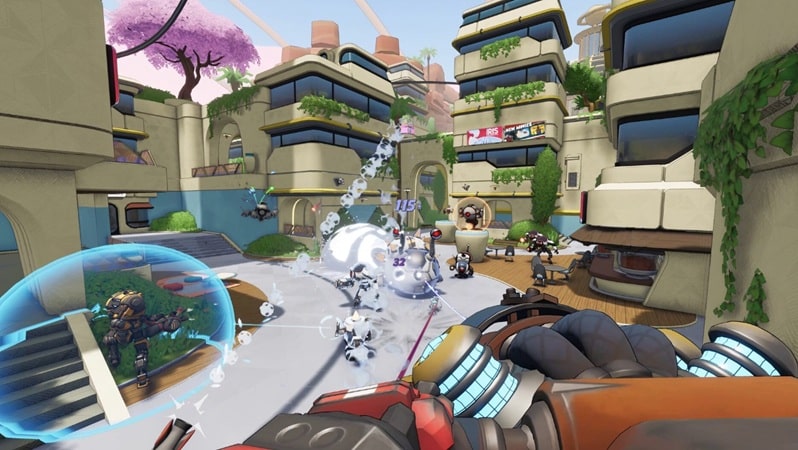
In regard to the maps themselves, these aren’t just a bunch of connected areas with enemies to kill, but are rather spaces that are riddled with secrets, puzzles and a surprising amount of verticality too. Indeed, Roboquest actively encourages the player to leap high and indulge in a bit of vertical 3D platforming, not least because at these higher removes precious Wrenches can be found and a range of other secrets too, such as some NPC bots that can be hugged and allow you to make friends with them, sometimes resulting in either a summonable bot to help you in combat or gaining a special ability. Again, this is all just another reason to explore every nook and cranny of Roboquest‘s many different maps and squeeze the most out of them from an exploration perspective.
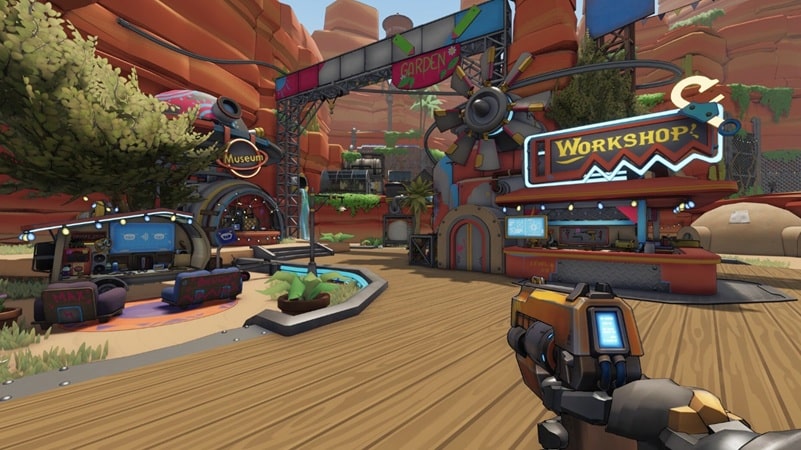
Speaking of Wrenches, when collected these handy tools aren’t just used for permanent perk upgrades outside of your run, but can also be used to expand your basecamp hub area as well, permitting access to a range of other upgrade areas and customisation options. And then on top of what is already a richly layered progression system, there are the various classes that you can unlock too. Essentially ‘experience-walled’ behind a number of kills and other objectives that are persistently tracked across all of your runs, you’ll unlock new classes that each have their own unique special abilities and perks to boot, too.
Finally, Gadgets provide yet another level of enduring progression that can translate from one run to the next. Essentially special permanent collectibles, these trinkets provide enduring abilities that can be toggled on and off in tandem with one another, such as a powerful jump that activates when you crouch, faster rail grinding speeds and so much more besides.
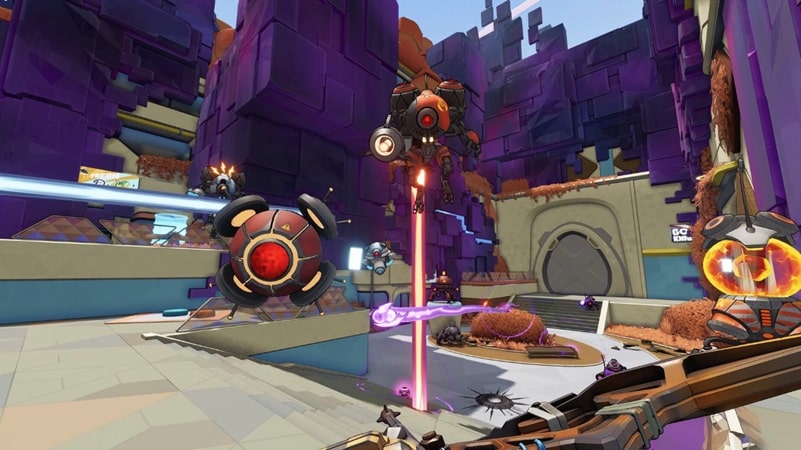
These aren’t just progression systems and mechanics that have been layered atop one another for the sake of artificially padding out the game, all of them work together in thoughtful and deftly designed ways to make every death feel not like a failure event, but rather a tantalising opportunity to push the envelope a little bit further on your next run on account of both your improved bot and your own gradually refined skills as a player. Honestly, it’s both dizzying and somewhat startling just how much Roguelite design RyseUp Studios has crammed into Roboquest and yet it executes all of it peerlessly without creaking under the weight of it all.
If there’s one (albeit small) nitpick that I’d have with Roboquest, it would be that there is a level of repetition in the map layouts that aren’t quite as varied or as random as I thought they would be. Though to be clear, this feels almost like a churlish nit-pick out of necessity to find something not-so-great with Roboquest rather than any real major or even minor fault with its design that would aggravate you over a period of time.
Wrapped around Roboquest‘s heady hybrid of FPS and Roguelite design elements is its remarkable audiovisual presentation. Though not really employing any really cutting edge visual technologies, Roboquest nonetheless remains a treat for the ol’ peepers thanks to a beguiling combination of pin-sharp 4K resolution and butter smooth 60 frames per second action wrapped around a colourful and vibrant art style, that if anything, echoes Activision-Blizzard’s original Overwatch in its formative years.
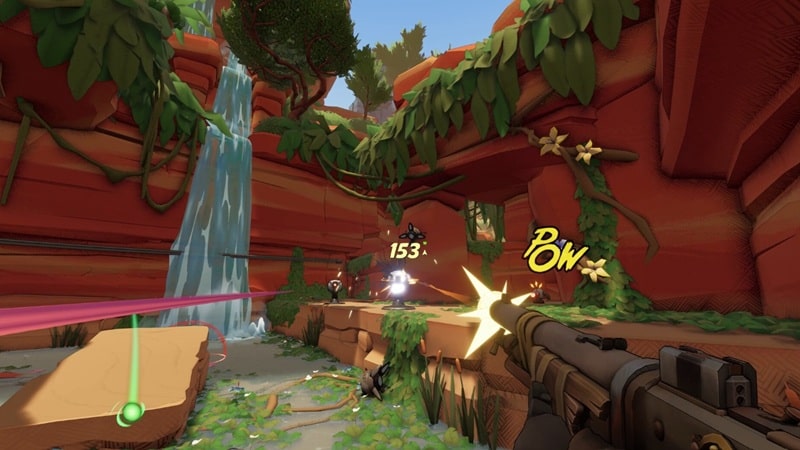
In the audio side of things, Roboquest absolutely shines here too, with a lively soundtrack supplied by Russian Federation artist Noisecream that provides a ear-busting synergy of heavy electronica, drum and bass, metal and dubstep which in turn provides the perfect accompaniment for the furiously manic on-screen action. In any fast-paced FPS a great soundtrack is as useful to players as an especially powerful in-game weapon or item, not least because it helps the player to get into the zone and tune their movements much more effectively and that’s very much the case with Roboquest as you’ll be gently (or harshly) head-banging your way through every frenetic enemy encounter.
From blisteringly fast and satisfying FPS action through to a thoughtfully layered series Roguelite mechanics that always manage to entice you to have another go, everything works in harmony to create one of the best FPS Roguelites money can buy. Roboquest gets so much absolutely right that this is really just about everything you could want from a Roguelite FPS and one of the easiest recommendations of the year.
Roboquest is out now on PS4 and PS5.
Review code kindly provided by PR.