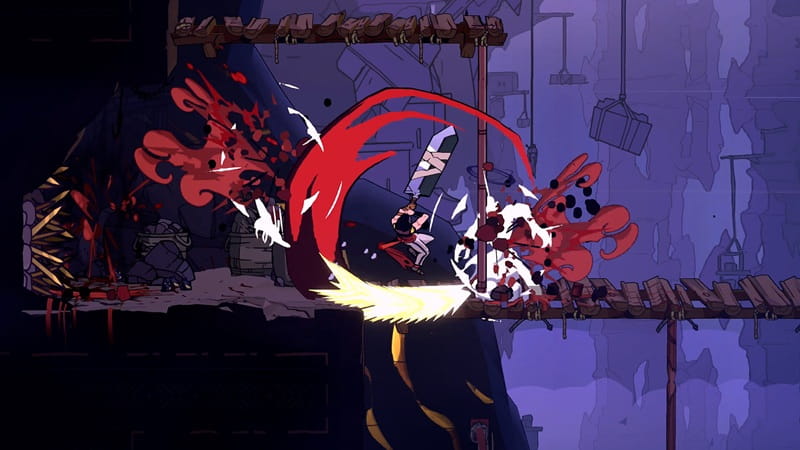
With all the praise that the Prince of Persia: The Lost Crown has had (and it is deserved, let’s be clear about that) it can be perhaps a little easy to forget that it isn’t actually the most recent entry in the Prince of Persia franchise. Instead that honour belongs to The Rogue Prince of Persia from Dead Cells developer Evil Empire. With the immediately compelling elevator pitch of ‘Prince of Persia, but make it Dead Cells’ at its core, The Rogue Prince of Persia is also much more than just some cynical reskin of Evil Empire’s finest hour, it’s a tremendous roguelite platforming yarn that stands on its own two feet, not only giving players a sublime genre offering but one of the best Prince of Persia games in years to boot.
The Rogue Prince Of Persia PS5 Review
In terms of narrative setup, The Rogue Prince of Persia is pleasantly straightforward in a way that doesn’t overstay its welcome. After an invading Hun horde, backed by mysterious black magic, lays waste to the townships and cities of our prince, he is pressed into action in order to kill the leader of the Hun forces and reclaim his homeland. The kicker? Well, every time the prince falls he awakens in the Oasis, a magical space that exists outside of the boundaries of the Hun’s black magic, allowing him to pursue his vengeful mandate indefinitely.
Right away anyone who has had experience with Dead Cells (and shame on you if you haven’t, as it’s been *right there* for years), will be able to get straight into action here as The Rogue Prince of Persia boasts enough of Dead Cells foundational design DNA in terms of platforming and combat, that it feels pleasantly familiar, like slowly slipping into a warm bath.
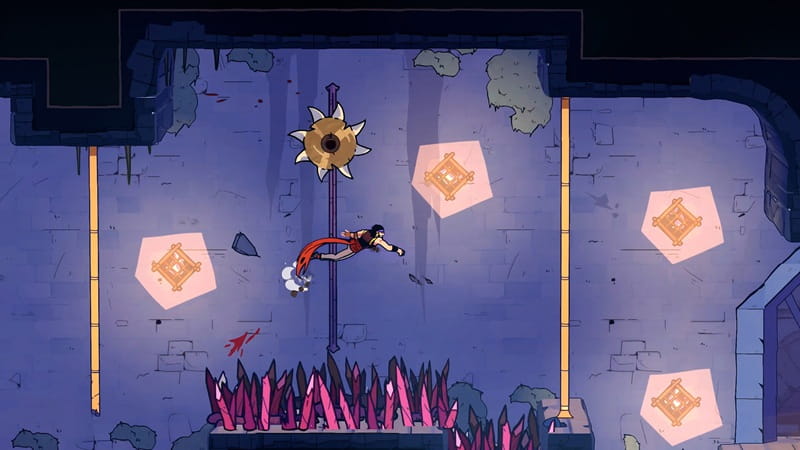
Certainly too, in keeping with Prince of Persia’s acrobatic and kinetic lineage, The Rogue Prince of Persia rewards players who perform a string of ‘perfect’ leaps, grabs and dashes (achieved by hitting the jump button at just the right time), by filling up something called Vayu’s breath which in turn results in faster and more effortless traversal at speed for as long as you maintain this perfect flow state. Put simply, moving around and traversing about the various beautifully drawn locales is a pleasure here, with the titular Persian royal proving to be hugely satisfying to control and ultra-responsive to any command you issue to him via the DualSense controller.
As a direct result then, I feel confident in saying that The Rogue Prince of Persia arguably feels even better than Dead Cells from a pure platforming perspective, as the chaining together the various wall runs, mid-air dashes, ledge swings and more is an evergreen satisfaction that Dead Cells cannot quite match. On that note, it’s certainly worth noting that if we’re comparing Evil Empire’s latest to Dead Cells, that The Rogue Prince of Persia conversely doesn’t compare favourably from a sheer content perspective (Dead Cells has been out and about for *far* longer in comparison, so it’s hardly a fair analogue despite the similar design heritage). That said, The Rogue Prince of Persia has a shedload of things to do that we keep even the most avowed Persia-fan locked in for a good while.
Away from the platforming side of things, The Rogue Prince of Persia does also indeed echo Dead Cells somewhat in the combat side of the equation. In addition to a main weapon which can be switched out, our plucky Prince can also use a ranged tool to hurt his enemies at a distance, while a range of medallions and artefacts serve to buff his martial abilities yet further still, providing neat effects like allowing the Prince to trail sticky resin after a dash, or immolate his foes with a special attack at the end of a combo.
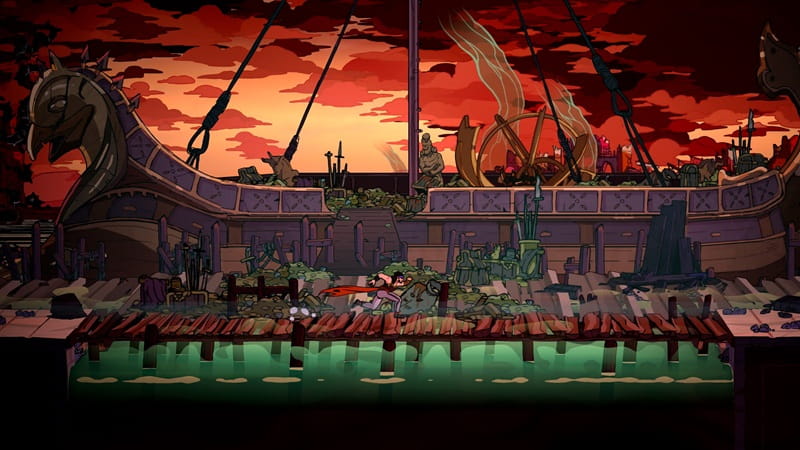
There’s also a great and pleasing degree of physicality to the combat in The Rogue Prince of Persia which makes every one of its scraps feel appropriately enjoyable and fulfilling. In Dead Cells, a quick tap of the evade button allows you to roll through and past your enemies to attack them from behind, here the Prince can essentially do a rolling leapfrog over his enemies (further bolstering his momentum) and can enjoy special damage bonuses from selected weapons for doing so. Another nice addition that The Rogue Prince of Persia brings to combat is the ability to kick, which not only allows our hero to wallop his foes into the many, many traps dotted around the joint, but also kick heaving great boulders into enemies to stun them for a volley of follow up strikes.
There’s a real sense of discovery in The Rogue Prince of Persia that keeps it so compelling. As you progress from the starting hub area of the Oasis, through the sun-drenched village of Zagros Village and on to such places as the Ruined Aqueduct, impressively architected Grand Academy and more, there’s always a veritable treasure trove of secrets to find, loot to collect and of course, precious gold and Soul Cinders to be scooped up.
In terms of progression, The Rogue Prince of Persia is impressively multi-layered and that aforementioned sense of discovery absolutely dovetails into it. At a basic level not counting the endgame, there are two main currencies that the player need to concern themselves with – gold and Soul Cinders. The former allows our hero to purchase wares and items from vendors in any given biome and are unique to that run, while Soul Cinders meanwhile can be used to purchase permanent upgrades at the Oasis hub, which is where the macro progression aspects of The Rogue Prince of Persia come into play.
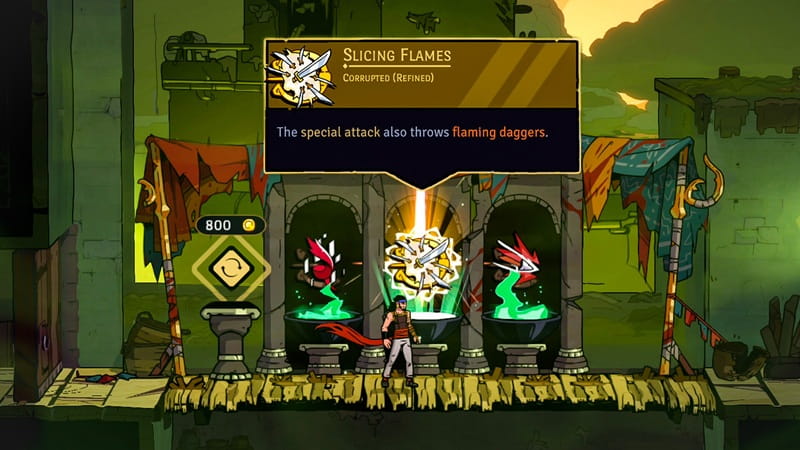
As you progress through the various biomes and areas, you’ll come across a range of NPCs that when rescued, often after completing a task for them, they will join the Oasis and permanently offer you their services. Whether it’s the forging of unique weapons by Sukhra the blacksmith, or the Nyamtur the chronicler, who essentially manages the achievement and rewards system within the game, you not only start each new run more capable than before, but so too do you also have some progression-aligned goal to work towards. It’s just fantastic stuff that absolutely turbocharges that ‘one more go’ mentality in ways that will assuredly wreck your social calendar as it did mine.
Finally, a word about the audiovisual presentation. In regards to its aesthetic, developer Evil Empire leverages a ‘line Claire’ or ‘clear line’ art style which draws liberally from Franco-Belgian comic books penned by the likes of Moebius. Synonymous with an eye-searing vibrant palette of colour and clear outlines, the striking art of The Rogue Prince of Persia looks even better in motion, often conjuring a kaleidoscopic spectacle of gorgeous, liquid smooth movement that all adds up to make The Rogue Prince of Persia one of the most attractive 2D efforts out there.
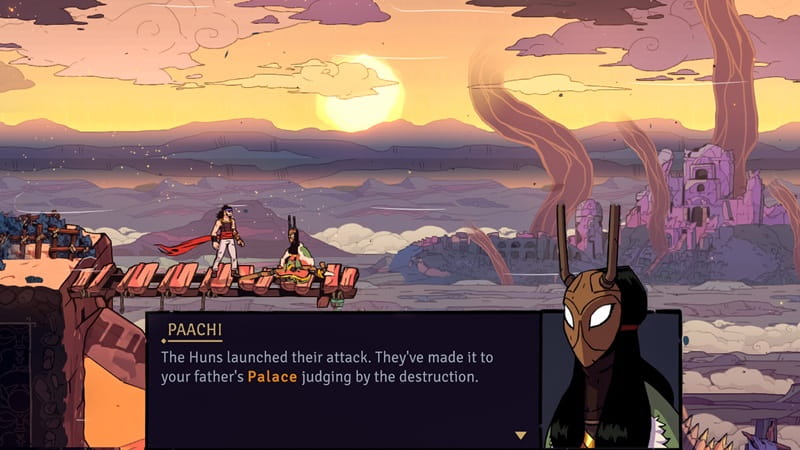
On the audio front, The Rogue Prince of Persia definitely doesn’t disappoint either. With a broadly styled soundtrack by ASADI, a Persian-American producer that blends traditional Persian instruments with modern electronic trap beats, the result is an ear-searing, relentlessly energetic score that simultaneously honours his heritage while also providing Evil Empire’s latest effort with the sort of pulse-pounding rhythms that are formidable enough to complement the frenetic on-screen action.
There is a timeline where the developers behind Dead Cells didn’t have the opportunity to use their ample talents to create a thoroughly excellent Prince of Persia. Thankfully, this is not that timeline, because in this timeline The Rogue Prince of Persia exists and isn’t just a great spiritual follow-up to Dead Cells, but also one of the best Prince of Persia games to ever be released. Period.
The Rogue Prince of Persia is out now on PS5.
Review code kindly provided by PR.