
Note: This content about casino VIP programs is strictly intended for mature audiences in the Rest of Canada (18+ in MB/QC; 19+ elsewhere). It is not directed at residents of Ontario, Alberta, or the US.
For Canadian players, casino VIP programs are often presented using marketing language that feels detached from how digital reward systems operate today. Loyalty points, tier thresholds, and casino rewards are familiar concepts, but the underlying mechanics are rarely explained clearly.
Look a little closer, and the structure underneath becomes immediately recognizable to anyone who uses modern loyalty systems — frequent flyer miles, premium credit card tiers, and the like. The premise of this article is that Casino VIP programs are not mysterious reward schemes; they are structured retention frameworks. When you know how it works, the mechanics are actually quite boring and predictable, mostly using player data tracking and long-term account progression.
If you have ever accumulated status credits to reach a higher account tier, you already understand how casino loyalty programs work. This article removes all the hype and breaks down how the VIP systems at Jackpot City, Spin Casino, and Ruby Fortune actually operate. The structure is explained clearly and realistically, with an emphasis on transparency and perspective.
Disclaimer: This content is strictly intended for players in the Rest of Canada and is not directed at residents of Ontario, Alberta, or the United States. Players must be at least 19 years old in most provinces (18+ in MB/QC). Casino games are not glamorous and are games of chance (not skill). Expect losses and always play responsibly. For support, visit ResponsibleGambling.org or find more local resources in the footer. This article is reader supported (details in footer).
Overview of Canadian Loyalty Programs
| # | Brand Name | Key Detail |
| 1 | Jackpot City | Personal account manager from Platinum tier upward |
| 2 | Spin Casino | Loyalty structure built around a strong live dealer catalog |
| 3 | Ruby Fortune | Dashboard UX is quite good with view of all five tier thresholds |
| 4 | Gaming Club | Longest-running Baytree brand; loyalty program predates most competitors |
| 5 | Royal Vegas | Full loyalty dashboard accessible directly from the mobile cashier |
| 6 | Lucky Nugget | Entry level brand with a very accessible loyalty program |
| 7 | Mummys Gold | Egyptian-themed interface running on the standard Baytree loyalty engine |
A Common Misconception About Casino VIP Programs
A lot of people mistakenly think that VIP programs somehow boost a player’s odds of winning, but they simply don’t. Whether you’re playing slot machines, table games, or live dealer titles, the rules remain the same: mathematical randomness governs everything. That said, the games still do have to offer “fair” odds, which are built into the software as RTP (Return to Player) percentages.
Did you know? RTP (Return to Player) is the theoretical percentage of all wagered money a game will pay back to players over the long run. For example, a 96% RTP slot means that over millions of spins, the game is programmed to return 96% of the total money wagered. The remaining 4% is the built-in mathematical advantage for the casino (the house edge).
And here is the crucial point: VIP tiers do not alter or improve that RTP. The payout percentage is baked into the game’s code by the software developer from the start, and it is independently tested and certified by third-party auditors like eCOGRA.
What VIP programs actually influence is everything around the game. It’s basically meta-data that operates as a tracking layer for the casino to monitor your account activity over time. The casino then uses that data to offer secondary benefits, like more account features. These vary by brand and we can’t possibly cover all features, but some examples might be loyalty multipliers or access to seasonal promotions.
You may think of it like an airline rewards program: it is the journey you go on that exists outside of the actual flight. It is not about changing how the plane operates or how fast you get there; it is simply a system designed to recognize and reward people who keep coming back.
It’s an important distinction to make. Once you understand what VIP programs are really about (ie not about helping you win more) you can start evaluating them for what they truly are.
At their core, online casino loyalty programs simply allow VIP players to accumulate loyalty points. Canadian players can later redeem points for in-game site credits. Points are awarded in proportion to their VIP status level.
VIP Points Function as Account Activity Trackers
At the center of every casino VIP program is loyalty point accumulation. Each time a player wagers real money, they earn a fixed number of loyalty points tied to that wager. Over time, those points add up and determine progression through the casino’s tier structure.
Functionally, these operate as status credits.
While the exact earning rate can vary by game type, the principle remains consistent: wagering activity results in loyalty points. The allocation of points is at the operator’s discretion and terms and conditions but we can make a few observations. Early tiers require relatively few points, allowing players to move through the initial levels fairly quickly. Higher tiers demand significantly higher thresholds, following a steepening progression curve designed for high-volume, long-term participants.
Importantly, this accumulation is predictable in structure, as you may see your status in the dashboard, even if outcomes in individual games are not. Loyalty progression does not value results (if you win or lose). This is a very different model than rakeback (used by poker players to earn a percentage back of the rake) or of “loss-back” which some iGaming brands offer to losing players. The latter is more common in the crypto space, but loyalty programs in the fiat space operate more predictably and independently of wins or losses.
Loyalty Point Mechanics: Baytree By the Numbers
From their T&Cs, the Baytree loyalty system ties point accumulation directly to wager volume and game type, factoring in the house edge of each category.
VIP Point Accumulation Rates – The Basics
At these casinos, accumulated points follow this simple conversion rule:
- All Slots (except Re-spin Featured Games): 1 point per $1 wagered
- Table Games (not mentioned below): 1 point per $5 wagered
- Sic Bo, Roulette & Re-spin Featured Games: 1 point per $10 wagered
- Video Pokers & Baccarat (not mentioned below): 1 point per $20 wagered
- Blackjack, Craps, Jacks or Better, All Aces, Aces and Faces Video Poker: 1 point per $100 wagered
From a mathematical standpoint, slots reward points up to 100 times faster than blackjack. This is standard industry practice: blackjack earns points more slowly because, when played with basic strategy, its odds are much closer to even, reducing the casino’s theoretical margin.
How Do Points Convert?
Loyalty points exchange for site credits at a fixed rate, always in set increments rather than freely. The rate itself stays the same regardless of tier, but what does change is how quickly you accumulate points in the first place (which is an internal metric).
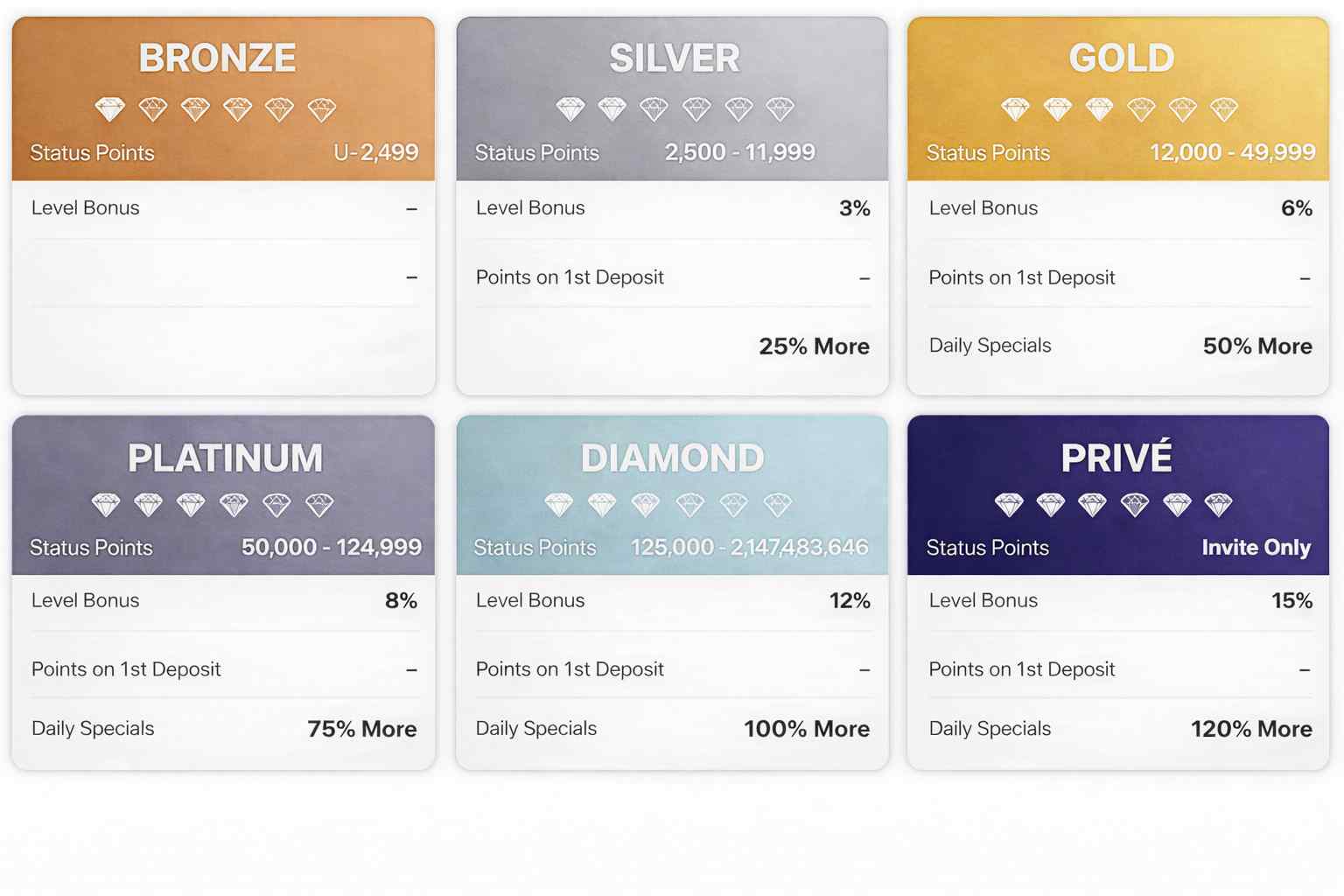
Each tier applies a percentage boost to point earning on every wager. Silver sits at 3%, Gold moves to 6%, Platinum reaches 8%, Diamond hits 12%, and Privé accounts earn at a 15% adjusted rate on top of the baseline. According to the operator’s published loyalty rules, here are the point accumulation structure and tier thresholds:
How the VIP Program Actually Works in Practice
There is more going on behind the scenes than just point tracking. Here is what we found as your account progresses through the tiers:
Your account does not start from zero: New real-money accounts at Baytree casinos are set up at the Silver tier from day one, with an initial point balance already applied to the ledger. The Bronze tier effectively does not exist for new players — the system simply skips it.
Account activity tracking: The platform’s software logs general account access and session frequency. This data is tracked in the background to calculate overall account status, independent of individual game outcomes.
At the higher tiers, a real person gets involved: Once an account crosses into Platinum, Diamond, or Privé territory, it gets flagged for hands-on attention. From that point on, a dedicated account manager handles withdrawal prioritization and reviews the account directly.
The higher your tier, the less generic your account treatment: Standard accounts run on default settings. Higher-volume accounts are managed differently — the platform looks at your actual history and current tier to determine how your account is handled day to day, rather than applying a one-size-fits-all approach.
Progression Through the Tiers
The tier structure is the same across all three Baytree brands:
- Bronze: 0 – 2,499 points (entry level)
- Silver: 2,500 – 11,999 points
- Gold: 12,000 – 49,999 points
- Platinum: 50,000 – 124,999 points (High-volume threshold)
- Diamond: 125,000+ points
- Privé: Not for everyone – by invite only
Baytree Interactive and the Shared Backend Model
Jackpot City, Spin Casino, and Ruby Fortune all operate under the same parent company, Baytree Interactive. From a systems perspective, that means they share a common backend, including a nearly identical loyalty framework.
We found the way loyalty points are earned, how tiers are structured, and how rewards are managed follow the exact same underlying logic across all three platforms. What differs is the presentation. Jackpot City emphasizes a classic casino atmosphere; Spin Casino adopts a more contemporary design; and Ruby Fortune positions itself as a luxury-focused experience.
Loyalty Point Mechanics and Utilization
Accumulating points is only part of a retention system; the cycle is completed when those points can be exchanged for something tangible. In Baytree casinos, loyalty points can typically be redeemed for site credits. These credits act as a secondary in-game balance that can be used for wagers without directly drawing from a player’s cash balance.
Points accumulate in the background and are exchanged in set increments rather than spent freely at any amount. This structure encourages players to treat loyalty points as an asset that builds gradually over time.
Siloed Account Structures and Brand-Specific Progression
One of the most important things to understand about Baytree’s loyalty structure is that progression is strictly brand-specific. Loyalty points and tier status earned at one casino do not carry over to the others. Although all three platforms share the same backend, each one tracks progression independently. Moving from Jackpot City to Spin Casino effectively resets your loyalty status back to the entry level. This differs from corporate casino networks that use unified loyalty programs across multiple properties.
Final Analysis: Understanding the System
Strip away the marketing language and casino VIP programs are really just structured loyalty schemes — the same principle behind airline miles or a hotel rewards card. You accumulate points by playing, those points determine your tier, and your tier determines what account-level features you have access to. That includes things like site credits and, at the higher tiers, a dedicated account manager.
None of that changes how the games work. The RTP of a slot machine or table game is fixed in the code before you ever log in, and no tier status touches it. The games remain games of chance.
One structural reality worth noting: because Jackpot City, Spin Casino, and Ruby Fortune each run siloed loyalty systems, points accumulated on one platform stay on that platform. There is no cross-brand carry-over, even though all three share the same underlying system.
For Canadian players, that is really the whole picture. These programs track how much you play and return a portion of that activity in account benefits.
Disclaimer:
This article is intended for Canadian audiences in the Rest of Canada (ROC), excluding Ontario, and Alberta. This technical overview is supported by referral partnerships; if you decide to use one of the iGaming brands listed, compensation may be received at no extra cost to you.
USA players are not accepted at these sites. Gamble responsibly and only with funds you can afford to lose.
Players must be at least 19 years old to gamble in most parts of Canada (18+ in Manitoba, and Quebec).If you or someone you know is concerned about gambling, free and confidential help is available 24/7.
Canada-Wide Support: Visit ResponsibleGambling.org for tools and resources available in all provinces.
Western Canada: (BC, AB, SK, MB): Call 1-888-795-6111 (BC) or 1-866-461-1259 (Alberta), 1-800-306-6789 (Saskatchewan), or 1-800-463-1554 (Manitoba).
Ontario: Call 1-866-531-2600 (ConnexOntario).
Quebec: Call 1-800-461-0140 (Gambling: Help and Referral)
Atlantic Canada:
Nova Scotia: 1-888-429-8167 (Mental Health and Addictions Crisis Line)
New Brunswick: 1-800-461-1234 (Gambling Information Line)
Newfoundland & Labrador: 1-888-899-4357 (Problem Gambling Help Line)
Prince Edward Island: 1-855-255-4255 (PEI Gambling Support)