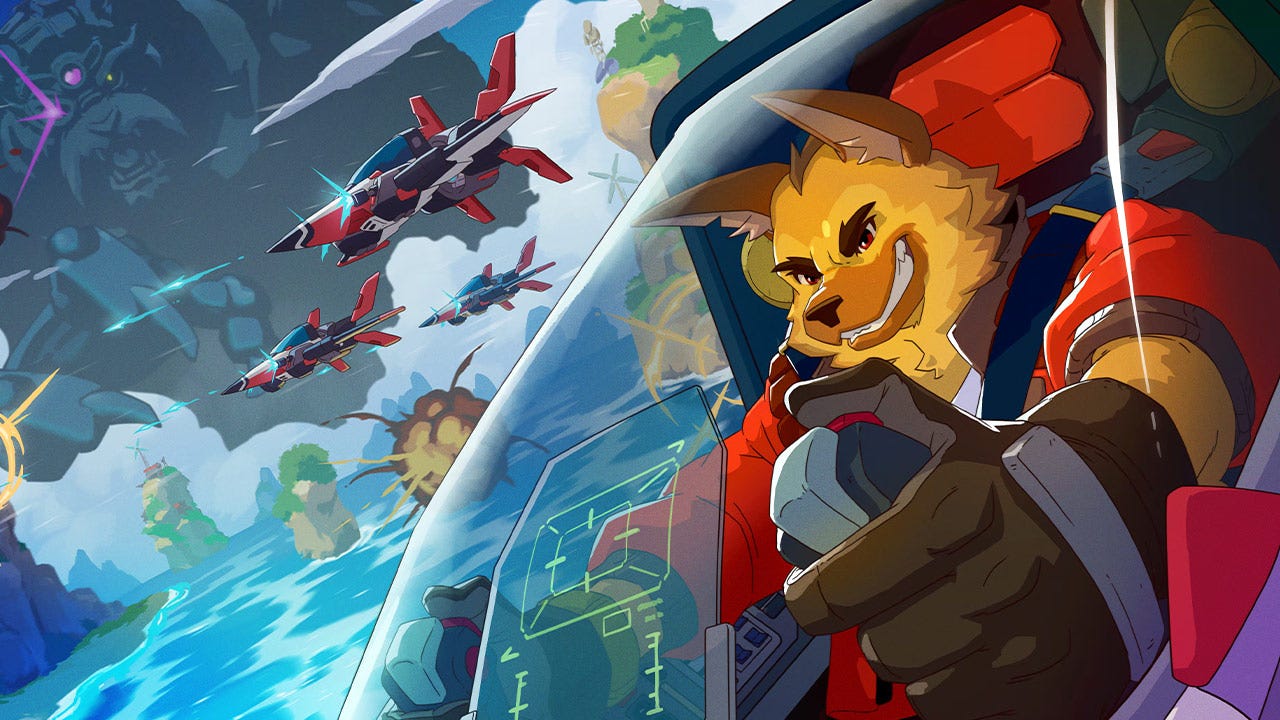
Wild Blue Skies PS5 Review. In some ways, Wild Blue Skies is the poster child of being caught between a rock and a hard place; this game was revealed during a period where it looked like the franchise it was paying homage to was unlikely to make a resurgence, and there was a feverish appetite that wasn’t being exactly catered to.
This unfortunate timing aside, Wild Blue Skies does precious little to distinguish itself from the homage that it pays. It plays the same cards, flies through the same rings, and ends up feeling like a retread despite ostensibly being ‘new’. Paying homage doesn’t mean having to play it this close to the source, and Wild Blue Skies unfortunately doesn’t go far enough.
Wild Blue Skies Review (PS5) – The Imitation Game
A Game With Merit
The on-rails shooter is a genre that’s been in desperate need of some TLC in recent years; it’s been a good while since a major studio has had a crack at one, and it seems that even independent studios have tended to veer towards other genres of choice. So then, Wild Blue Skies is an enticing prospect on that merit alone.
It seeks to fill in a gap and cater to an audience that is hungry for this type of direct level structure. The core loop of Wild Blue Skies very much adheres to that foundation, featuring a mostly linear structure with the potential to veer off into alternate paths, depending on the missions that you complete. Each ‘run’ of the game begins in the same place, and offers you a variety of missions to do next, keeping things relatively simple.
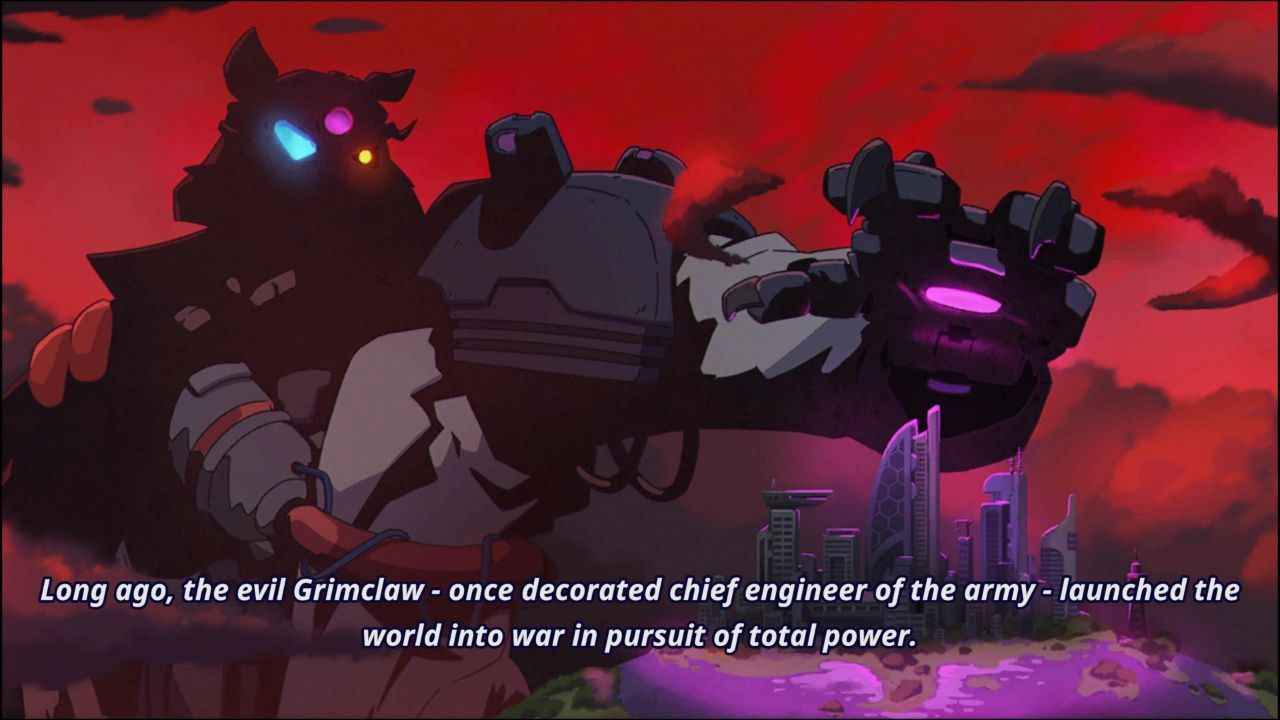
You take control of squad leader Bowie, and travel across the planet in order to stop the nefarious plans of designated villain Grimclaw. Despite having a fairly impressive cast to its name, Wild Blue Skies does precious little with the characters that it introduces, making me question the point of going so far to acquire such legacy talent. There’s the barest bones of a story here, in a way that also reflects a particular inspiration point.
If I was feeling generous, I could say that Wild Blue Skies is more focused on putting gameplay first, and that it simply harkens to a ‘simpler time’ for narrative design. I would happily give it those flowers, if this game wasn’t so patently retreading the exact same ground that a certain Nintendo 64 game did.
From Beat To Beat, Stage to Stage
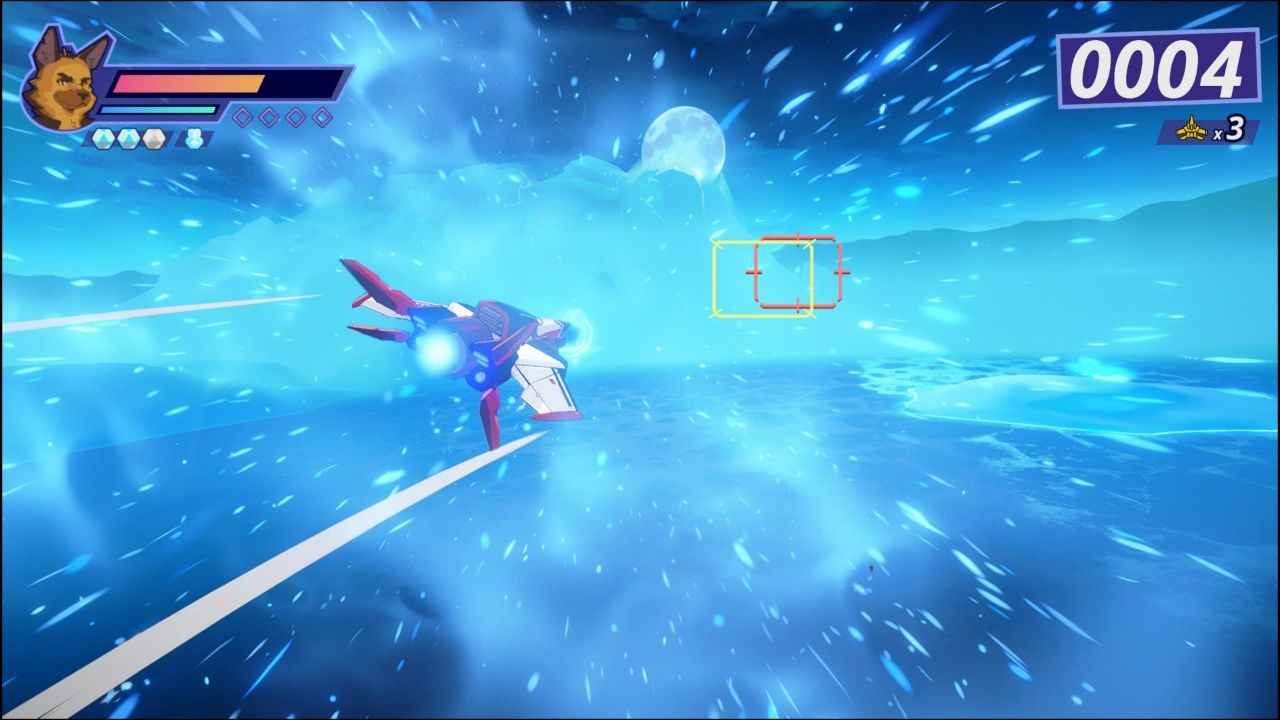
Wild Blue Skies prides itself on sticking close to tradition, and that is at its most apparent during gameplay. You control Bowie and the Blue Bombers travelling through a linear range of levels, starting off each run in the same place, before going on divergent paths, with six levels in total per run. It’s a certified classic formula and makes repeat playthroughs a borderline must with how trite a single run can be.
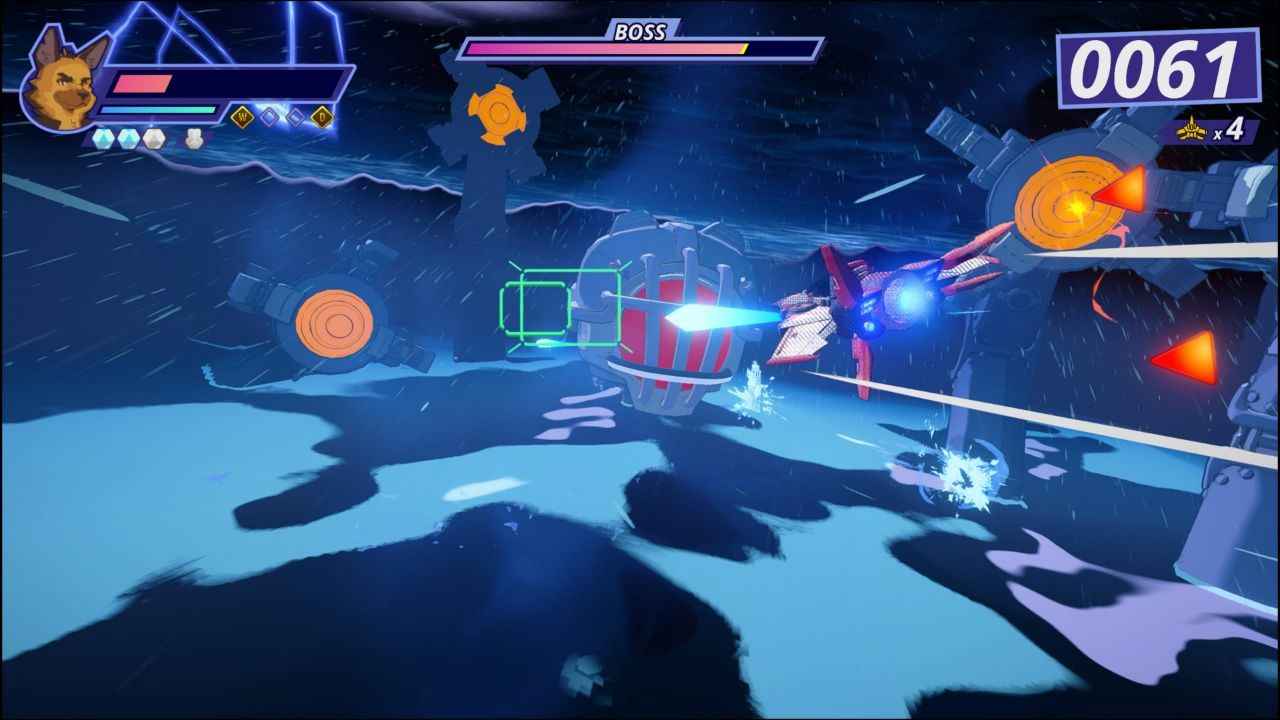
Each level will run you only a few minutes, with a run taking me close to an hour, usually. Most missions are straight shots to the end, with a big boss at the end to cap off the stage. These bosses tend to be fairly straight forward, with pretty blatant weak points to aim for. Flight controls are responsive, and emulate a scheme that was practically mastered before, without much in ways of additions.
Occasionally you might have to save a teammate from a sticky situation, or risk losing them in the next level.
I find myself uniquely struggling here, because despite having played what I assume to be the entire game through at least four times for this review, every positive aspect of Wild Blue Skies can be put down to a far too doting tribute, that is stuck, more than any other example I can think of, in the shadow of other titans.
It’s impossible to ignore, as hard as I tried to.
A Tribute Act, To A Fault
Without beating around the bush, it’s incredibly clear that Star Fox was the primary point of call for designing this game in terms of both its characters, gameplay, and level design. From the core flying gameplay, to the fact that your main crew of characters is four anthropomorphic animal pilots, to the fact that there’s a rival crew of anthropomorphic pilots who appear depending on the mission.
Nothing about these foundations are particularly faulty, but viewed in the light of how far it echoes that inspiration, it feels almost pointless. Each run begins with the Blue Bombers flying their way through a besieged city under the threat of destruction, before defeating a boss at the end in a large arena. From there, almost every level theme is rote. You’ll fly through a storm, a desert, a lava based factory, a cliffside.
I’m not opposed to games using these standard themes, but there’s a time and a place to be transformative, and Wild Blue Skies needed to be inventive in order to set itself apart, rather than just being a replacement. I needed something new to chew while going through the same rings again.
Even down to the personalities of the main crew, I find myself staring into a bizarre mirror of Star Fox. There’s the confident young leader, the slightly brash overconfident one, the ace pilot, and the older one who ambiguously has a larger history, and there’s the general that briefs you between missions. I really hate to write a review that is so steeped in comparisons, but Wild Blue Skies does absolutely nothing to prevent me from doing that.
Imitation Imperfections
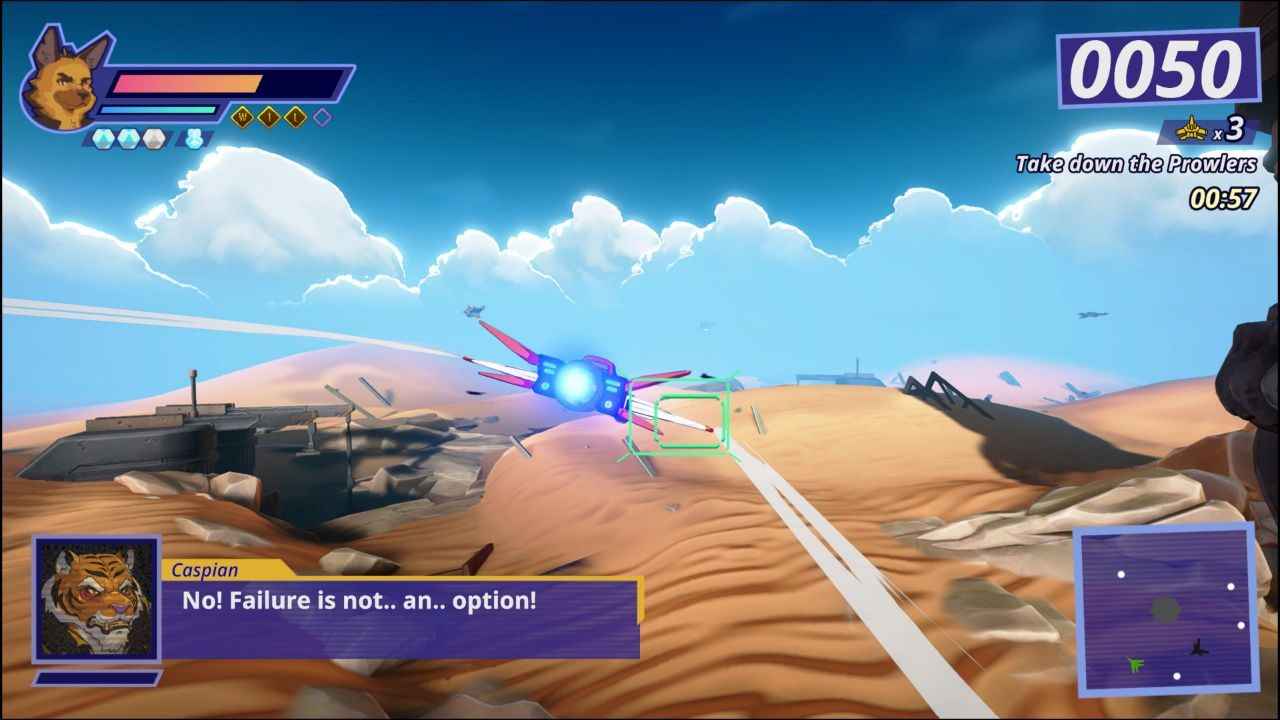
Another unfortunate rub of being this close to the source material is the stuff that it misses. The somersault being the most prominent omission that stuck with me. In levels that forgo the straightforward progression, you fly around open areas in order to attack various targets. In Star Fox, this movement is facilitated by the somersault, an ability to go back on yourself without doing a full 360.
Despite having levels of this exact structure, this is where Wild Blue Skies decides to stray from the norm and totally ignores the move existing. It simply isn’t fun to play, and made me want to play something else a whole lot more.
A true shame, because this game does have moments where the artstyle really shines. I love the cel-shaded look of the environments, and think that the colours of the world are brilliant. Unfortunately, this art direction was wasted on chasing after a spaceship that had already taken off. That, and some incredibly bumpy performances in particular situations.
I make a point of these small details because, again, this is all I have to go off. These are what makes Wild Blue Skies stand out, and barely any of it is for a positive reason. I didn’t want to come into this review with a laundry list of issues, but I find myself forced to share them. Inspiration is something that literally everyone has had, and does. My style of writing has been actively inspired by people, but that lets me grow my own something from it.
Wild Blue Skies definition of inspiration feels more like a shorthand to getting a game out there that forgoes creating something for itself. I don’t care about Bowie, or the Blue Bombers. I don’t care about the obligatory rival team, and I especially don’t care about Grimclaw. I’ve played this story before, and unfortunately, it’s already a well-worn story in its own right.
Wild Blue Skies is available on PlayStation 5, Nintendo Switch 2, Xbox Series S/X, and PC.
Review code kindly provided by publisher.